I’ve written articles about handling fish we intend to release before. It’s a good idea to refresh and remind ourselves of the known best practices for maximizing their chances for survival.
Catch-and-release is often treated as a free pass. It isn’t. Even a fish that swims away strong can die hours or days later from stress, exhaustion, or injury. For California’s native trout, steelhead, and salmon, many of which live in small or declining populations, every fish matters. The good news is that a handful of habits dramatically improves survival, and they’re easy to adopt.
Start with the Right Gear
Crush your barbs, or buy barbless hooks. They come out faster, cause less tissue damage, and are required in many California waters anyway. Match your tippet to the fish and the water. Light tippet feels sporting, but it prolongs the fight, and a fish played to exhaustion builds up lactic acid that can kill it after release. Use a rubber or knotless net, since traditional mesh strips protective slime and tangles fins.
Win the Fight Quickly
Land fish decisively. Keep steady pressure, turn the fish’s head, and bring it to the net without letting it thrash for minutes. If you’re fishing a heavy run of steelhead, go up a tippet size. The fish you release in five minutes has a much better chance than the one you played for fifteen.
Keep Them Wet
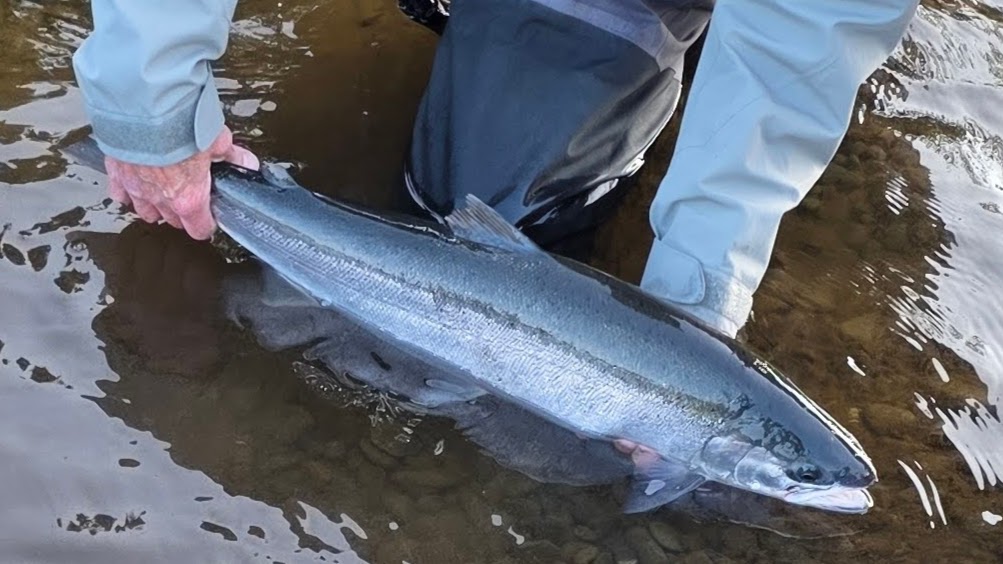
This is the single most important rule at the moment of release. Leave the fish in the water whenever possible. If you must lift it, wet your hands first, avoid the gills, and never squeeze. A good benchmark is to keep a fish out of the water no longer than you can comfortably hold your own breath. Photos are part of the sport, but a great photo can be taken with the fish resting in your net in the current, or with a quick lift and immediate return.
If a fish is hooked deep, don’t dig for the hook. Clip the line as close to the fish as you can. Fish often shed or dissolve the hook with better odds than they’d survive the surgery.
Respect the Thermometer
Warm water holds less oxygen, and a stressed fish in warm water may not recover. Carry a thermometer and check it. Once the water climbs into the mid-60s °F, cold-water species are already under strain, and by the high 60s, releases become risky. On hot days, fish early in the morning or move to higher elevations. Never target fish crowded into cold-water refuges, such as creek mouths and deep pools, where they gather to survive summer heat.
Stay Off the Redds
Spawning gravel is the nursery of every future fish. Redds look like patches of clean, disturbed gravel, often with a tail-shaped depression. Don’t wade through them, and don’t target fish actively spawning. Trampling redds can crush eggs, and harassing spawners wastes energy they need to reproduce.
Know What You’re Catching
Native species, including coastal rainbow trout, steelhead, coho salmon, Lahontan and Paiute cutthroat, and golden trout, often carry special regulations, seasonal closures, or protected status. In many waters, wild steelhead must be released, and listed fish may not be removed from the water at all. Check the current CDFW regulations for every stream you fish, since rules change and vary by watershed.
Don’t Move Trouble Between Streams
Clean, drain, and dry your waders, boots, and gear between waters. Invasive organisms like New Zealand mudsnails and didymo, along with fish diseases like whirling disease, spread easily on felt and damp equipment and can devastate native fish habitat.
Be the Example
None of this requires giving up the joy of fishing. It requires a little forethought and a willingness to slow down. If you see another angler holding a fish out of the water for a long photo, a friendly word or a good example goes a long way. Our sport’s future depends on healthy wild fish, and a lot of that health is in our hands, wet ones, ideally. There’s something extremely satisfying to see a beautiful fish swim away, hopefully to see many more days. Although this article emphasizes our California waters, these same guidelines apply to salmonids we fish for outside the state.
Posted on September 29th, 2026