Aug 21 : Yuba River – 21 Aug 26
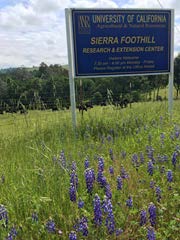 University of California Sierra Foothill Research and Extension Center
 (Click for address and map)
Fishmaster:
Santa Cruz Fly Fishing Club (SCFFC)Lower Yuba Private Water Camp & Fishout
August 21st – 23rd 2026
(Date subject to change due to weather and flows)
The information provided below has been modified from the Grizzly Peak Fly Fishing Club and Tri-Valley Fly Fishing Club (2022-23)
Special Notes
The outing is limited to 20 people. With a $50.00 buy in payable to the club. Jump to reservation form
Due to the limited capacity, reserving your spot is first come first serve starting July 1st at 9am thru the club website. Payment due at time of reservation. No refunds.
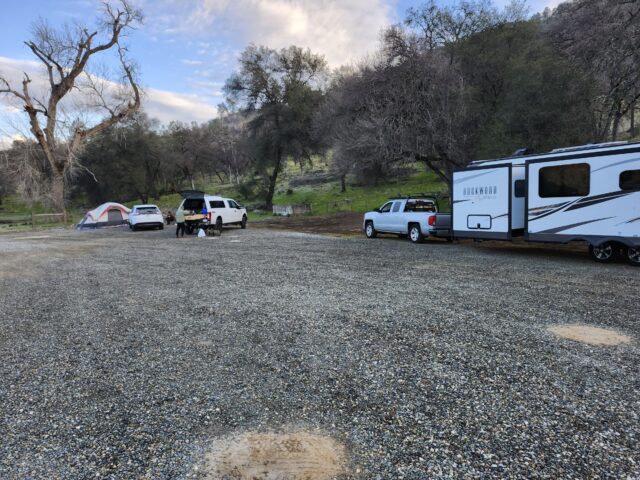
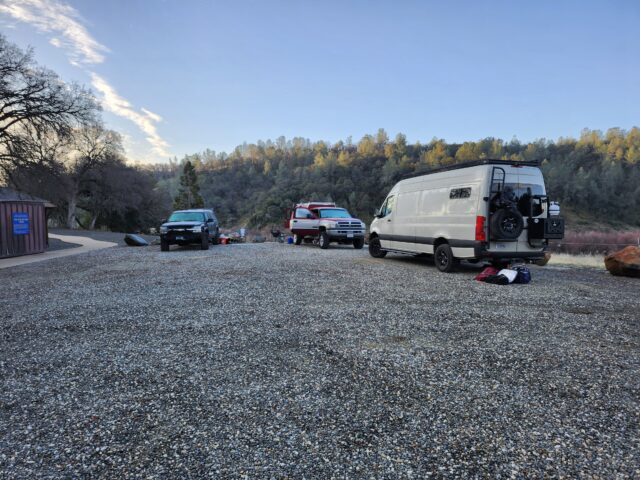
Camping will be available on the property beginning at 4 PM Friday and extending to Sunday evening. Fishing hours are dawn to dusk. Gate code will be sent out as we get closer to the Fishout date. Each angler will be responsible to close the gate behind them. The gate code will be emailed to us the week before the trip. Additional details to follow as we get closer to the date
The Lower Yuba is accessible from the sea – you must have a 2026 California Steelhead Reporting Card in addition to your fishing license. Unlike the license, the report card must be delivered in hard copy, either by snail mail or by hand from a fishing store. Plan ahead!
Location
University of California Sierra Foothill Research and Extension Center, 8279 Scott Forbes Road, Browns Valley, CA 95918. Meet at the gate to the river road (N39.24672°, W121.32222°), which is on your right about 1/3 mile before you reach the research center. Note that, misleadingly, there is a sign at the gate that says “No Fishing Access”. The gate will be opened and then locked behind us. 2.5 hrs from Berkeley. Take I-80 east to Sacramento, turn onto I-5 north, then onto Hwy 70 to Marysville. Pass through downtown Marysville on 70, and as you round the lake, turn right onto Hwy 20 east. Continue 15 miles, pass the Sycamore Ranch Campground. At the sign to the UC Station, turn left onto Peoria Rd, and then at another sign, bear right onto Scott Forbes Rd (also called Long Bar Rd). The gate is just past Sicard Flat Ditch. SCFFC strongly encourages carpooling.
General Notes
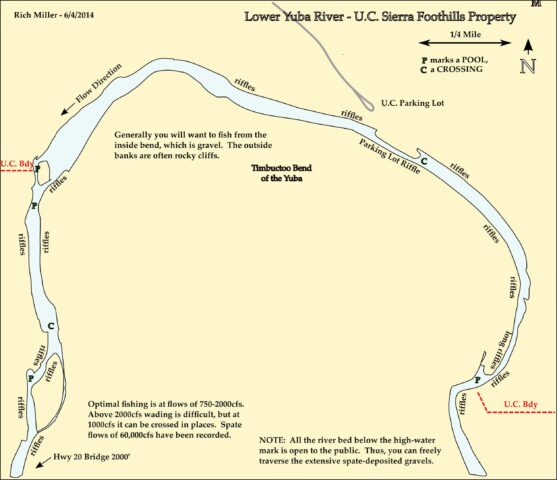
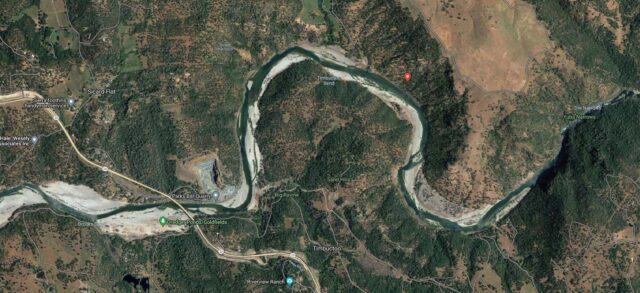
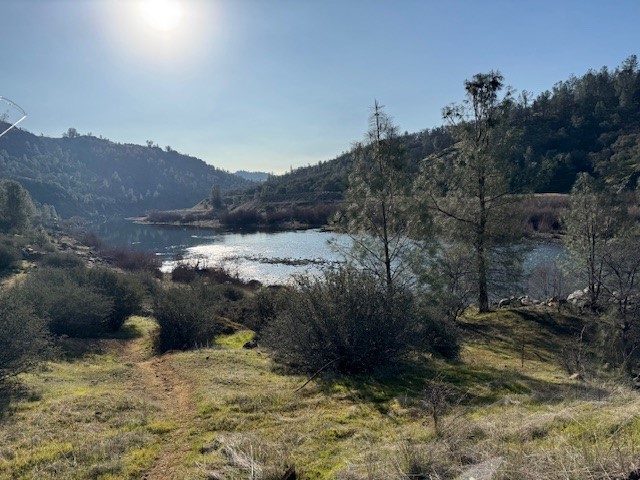
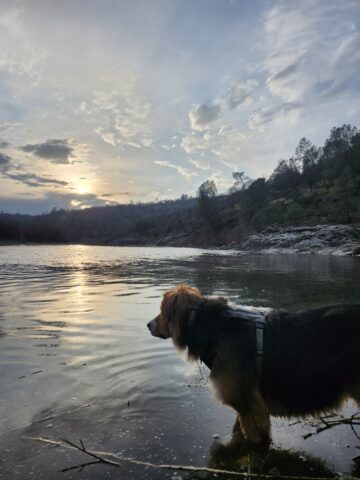
Our Club event on the Yuba will be on the private property owned by the University of California and is one of their Sierra Research facilities. We have contracted for TVFF’s exclusive use of the facility for the two days over the weekend. The river is about 1.5 miles above the highway 20 bridge over the Yuba and accessible only through a locked gate for a maximum of twenty (20) anglers per day. There is approximately 2.5 miles of available river that is the tailwater section a mile or so below Englebright Dam. The river has easy and level access, so it’s ideal for those less comfortable in heavy current wading situations, although that is also available for those Euro Nymphing.
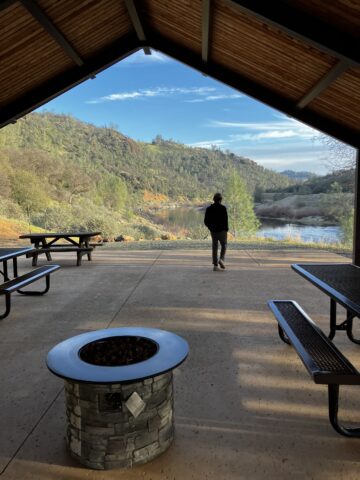
The UC facility is on many acres in a pastoral valley leading down to the river. Most of the research here is for cattle, grazing land management, and erosion control so it is very quiet with no nearby roads, ranches, or houses. There is a covered picnic area that sits above the river with 8-10 picnic tables and a porta potty restroom with hand wash station that is also available on site. No water on site, limited cell phone reception, no fires. All in all, it’s a very scenic and serene site.
Gear and Tackle Recommendations:
Yuba River fish are notoriously “hot” and frisky. They workout full time in the strong current and just love to play in it when disturbed by a sharp hook. Anticipate that you will see strong runs on hook ups and that the fish will feel like they are 4-6″ larger than you see in the net. So…
Rod & line weights/types: 5 or 6 weight rods, reels and floating lines are the norm to help control their runs. A 4 weight for Euro Nymphing should work well as long as it has a good stiff butt section to manage any runs.
Leaders and tippet: Fishing style dependent but normally I fish a 9’ 4X leader and adjust with added tippet of up to 4-6’ of 5 for the dry flies, and stick with 4X fluoro for the nymphs.
Other gear:
Note that we will not be using any watercraft as this is a walk and wade event with float takeouts way too far downstream to be of use for us.
Flies: Flies to match and we will send out a more current list as we get closer to the dates and better understand how the weather and water are impacting the hatches. Typically, you will need Skwala dries and nymphs, Pale Morning Duns, Baetis/Blue Wing Olives, Pink Alberts, Little Yellow Sallies, Pale Evening Duns, Golden Stones, and four varieties of Caddis.
Location / Date
University of California Sierra Foothill Research and Extension Center, 8279 Scott Forbes Road, Browns Valley, CA 95918.
August 21st – 23rd 2026
Fishmaster
TBD – Please contact Justin Ice if interested in hosting this event justin@schwagerdavis.com
Sep 08 : Alaska Kenai Peninsula Fly Fishing
(Click for address and map)
Fishmaster:
Alaska Kenai Peninsula Fly Fishing Trip
September 8–15, 2026
(Additional week: September 1–8, 2026, if enough anglers)
Each week will be made up of 8 anglers, with Rick and Jesse serving as hosts. This document provides an outline of the fall Alaska fly fishing trip. All projected dates and plans are subject to change based on weather conditions.
Trip Structure & Expectations
- For the first three days, anglers will be split into three groups:
- Three anglers fishing with Jesse from a drift boat
- Two anglers fishing with Rick from a drift boat
- One group driving to a wade-fishing location
- On the fourth day, the three groups will consolidate into two groups.
- Groups will rotate daily to ensure all anglers have time fishing from the boats.
- Wade fishing will take place every day, and anglers must be comfortable with wading and light hiking.
Recommended Equipment
- 4-5 wt. Rods (Switch / Spey / Single Hand)
- Full Sink
- Floating
- Sink Tips
Wade Fishing Locations
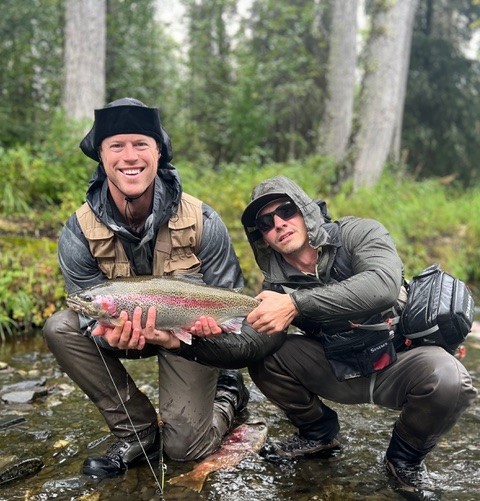
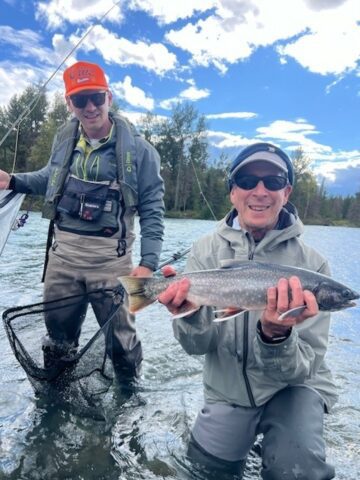
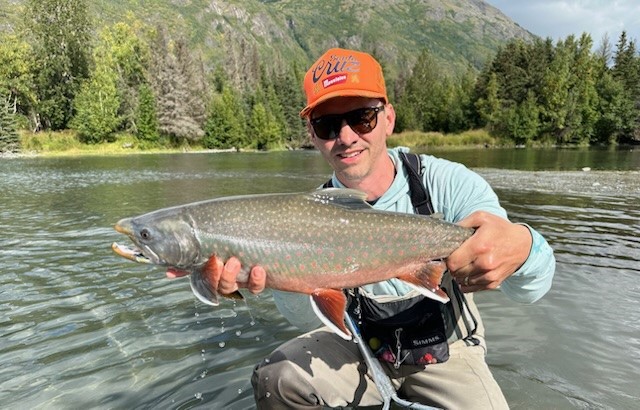
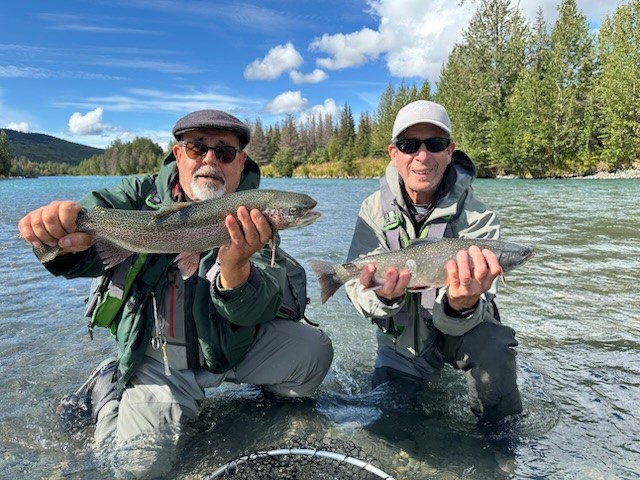
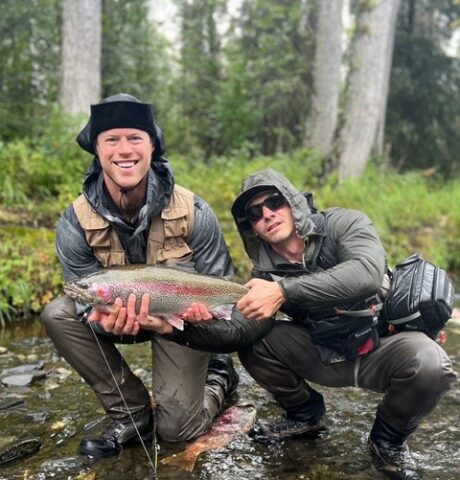
- Russian River – Rainbow Trout and Dolly Varden
- Anchor River – Steelhead
- Deep Creek – Steelhead
Daily Itinerary
Day 1 – Travel Day
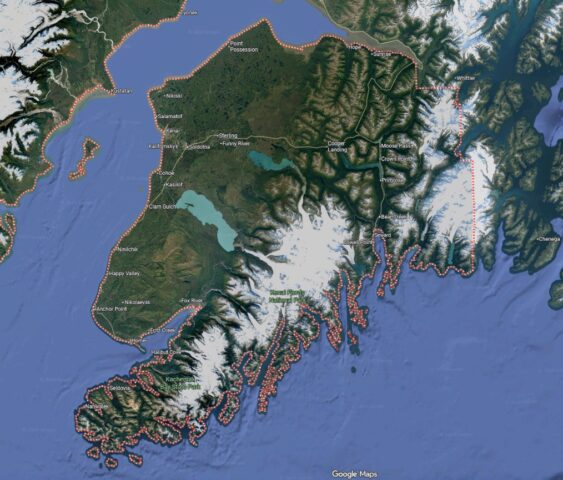
Arrive in Anchorage. Groups will pick up Turo rental vehicles and drive to a rental cabin near Sterling (between Soldotna and Cooper Landing). Groceries and supplies will be purchased in town.
Day 2
Drift boat fishing on the Upper Kenai River with Rick and Jesse (weather permitting, possibly through the canyon). The third group will wade fish the Russian River.
Day 3
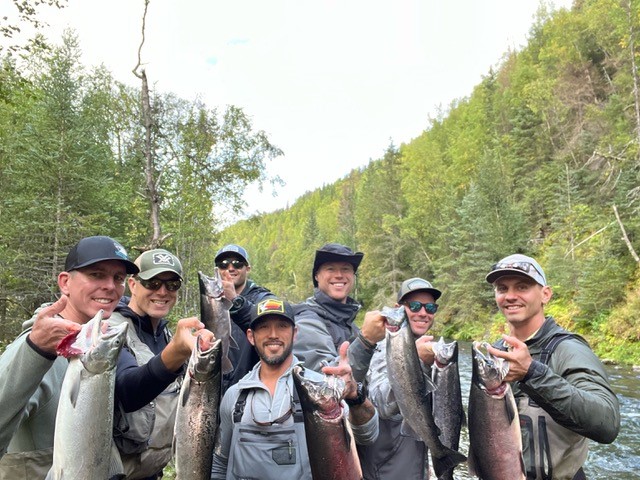
Drift boat float from Skilak Lake outlet to Bing’s Landing on the Middle Kenai for Rainbow Trout and Dolly Varden, with potential Coho opportunities. The wade-fishing group will travel south to the Anchor River for Steelhead.
Day 4
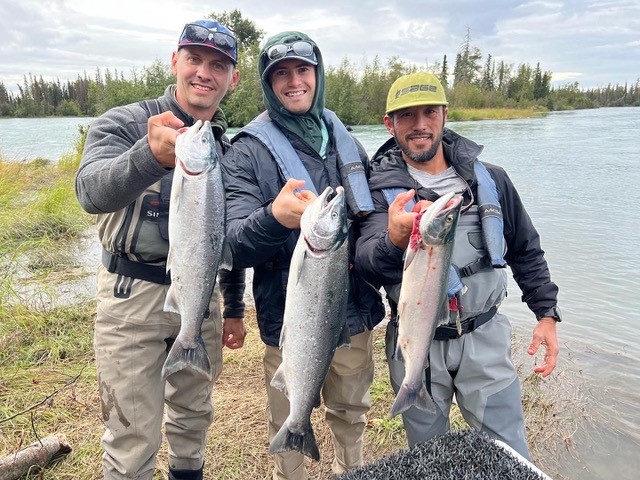
Rick and Jesse’s groups will either fish the Upper Kenai again for Rainbow Trout or float the Kasilof River from Tustumena Lake to the bridge for Steelhead and Silver Salmon.
Day 5
Groups consolidate into two groups of five anglers. Fishing will take place on the Anchor River and Deep Creek for Steelhead. If weather conditions prevent fishing, the group will fish the Russian River.
Day 6
Both groups fish the Upper Kenai and Russian River together. Optional hike to the Upper Russian River to view salmon jumping the falls.
Day 7
Optional saltwater fishing charter for one group while the other group fishes for Steelhead or Trout.
Day 8 – Departure
Drive back to Anchorage, return Turo rentals in daily parking, and depart Alaska.
Trip Cost
$700 Deposit per person (Non Refundable)
$1,400 per person (Total) — Includes:
- Rental vehicles
- Drift boat rentals and shuttles
- U-Haul rental for towing one drift boat
- Lodging
- Fishing beads
Does Not Include:
- Airfare
- Fishing licenses
- Rods and fishing equipment
- Food
Estimated Additional Costs
- Round-trip airfare (Alaska Airlines): approximately $612
- Alaska fishing license: approximately $45
- Estimated food and dining: approximately $300
- Estimated total trip cost: approximately $2,500
(Not including optional saltwater charter)
Meals
The group will dine out in town for three dinners. The remaining four dinners will be prepared at the cabin, with two anglers paired each night to cook. Breakfast and lunch planning will be finalized once all anglers are confirmed.
Cancellation Policy
If an angler decides not to attend, they are responsible for selling their spot to another angler or forfeiting their portion of the rental costs (deposits & payments are non refundable).
Host Contact Information
Jesse Collins
C: 831-227-9987 <jesse@jcollinsproperties.com>
Rick Chace
C: 831-234-9200 <rchace@got.net>
Jesse & Rick will be hosting a table at the January SCFF meeting. At that time will take $700.00 deposits on the trip.

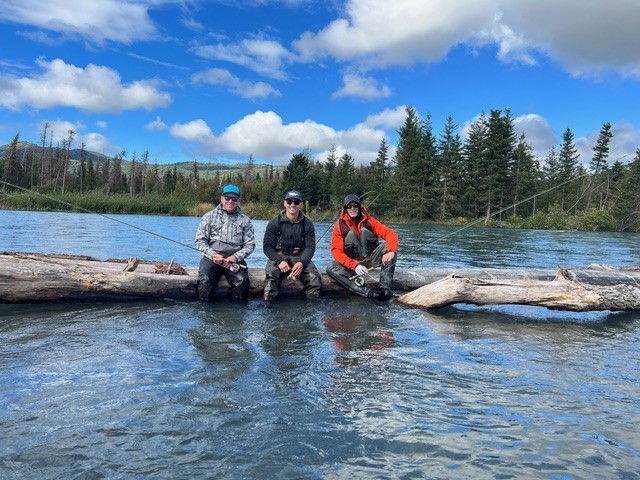
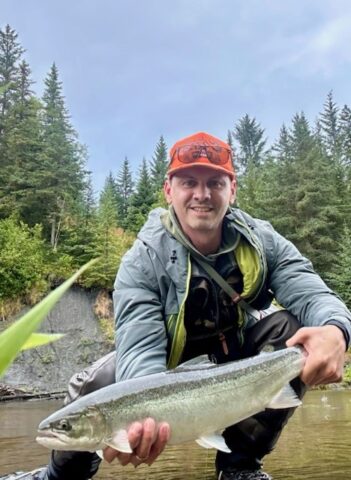
Sep 19 : Mammoth Fishout -Sept. 19-Oct. 3rd 2026
 Mammoth Lakes
 (Click for address and map)
Fishmaster: John Cook fishmaster-- (831)688-1561 or (831)234-6515
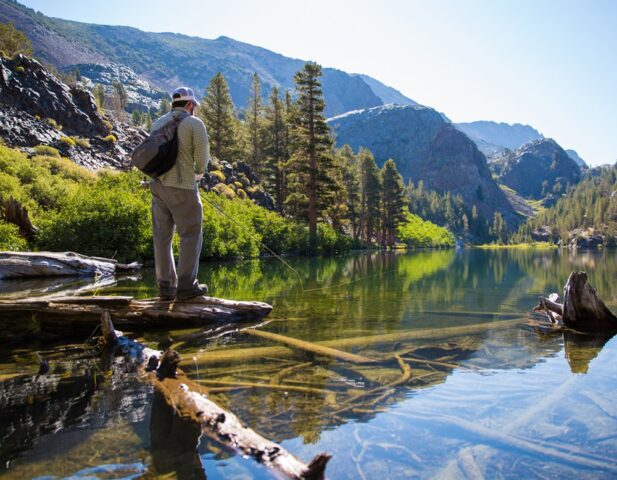
General: We will be staying in condominiums in the town of Mammoth Lakes (Max limit 8 per week). The condo complex has a lovely hot tub, so bring your suit. Two people per bedroom. Most people bring a sleeping bag to share queen size bed or a pad and sleeping bag to sleep on floor. A private room option is possible at an increased fee.
Cost: Shared single: $500/wk, $1000/2 wks.
Sign Ups: We will begin taking Mammoth reservations and money starting at 6:30 pm on Wednesday, March 4th (at the March Meeting). Please note that you are NOT on the list until I have your check, YOUR CHECK SAVES YOUR SPOT!
Check Payable to: Scott Kitayama. Mail: 36 Pima St, Watsonville, CA 95076
Group is limited to 8 in the condo per week. COST: $500/person . Please note that you are NOT on the list until I have your check, YOUR CHECK SAVES YOUR SPOT!
Payment of $500 is required to secure your spot. we need people to sign up as soon as possible. Should you need to cancel, you can find someone to take your place and get your money back.
Fishmasters:Scott Kitayama: scottkitayama@gmail.com , mobile: 650 279 5871 and Randy Saar: randy_saar@yahoo.com, mobile: 650 269 6138
Dates: This Fishout will take place over two consecutive one-week periods. You may sign up for one or both weeks. Week 1: Sept 19- Sept 26. Week 2: Sept 26 – Oct 3.
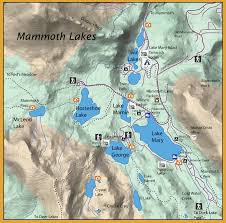
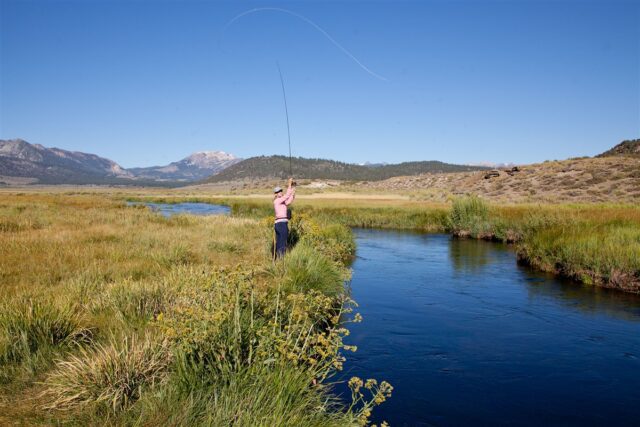
Location: The town of Mammoth Lakes is located on the eastern side of the Sierra, 6 or 7 hours drive from Santa Cruz. There are many lakes and streams in the area to fish.
Food Preparation: Breakfast and lunch items will be purchased by the Fishmaster ahead of time. Each person will be assigned a Kitchen Day. On that day, tasks will include setting out breakfast and lunch items, store unused food, and preparing the evening meal and clean up afterwards. Each person will be responsible for a dinner that you will need to purchase and prepare. You will then be reimbursed for the cost for the dinner.
Oct 10 : Lower Sacramento River Group Float – Hosted by the Delta Fly Fishers
(Click for address and map)
Fishmaster:
Greetings,
The Delta Fly Fishers have offered the Santa Cruz Fly Fishing Club the opportunity to join them on their annual guided float trip on the Lower Sacramento River.
See the information below from the Fishmaster Robert Fujimura.
Lower Sacramento River Group Float Outing with Santa Cruz Fly Fishing Club– Saturday October 10, 2026
Delta Fly Fishers are happy again to invite your club to join this annual Delta Fly Fishers outing with host Scott Sugimoto of On the Riffle Guide Service and his guides and support staff for another awesome day on this famous tailwater fishery for resident rainbow trout. Scott and his team have successfully hosted our club annually for several years during the prime fly fishing season. The Lower Sacramento River fishing has been a reliable and renowned trophy trout fishery of the West. Suitable for novice fly fishers but still fun and challenging for the more experienced ones.
Participants will have a full day of guided indicator nymph fishing from a drift boat with an experienced guide per two anglers. Fishing gear, flies, shuttle service, and all you can eat group BBQ lunch are provided. The guide fee of $300 per person (double occupancy per boat) does not include tip.
Please contact Bob Fujimura to register and pay your guide fee before August 30 or earlier (email [deltaflyfishers@gmail.com] . Early registration will help ensure that we reserve our guides in advance – so don’t delay in registering if you are interested in this annual crowd pleaser. Registration requires prepayment of guide fees and submission of a DFF liability waiver form. All guide fees are non-refundable in the case of you cancel your trip – however, you can sell your spot to another club member.
Our annual outing is a fun event for our club members with a long history of repeated participation by its attendees. Registered participants will be provided with additional detailed information (via email) on pre-event fishing conditions, recommended fishing equipment or gear for optional use during or outside of the guided day, local group dining or lodging options, and other trip activities. On request, non-DFF club registrants can be provided with a Zoom orientation session prior to the event. Scott also welcomes inquiries about the guided itinerary and technical questions about this event (email: scott@ontheriffle.com or phone: (530) 276-1612).
Oct 15 : O’Neill Forebay ‘Stosh’ Memorial Fishout October 15-18th
 Medeiros Primitive Campground - Oneill Forebay
 (Click for address and map)
Fishmaster:
Event: O’Neill Forebay ‘Stosh’ Memorial Fishout
Date: October 15th – 18th
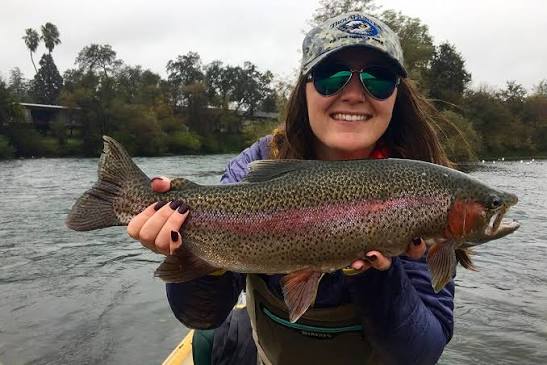
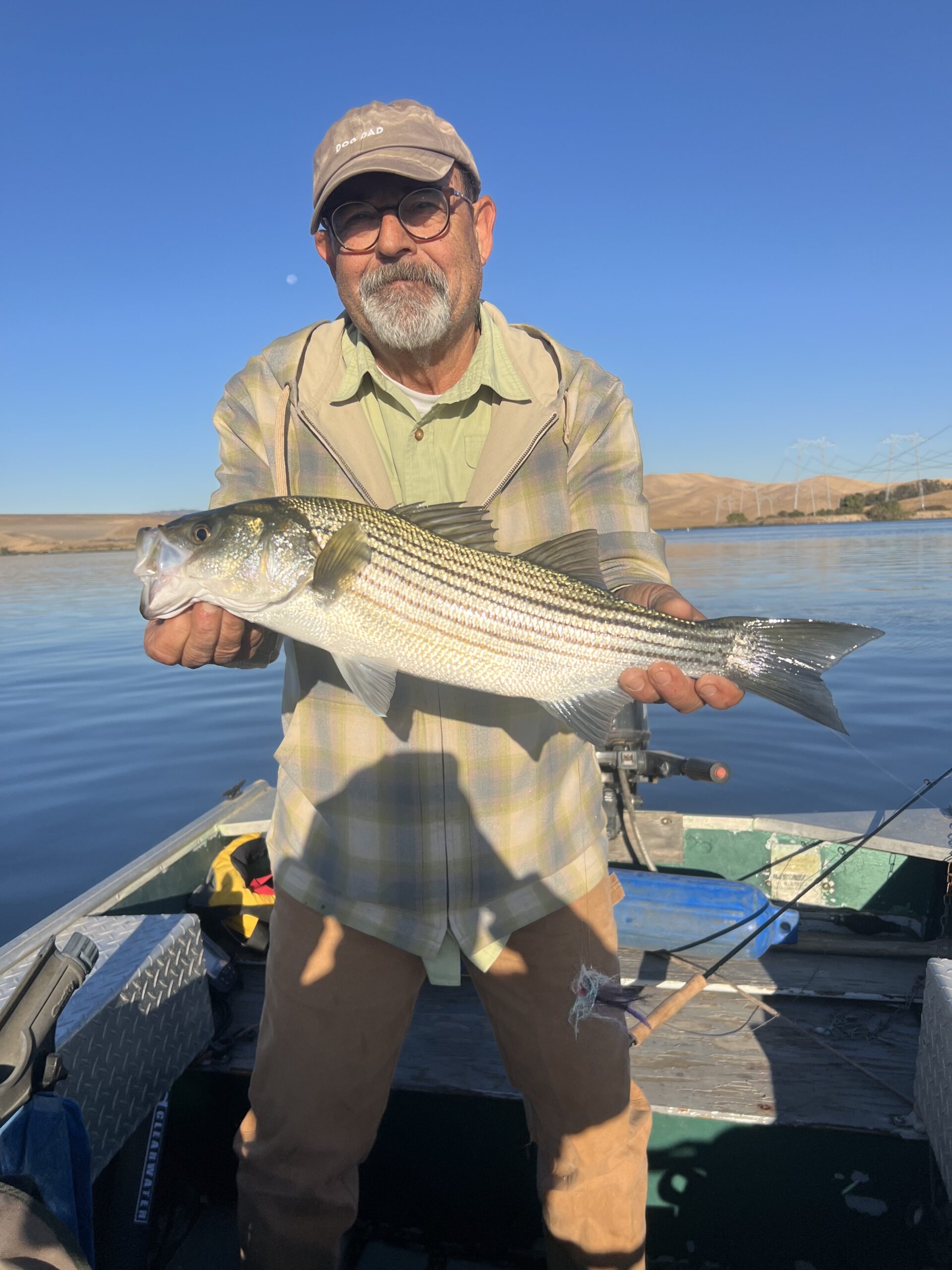
Target Gamefish: Striped Bass
Location: Medeiros Campground located on the Southern Shoreline of the O’Neill Forebay, access off of Santa Nella Blvd. (Highway 33)
Hosts: Kevin Murdock troutdock89@gmail.com
These are primitive campsites so bring your own water. There are tables, sun pavilions, and chemical toilets, or outhouses and fire rings. No open fires are allowed outside of the rings.
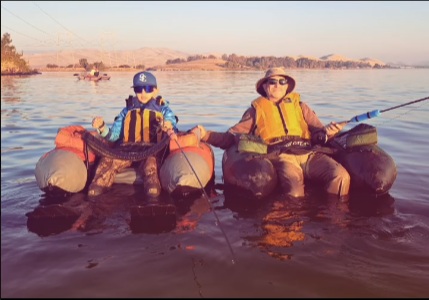
Typically we will be camping as close to site 29 as we can get. This is a first come, first serve campground, so no reservations are accepted. Float tubes can be launched near the campsites, but boats must be first inspected, then launched from the San Luis Creek Boat launch. Boats may not be left on the lake overnight. Boaters would be wise to exit prior to the closing of the entry kiosk. The ranger can place a seal on your trailer, allowing you to bypass the inspection process the next morning.
The rangers at the kiosk by the Medeiros entrance may insist that your float tubes need inspection. make sure they’re clean & dry.
Equipment: 8wt rods with fast sinking lines. Some anglers will occasionally use a floating line with a ‘gurgler’ type fly
Flies: Lee Haskins San Luis smelt, ‘Deceiver’ type patterns in red, white, chartreuse, the aforementioned gurglers and poppers.
Float tubes (may require inspection for quagga and golden mussels)
Fins, sunscreen, polarized glasses, life vest
Links:
Fly Fishing O’Neill Forebay for Stripers
https://mengsyn.com/ A fly-fishing addict who fishes San Luis Reservoir and the Forebay.
http://www.danblanton.com/ Long time local fishing guide.
Forebay Water level:
https://cdec.water.ca.gov/dynamicapp/QueryDaily?s=Onf
There will be a signup sheet at our September meeting. We’ll also create a list for those hoping to participate in a pot luck in honor of Steve ‘Stosh’ Rudzinski.
Weather conditions can vary dramatically, so it would behoove members to check prior to departure. You could email me or just get conditions on-line. High winds can cause the lake to be closed to all vessels.
This is one of our nearest Fishouts, with the possible payoff of a double digit fish! Don’t miss out!
Nov 13 : Trinity River Fishout
(Click for address and map)
Fishmaster:
NOTE: Contact Alex Ferber if you are interested in going on the trip. After knowing how many people are interested, it will be easier to plan logistics (camping? motel?). You can text Alex at (831) 419-0564 or alex.ferber74@gmail.com. If you want to go on this trip, it is highly recommended to attend the Spey Classes.
The fishery:
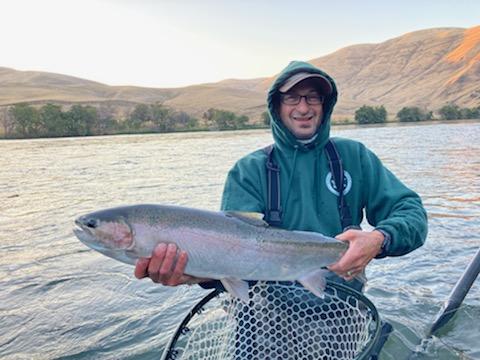
Basically, this is a Steelhead Trip. There are some resident trout, including some really nice brown trout. I walk wade or float my raft, depending on the river conditions. I personally use a Spey rod to swing flies. Many people use indicators. There are a lot of walk in spots to explore. The river can be floated with rafts or driftboats. There is a shuttle service available.
Tackle:
Single hand rods, 7-8 wt rods, using floating lines with indicator set up. Typical flies used are Egg patterns, Copper John’s, Stonefly imitations like Rubberlegs, Dark Perdigons. Sizes ranging from Size 8-14.
Spey or Switch rods, usually 5-6 wt in the Fall, I use a 7 wt in the winter. Skagit or Scandi heads, with floating to heavy sink tips, depending on the river conditions and season. Flies that work well include leeches, intruders, HoBo Spey, Traditionals, as well as dry fly patterns ( Skaters) in the early Fall.
The River:
The Trinity River is located aprox 1 hr west of Redding on Hwy 299. Its a beautiful tailwater fishery, with flows controlled from the Lewiston Dam. This is where the hatchery can be found. It has many different faces, including some big water as it runs west. It meets up with the Klamath River on its journey to the ocean. It has an excellent run of both wild and hatchery fish, ranging from 5-7 #, with some larger fish in the +10-12 # range. There are fish in the system year round, but typically a push of fish starts in late September and peaks in late November, with a second run usually in late December- March. The fishing remained really good thru the end of March last season. It is very flow dependant and can run quite low in the Fall, with occasional bumps in flows when there is precipitation. It can blow out on occasion, but clears pretty fast.
Amenities:
Weaverville is the closest town, where there are good restaurants, motels and a really nice Holiday Market. It’s kinda the hub. There is an RV park in Weaverville, but no campsites.
Camping is available in Douglas City area as well as Junction City and further west on 299. The town of Douglas city doesn’t have much, other than a small mini mart. Indian Creek Lodge is a few miles east of Douglas City. The town of Lewiston is just below the Lewiston dam. It offers some camping and motels. There is a really nice motel west of Junction City (I believe it is called Steelhead Lodge?). It’s an excellent place to stay if one wishes to fish below Junction City.
 We have a lot of talent in our community. For a fly-fishing club, in a surf community that was once mostly a retirement town with surfers and outdoorsy people, we became a fly-fishing club.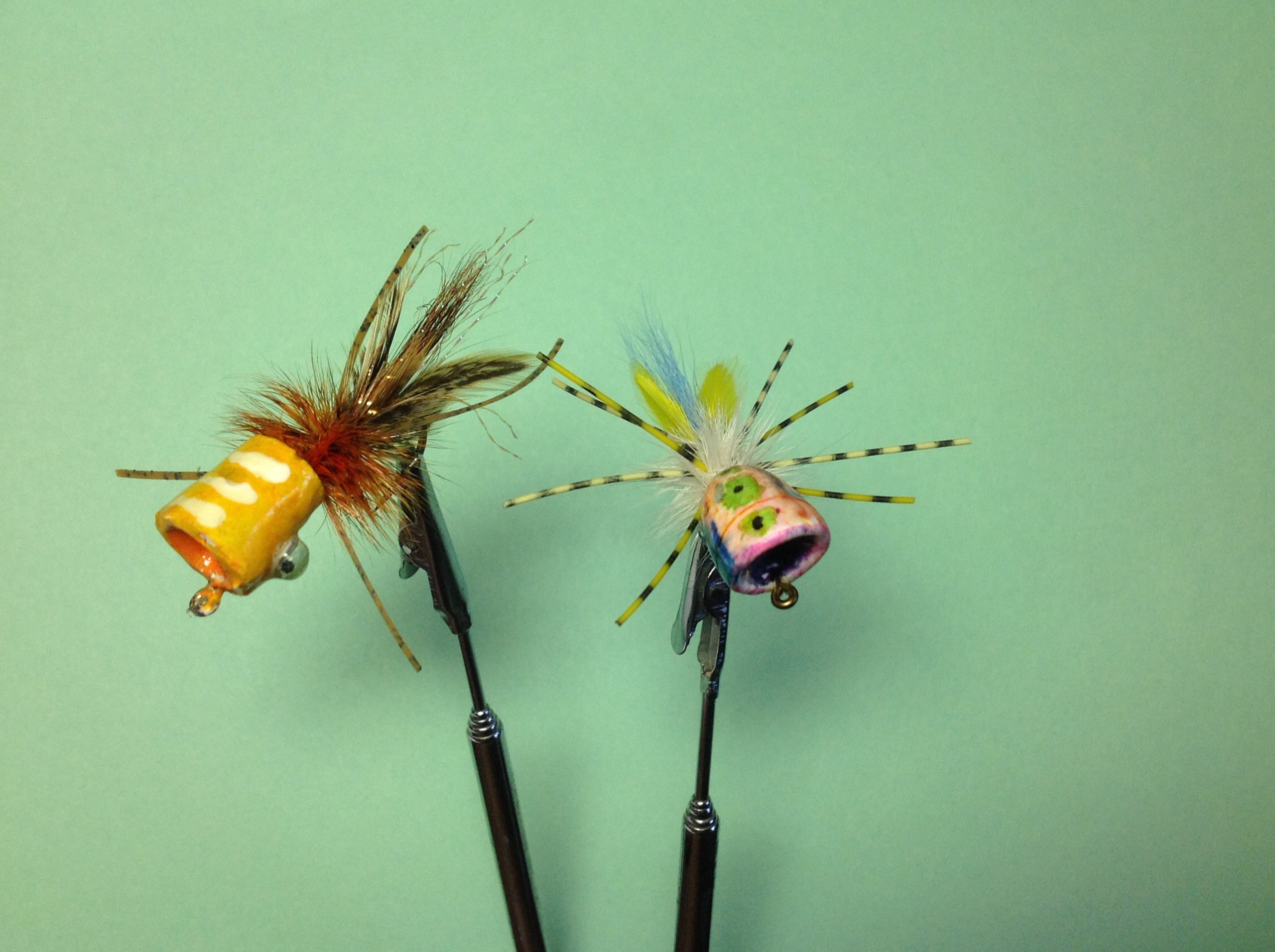
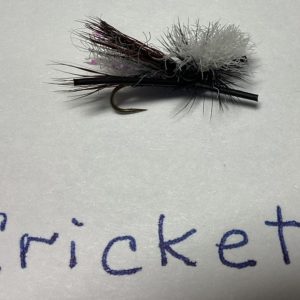
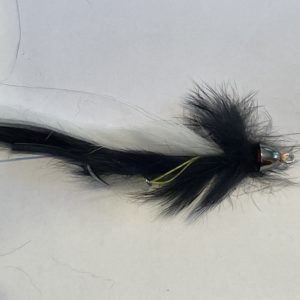
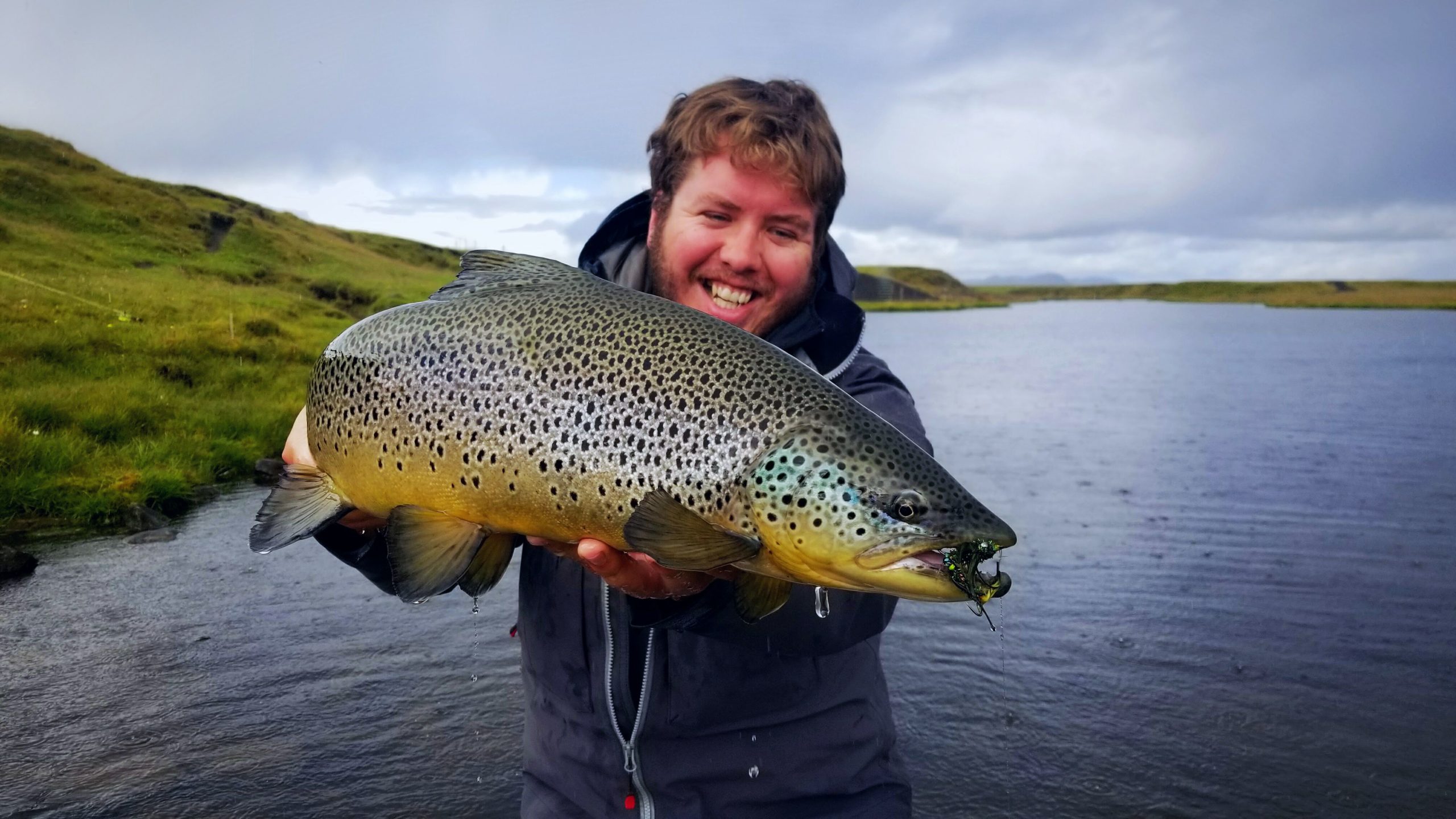
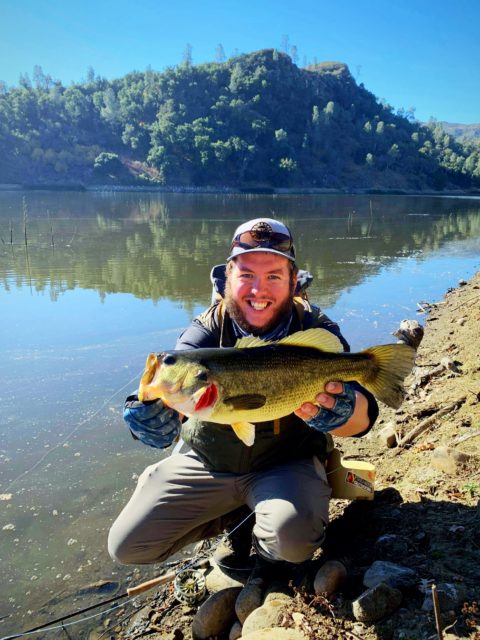
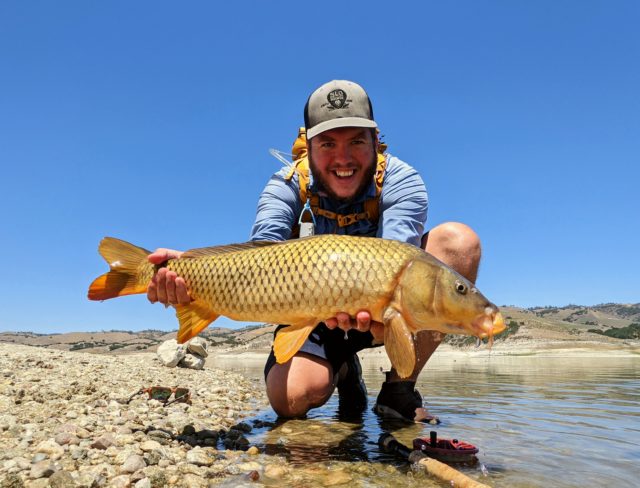 In between spending his summers guiding in Iceland, Dagur attended California Polytechnic State University-San Luis Obispo, where he acquainted himself with the local fisheries through lots of trial and error. He recently started a fly fishing guide service in San Luis Obispo with a focus on the area’s overlooked fisheries when it comes to fly fishing, such as bass, carp, and surf perch. Dagur also ties and sells flies, is a regular contributor to California Fly Fisher magazine, and teaches clinics on carp and bass through the Central Coast Fly Fishing fly shop in Carmel.