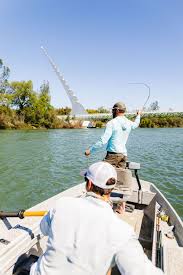
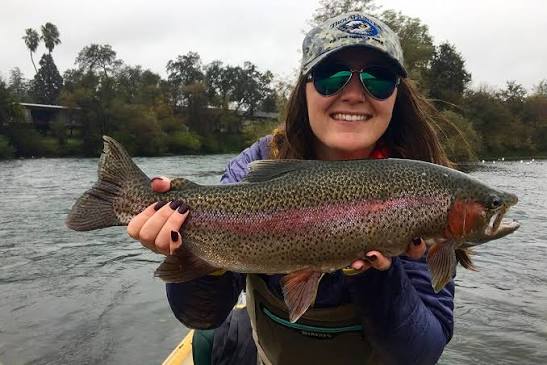
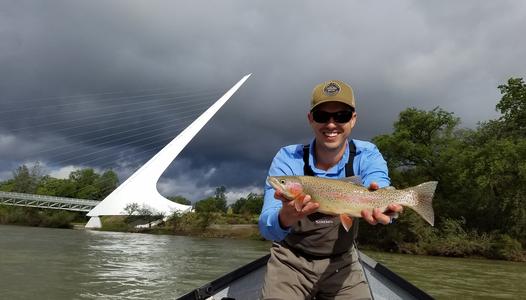
Do you want to spend a day celebrating fly fishing, our great California rivers, and spend time with friends and fellow advocates for our fisheries? This will be what YubaFest is all about. The Northern California Council, Fly Fishers International and our partners are organizing fun days of family focused education, learning, good food and music, and bringing our fishing community together to enjoy this wonderful River.
The event is Dedicated to the late Jon Baiocchi, our friend, fishing guide, and Yuba River advocate. Please come to celebrate Jon’s life and what he stood for. It will be a day of joy, music and fun.
The event will include:
Partner booths – NCCFFI, Cal Trout, TU, Gold Country Fly Fishers, and many other partners who advocate for fisheries & watersheds and enjoy fishing.
Learning opportunities –
Fly Fishing 101 – how to fly fish
How to fly cast – presenting the fly to fish
Participate in the FFI fly casting challenge – a skills test – bronze, silver levels
Entomology – what fish eat
How to create flies that catch fish – fly tying starter
Women in fly fishing (Women Connect)
Fishing the Yuba – how to catch the wild rainbows of the Yuba
Restoration work on the Yuba – SYRCL program to restore this great river
Water safety – rivers are dangerous – how to stay safe
Food & drinks available throughout the day, including a BBQ dinner on Saturday
Music – Afternoon fun music, and Karrie O’Neill, singer/song writer for the evening
Story teller to bring the history & glory of the region to a personal level
Special women’s programs for learning and taking fishing trips together
Sunday special on-the-water teaching and fishing opportunities with possible casting classes too
Raffle & auction of fly fishing “stuff” as well as other non-fishing items.
Times for the event are: Saturday 10 – 5:30 for learning and river activities, 6 – 9 for dinner, story telling, and music around the camp fire (if we can have it).
Location: Sycamore Ranch Park, 5390 State Hwy. 20, Browns Valley, CA. 95918,
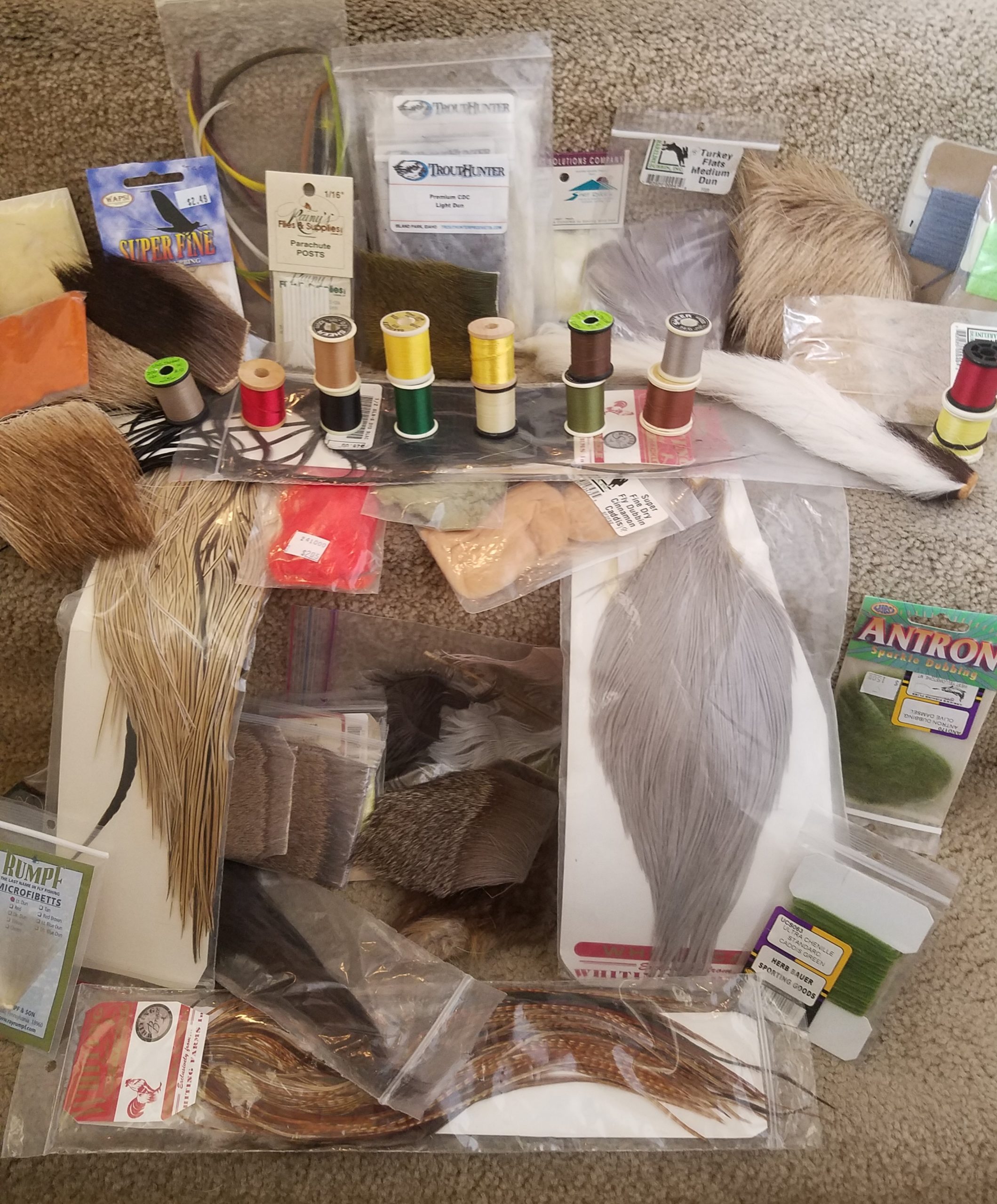
No rods, no reels, no bottles of questionable booze; this month’s raffle is all fly tying materials. Our queen of fly tying, Elaine Cook, waded through thousands of dollars worth of new donated materials to come up with eight different treasure bags stuffed with hundreds of dollars worth of quality tying materials as follows:
Bag 1 Nymphs
Bag 2 Drys
Bag 3 Terrestrials
Bag 4 Buggers/Streamers
Bag 5 Small flies
Bag 6 Ocean/Surf
Bag 7 Stripers
Bag 8 Beginners
Ticket purchasers should designate which Bag they wish to have their tickets applied toward. The more tickets purchased, the better your chances are to win. I really gotta’ say, this is some nice stuff!
Raffle tickets go for a dollar each, $20 bucks gets you 25. Ticket office is open and closes at noon on the day of the meeting
(Wednesday 8/3). Tickets will also be available at the door the night of the meeting/BBQ/swap meet. Need not be a member to participate or be present to win.
Questions? Call or text Jeff at 831-234-0033
BTW!
Great door prize/everybody attending gets a free ticket: $50 gift card from the The Fly Shop in Redding.
Santa Cruz Fly Fishing Club (SCFFC)Lower Yuba Private Water Camp & Fishout
June 19th-21st 2026
(Date subject to change due to weather and flows)
The information provided below has been modified from the Grizzly Peak Fly Fishing Club and Tri-Valley Fly Fishing Club (2022-23)
Special Notes
The outing is limited to 20 people. With a $50.00 buy in payable to the club. Reservations will be accepted via email to the Fishmaster (Justin Ice) only one person reservation per email (if you and your buddy want to go then 2 emails are needed). Due to the limited capacity, reserving your spot is first come first serve starting Feb. 4th at 9am Payment to the club by Feb. 13th if payment not received on this date your space will be forfeited. No refunds.
Camping will be available on the property beginning at 4 PM Friday and extending to Sunday evening. Fishing hours are dawn to dusk. Gate code will be sent out as we get closer to the Fishout date. Each angler will be responsible to close the gate behind them. The gate code will be emailed to us the week before the trip. Additional details to follow as we get closer to the date
The Lower Yuba is accessible from the sea – you must have a 2026 California Steelhead Reporting Card in addition to your fishing license. Unlike the license, the report card must be delivered in hard copy, either by snail mail or by hand from a fishing store. Plan ahead!
Location
University of California Sierra Foothill Research and Extension Center, 8279 Scott Forbes Road, Browns Valley, CA 95918. Meet at the gate to the river road (N39.24672°, W121.32222°), which is on your right about 1/3 mile before you reach the research center. Note that, misleadingly, there is a sign at the gate that says “No Fishing Access”. The gate will be opened and then locked behind us. 2.5 hrs from Berkeley. Take I-80 east to Sacramento, turn onto I-5 north, then onto Hwy 70 to Marysville. Pass through downtown Marysville on 70, and as you round the lake, turn right onto Hwy 20 east. Continue 15 miles, pass the Sycamore Ranch Campground. At the sign to the UC Station, turn left onto Peoria Rd, and then at another sign, bear right onto Scott Forbes Rd (also called Long Bar Rd). The gate is just past Sicard Flat Ditch. SCFFC strongly encourages carpooling.
General Notes
Our Club event on the Yuba will be on the private property owned by the University of California and is one of their Sierra Research facilities. We have contracted for TVFF’s exclusive use of the facility for the two days over the weekend. The river is about 1.5 miles above the highway 20 bridge over the Yuba and accessible only through a locked gate for a maximum of twenty (20) anglers per day. There is approximately 2.5 miles of available river that is the tailwater section a mile or so below Englebright Dam. The river has easy and level access, so it’s ideal for those less comfortable in heavy current wading situations, although that is also available for those Euro Nymphing.
The UC facility is on many acres in a pastoral valley leading down to the river. Most of the research here is for cattle, grazing land management, and erosion control so it is very quiet with no nearby roads, ranches, or houses. There is a covered picnic area that sits above the river with 8-10 picnic tables and a porta potty restroom with hand wash station that is also available on site no water on site, limited cell phone reception, no fires. All in all, it’s a very scenic and serene site.
Gear and Tackle Recommendations:
Yuba River fish are notoriously “hot” and frisky. They workout full time in the strong current and just love to play in it when disturbed by a sharp hook. Anticipate that you will see strong runs on hook ups and that the fish will feel like they are 4-6″ larger than you see in the net. So…
Rod & line weights/types: 5 or 6 weight rods, reels and floating lines are the norm to help control their runs. A 4 weight for Euro Nymphing should work well as long as it has a good stiff butt section to manage any runs.
Leaders and tippet: Fishing style dependent but normally I fish a 9’ 4X leader and adjust with added tippet of up to 4-6’ of 5 for the dry flies, and stick with 4X fluoro for the nymphs.
Other gear:
Note that we will not be using any watercraft as this is a walk and wade event with float takeouts way too far downstream to be of use for us.
Flies: Flies to match and we will send out a more current list as we get closer to the dates and better understand how the weather and water are impacting the hatches. Typically, you will need Skwala dries and nymphs, Pale Morning Duns, Baetis/Blue Wing Olives, Pink Alberts, Little Yellow Sallies, Pale Evening Duns, Golden Stones, and four varieties of Caddis.
Location / Date
University of California Sierra Foothill Research and Extension Center, 8279 Scott Forbes Road, Browns Valley, CA 95918.
June 19th – 21st 2026
Registration / Booking Info
February 4th (Wednesday) 9am
Email only, one reservation per email, first come first served
Payment to Santa Cruz Fly Fishing Club by February 13th . Payments not received on this date the space will be forfeited.
Payment details to follow
Jun 20 : Lake Almanor/Hex Hatch – Jun 20th – 27th 2026
Rocky Point Campground (Click for address and map) Fishmaster: Jeff (Yog) Goyert - Fishmaster (831)234-0033
The Lake Almanor Fishout is scheduled for June 20th thru 27th, 2026. This time period is, hopefully, the peak of the annual Hexagenia hatch that begins generally mid-June and runs through mid-July. The most productive fishing takes place early evenings on into past dark between Lake Almanor West to Canyon Dam on the Southwest side of the lake. Most of the fishing is done from float tubes as well as small boats or even from shore.
In addition to the evening “Hex” hatch, a multitude of opportunities exist for fishing throughout the day to include Little Crater Lake, Manzanita Lake, Baum Lake, Eagle Lake, Butt Valley Reservoir, Deer Creek, Clear Creek, Feather River, Yellow Creek, plus many more.
Lodging will be the responsibility of individual attendees. A popular campground operated by PG&E is the Rocky Point Campground, for reservation information call 916-386-5164. Many USFS campgrounds are in the area. Reservations are available through www.recreation.gov or by calling 877-444-6777. Make use of internet resources to acquire the actual campground names. There are also many resorts and rental cabins available in the area. A few examples are Wilson’s Camp/530-259-2267 and Plumas Pines Resort/530-259-4343. Other options are available via online research. Be advised that due to the popularity of fishing at this time of year reservations fill up early.
On Tuesday the 23th plan on breakfast with the club. Location TBD as Carol’s Café is under new ownership.
Sierra Fly and Tackle, stores in Chester and Hamilton Branch, is a great resource for current conditions and reports along with a large inventory flies and equipment. A must stop for all visiting fly fishers if only to get one of their cool tee-shirts. Both first time and veteran “Hex” Anglers could well benefit from the expertise provided by a knowledgeable and experienced guide. Lance Gray (530-517-2204) or Tim Loomis (831-345-8411) both offer instructional packages to help achieve success during the “Hex”.
Due to unforeseen circumstances, this Fishout has been canceled. Please stay tuned as there is a chance for rescheduling.
Fishmaster:
Alex Ferber
Location:
Lakes, rivers and streams of the Burney area
Species:
Trout
Date:
July 10th-12th
Cost:
No Cost
Meet Up:
Date of Fishout TBD and subject to change due seasonal conditions
Hat Creek Park off Hy 299 (See the map below). The park is approximately 10 minutes from the highway 299/80 junction. The park is on the left hand side going east on 299. If you google Hat Creek Park, it should show up.
This meet up will be a general discussion with your Fishmaster Alex Ferber. Here he will be discussing the local fishery, access points, general information and answering any questions you might have about making this a successful outing.
Meeting time to be updated as we get closer
Equipment:
Typical Trout Set Up 9′, 4-6wt Rods w/ Floating Lines Ideal
Euro Nymphing, and Trout Spey conditions available
Nymphs: Pheasant Tail, Hairs Ear, Prince Nymph, Wooly Buggers, Perdigon, Copper Johns, Zebra Midge, Micro May, Golden Stones
Drys: Caddis Patterns 12-16, Upright wing vs. Emerges, Missing Link, Stone Flys, Parachute Adams, Comparaduns (various sizes 16-12)
Misc.: Soft Hackles, Streamers, Leaches
What To Expect:
This Fishout is DIY Fishout with your Fishmaster acting as a resource person helping with any questions regarding where to fish, access, use of personal watercraft, fishery history, etc. Depending on interest there is potential of a pre Fishout presentation (TBD) and or tour of any one of the local areas with the most interest.
More information to be updated as interest develops. Please contact the Fishmaster if you are interested in attending.
Local Waters:
Hat Creek: Spring creek with plenty of easy access, walk and wading. There are 3 distict sections from the Power House Riffle, to The Lower Freestone Section. There are an abundence of hatches year round and daily from mayflies, caddis, and stone flies with the potential of a trico or green drake hatch.
Burney Creek: Spring creek with access around the McArthur Burney Falls State Park. The waterfall is a must see. This is great water for a dry/dropper set up as well as traditional dry and nymph fishing. Above the falls the creek is stocked and below the fish are wild.
Pit River: Classic tailwater freestone fishery. This river is known for its hard fighting wild rainbows. There is great walk and wade access but the terrain is difficult with large snot covered bowling balls covering the river bed. Those with strong wading skills and a stout wading stick only need apply. The river is broken up by multiple power houses each with their own characters. Primary a nymphing river either by indicator or tight line. Rubber legs and dark lords and lots of weight (bring lots of both).
BaumLake: Stocked and great for a small float tube or kayak. Excellent dry fly and streamer fishing.
Lake Britton: Primarily a motorized boat lake. Warm water fishery with small mouth bass, and potential for bull trout.
Ahjumawi / Big Lake Lava Springs State Park: Launch at “Rat Farm”
Fall River: Iconic spring creek with an abundance of large wild rainbows. No shore access. Non motorized boats can be launched at the Cal Trout public access or a kayak/motor boat at the “Rat Farm” (Big Lake/Ahjjumawi launch). Awesome dry fly, streamer and indicator fishing.
Lodging:
Camping – Too many to list, this is an outdoors paridise with options from unimproved to glamping. Plenty of places for RV hookups and KOA camping
Hotels & Motels: Various options available in the Burney area
Burney Sporting Goods – 37427 CA-299, Burney, CA 96013
Jul 11 : Beer Can Beach Surf Fishing
(Click for address and map) Fishmaster:
Location: Beer Can Beach (AKA Summer Beach) – Staircase at 1191 Via Palo Alto, Aptos
Fish Master: Sam Bishop / sambishop@totlcom.com / 831-274-4024
Species: Surf Perch, Striped Bass
Min./Max Participants: No Limit
Gear: 6-8wt. Rods with full sinking lines or shooting heads to match the rod. Polarized glasses (safety),
Mandatory Accessories: Wader Belt & Stripping Basket
(If a basket is needed, some maybe available to borrow or purchase. Please contact the Fishmaster ahead of time. Also there are many DIY Stripping Basket making tutorials online)
Fishmaster: Scott Kitayama / scottkitayama@gmail.com
Location: Palm Beach
Target Species: Surf Perch and Stripers
Gear: 6-8wt. Rods with full sinking lines or shooting heads to match the rod. Polarized glasses (safety),
Mandatory Accessories: Wader Belt & Stripping Basket
(If a basket is needed, some maybe available to borrow or purchase. Please contact the Fishmaster ahead of time. Also there are many DIY Stripping Basket making tutorials online)
Single, double & triple fly rigs
Clousers to sand crabs
Directions: Take W. Beach St. in Watsonville towards Pajaro Dunes. Park at the end of W. Beach St. on the right side of the road outside of the entrance to Pajaro Dunes.
Note: The Delta Fly Fishers will be joining us on this Fishout. Join us and meet some new people and trade some notes.
Tides for Santa Cruz, Monterey Bay August 1, 2026.
Day High Tide Height Sunrise Moon Time % Moon
/Low Time Feet Sunset Visible
Sa 1 Low 6:52 AM 0.0 6:14 AM Set 9:14 AM 95
1 High 1:35 PM 4.3 8:15 PM Rise 9:56 PM
1 Low 6:49 PM 2.3
September 8–15, 2026 (Additional week: September 1–8, 2026, if enough anglers)
Each week will be made up of 8 anglers, with Rick and Jesse serving as hosts. This document provides an outline of the fall Alaska fly fishing trip. All projected dates and plans are subject to change based on weather conditions.
Trip Structure & Expectations
For the first three days, anglers will be split into three groups:
Three anglers fishing with Jesse from a drift boat
Two anglers fishing with Rick from a drift boat
One group driving to a wade-fishing location
On the fourth day, the three groups will consolidate into two groups.
Groups will rotate daily to ensure all anglers have time fishing from the boats.
Wade fishing will take place every day, and anglers must be comfortable with wading and light hiking.
Recommended Equipment
4-5 wt. Rods (Switch / Spey / Single Hand)
Full Sink
Floating
Sink Tips
Wade Fishing Locations
Russian River – Rainbow Trout and Dolly Varden
Anchor River – Steelhead
Deep Creek – Steelhead
Daily Itinerary
Day 1 – Travel Day
Arrive in Anchorage. Groups will pick up Turo rental vehicles and drive to a rental cabin near Sterling (between Soldotna and Cooper Landing). Groceries and supplies will be purchased in town.
Day 2
Drift boat fishing on the Upper Kenai River with Rick and Jesse (weather permitting, possibly through the canyon). The third group will wade fish the Russian River.
Day 3
Drift boat float from Skilak Lake outlet to Bing’s Landing on the Middle Kenai for Rainbow Trout and Dolly Varden, with potential Coho opportunities. The wade-fishing group will travel south to the Anchor River for Steelhead.
Day 4
Rick and Jesse’s groups will either fish the Upper Kenai again for Rainbow Trout or float the Kasilof River from Tustumena Lake to the bridge for Steelhead and Silver Salmon.
Day 5
Groups consolidate into two groups of five anglers. Fishing will take place on the Anchor River and Deep Creek for Steelhead. If weather conditions prevent fishing, the group will fish the Russian River.
Day 6
Both groups fish the Upper Kenai and Russian River together. Optional hike to the Upper Russian River to view salmon jumping the falls.
Day 7
Optional saltwater fishing charter for one group while the other group fishes for Steelhead or Trout.
Day 8 – Departure
Drive back to Anchorage, return Turo rentals in daily parking, and depart Alaska.
Trip Cost
$700 Deposit per person (Non Refundable)
$1,400 per person (Total) — Includes:
Rental vehicles
Drift boat rentals and shuttles
U-Haul rental for towing one drift boat
Lodging
Fishing beads
Does Not Include:
Airfare
Fishing licenses
Rods and fishing equipment
Food
Estimated Additional Costs
Round-trip airfare (Alaska Airlines): approximately $612
Alaska fishing license: approximately $45
Estimated food and dining: approximately $300
Estimated total trip cost: approximately $2,500 (Not including optional saltwater charter)
Meals
The group will dine out in town for three dinners. The remaining four dinners will be prepared at the cabin, with two anglers paired each night to cook. Breakfast and lunch planning will be finalized once all anglers are confirmed.
Cancellation Policy
If an angler decides not to attend, they are responsible for selling their spot to another angler or forfeiting their portion of the rental costs (deposits & payments are non refundable).
Jesse & Rick will be hosting a table at the January SCFF meeting. At that time will take $700.00 deposits on the trip.
Sep 19 : Mammoth Fishout -Sept. 19-Oct. 3rd 2026
Mammoth Lakes (Click for address and map) Fishmaster: John Cook fishmaster-- (831)688-1561 or (831)234-6515
General: We will be staying in condominiums in the town of Mammoth Lakes (Max limit 8 per week). The condo complex has a lovely hot tub, so bring your suit. Two people per bedroom. Most people bring a sleeping bag to share queen size bed or a pad and sleeping bag to sleep on floor. A private room option is possible at an increased fee.
Cost: Shared single: $500/wk, $1000/2 wks.
Sign Ups: We will begin taking Mammoth reservations and money starting at 6:30 pm on Wednesday, March 4th (at the March Meeting). Please note that you are NOT on the list until I have your check, YOUR CHECK SAVES YOUR SPOT!
Check Payable to: Scott Kitayama. Mail: 36 Pima St, Watsonville, CA 95076
Group is limited to 8 in the condo per week. COST: $500/person . Please note that you are NOT on the list until I have your check, YOUR CHECK SAVES YOUR SPOT!
Payment of $500 is required to secure your spot. we need people to sign up as soon as possible. Should you need to cancel, you can find someone to take your place and get your money back.
Fishmasters:Scott Kitayama: scottkitayama@gmail.com , mobile: 650 279 5871 and Randy Saar: randy_saar@yahoo.com, mobile: 650 269 6138
Dates: This Fishout will take place over two consecutive one-week periods. You may sign up for one or both weeks. Week 1: Sept 19- Sept 26. Week 2: Sept 26 – Oct 3.
Location: The town of Mammoth Lakes is located on the eastern side of the Sierra, 6 or 7 hours drive from Santa Cruz. There are many lakes and streams in the area to fish.
Food Preparation: Breakfast and lunch items will be purchased by the Fishmaster ahead of time. Each person will be assigned a Kitchen Day. On that day, tasks will include setting out breakfast and lunch items, store unused food, and preparing the evening meal and clean up afterwards. Each person will be responsible for a dinner that you will need to purchase and prepare. You will then be reimbursed for the cost for the dinner.
Oct 15 : O’Neill Forebay ‘Stosh’ Memorial Fishout October 15-18th
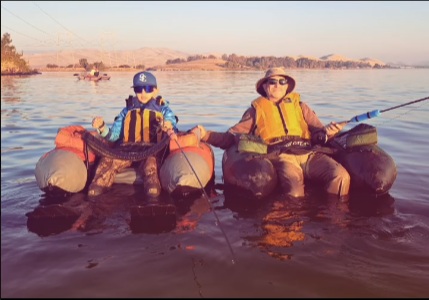
These are primitive campsites so bring your own water. There are tables, sun pavilions, and chemical toilets, or outhouses and fire rings. No open fires are allowed outside of the rings.
Typically we will be camping as close to site 29 as we can get. This is a first come, first serve campground, so no reservations are accepted. Float tubes can be launched near the campsites, but boats must be first inspected, then launched from the San Luis Creek Boat launch. Boats may not be left on the lake overnight. Boaters would be wise to exit prior to the closing of the entry kiosk. The ranger can place a seal on your trailer, allowing you to bypass the inspection process the next morning.
The rangers at the kiosk by the Medeiros entrance may insist that your float tubes need inspection. make sure they’re clean & dry.
Equipment: 8wt rods with fast sinking lines. Some anglers will occasionally use a floating line with a ‘gurgler’ type fly
Flies: Lee Haskins San Luis smelt, ‘Deceiver’ type patterns in red, white, chartreuse, the aforementioned gurglers and poppers.
Float tubes (may require inspection for quagga and golden mussels)
There will be a signup sheet at our September meeting. We’ll also create a list for those hoping to participate in a pot luck in honor of Steve ‘Stosh’ Rudzinski.
Weather conditions can vary dramatically, so it would behoove members to check prior to departure. You could email me or just get conditions on-line. High winds can cause the lake to be closed to all vessels.
This is one of our nearest Fishouts, with the possible payoff of a double digit fish! Don’t miss out!
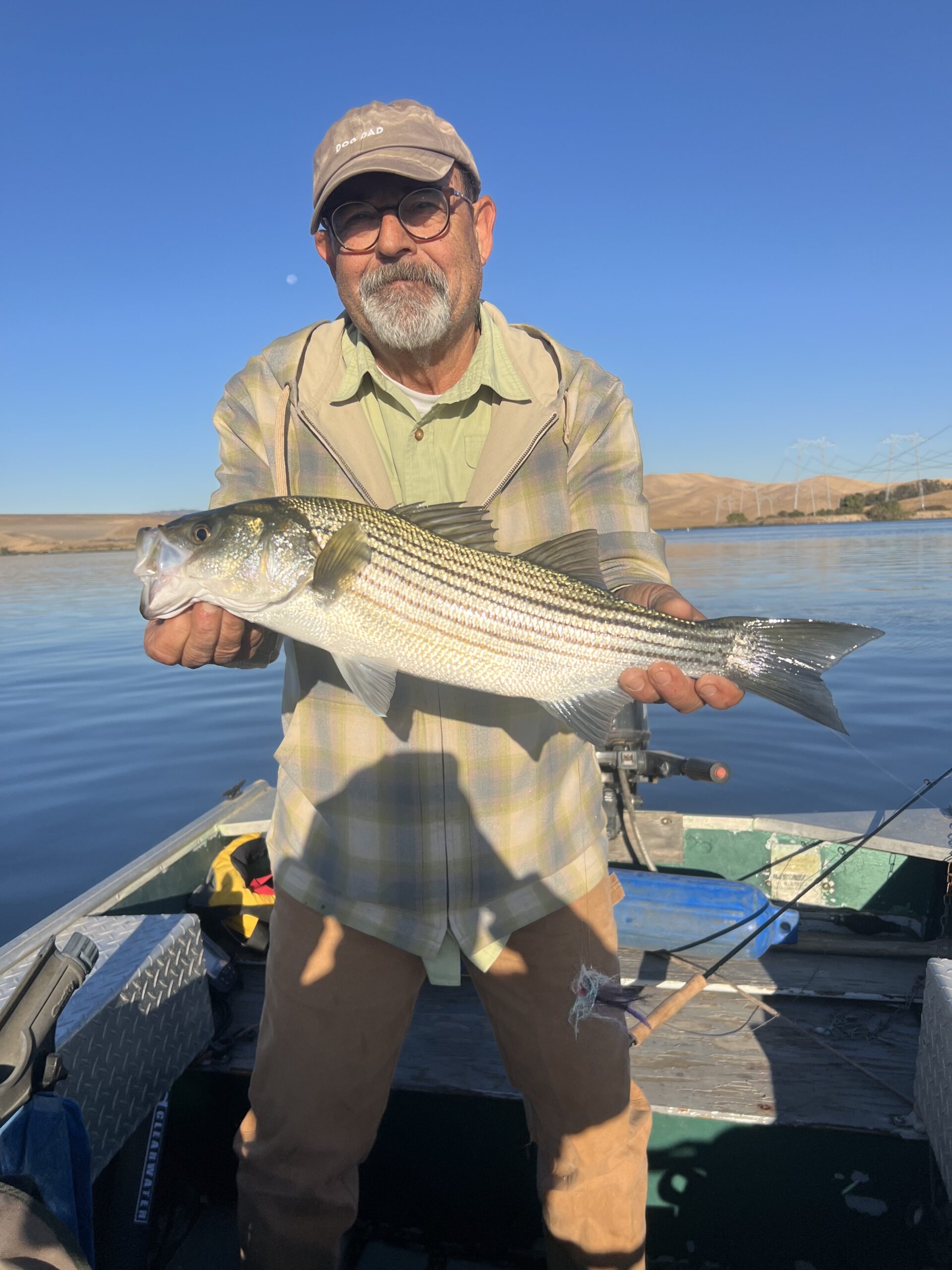
Nov 13 : Trinity River Fishout
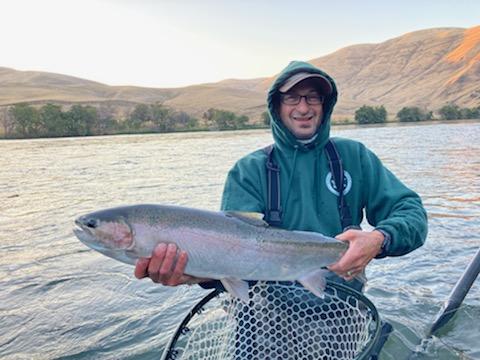
(Click for address and map) Fishmaster:
NOTE: Contact Alex Ferber if you are interested in going on the trip. After knowing how many people are interested, it will be easier to plan logistics (camping? motel?). You can text Alex at (831) 419-0564 or alex.ferber74@gmail.com. If you want to go on this trip, it is highly recommended to attend the Spey Classes.
The fishery:
Basically, this is a Steelhead Trip. There are some resident trout, including some really nice brown trout. I walk wade or float my raft, depending on the river conditions. I personally use a Spey rod to swing flies. Many people use indicators. There are a lot of walk in spots to explore. The river can be floated with rafts or driftboats. There is a shuttle service available.
Tackle:
Single hand rods, 7-8 wt rods, using floating lines with indicator set up. Typical flies used are Egg patterns, Copper John’s, Stonefly imitations like Rubberlegs, Dark Perdigons. Sizes ranging from Size 8-14.
Spey or Switch rods, usually 5-6 wt in the Fall, I use a 7 wt in the winter. Skagit or Scandi heads, with floating to heavy sink tips, depending on the river conditions and season. Flies that work well include leeches, intruders, HoBo Spey, Traditionals, as well as dry fly patterns ( Skaters) in the early Fall.
The River:
The Trinity River is located aprox 1 hr west of Redding on Hwy 299. Its a beautiful tailwater fishery, with flows controlled from the Lewiston Dam. This is where the hatchery can be found. It has many different faces, including some big water as it runs west. It meets up with the Klamath River on its journey to the ocean. It has an excellent run of both wild and hatchery fish, ranging from 5-7 #, with some larger fish in the +10-12 # range. There are fish in the system year round, but typically a push of fish starts in late September and peaks in late November, with a second run usually in late December- March. The fishing remained really good thru the end of March last season. It is very flow dependant and can run quite low in the Fall, with occasional bumps in flows when there is precipitation. It can blow out on occasion, but clears pretty fast.
Amenities:
Weaverville is the closest town, where there are good restaurants, motels and a really nice Holiday Market. It’s kinda the hub. There is an RV park in Weaverville, but no campsites.
Camping is available in Douglas City area as well as Junction City and further west on 299. The town of Douglas city doesn’t have much, other than a small mini mart. Indian Creek Lodge is a few miles east of Douglas City. The town of Lewiston is just below the Lewiston dam. It offers some camping and motels. There is a really nice motel west of Junction City (I believe it is called Steelhead Lodge?). It’s an excellent place to stay if one wishes to fish below Junction City.
IMPORTANT: This class will be taught at the Aptos Grange. Masks will be OPTIONAL if you are vaccinated. NO ZOOM access.
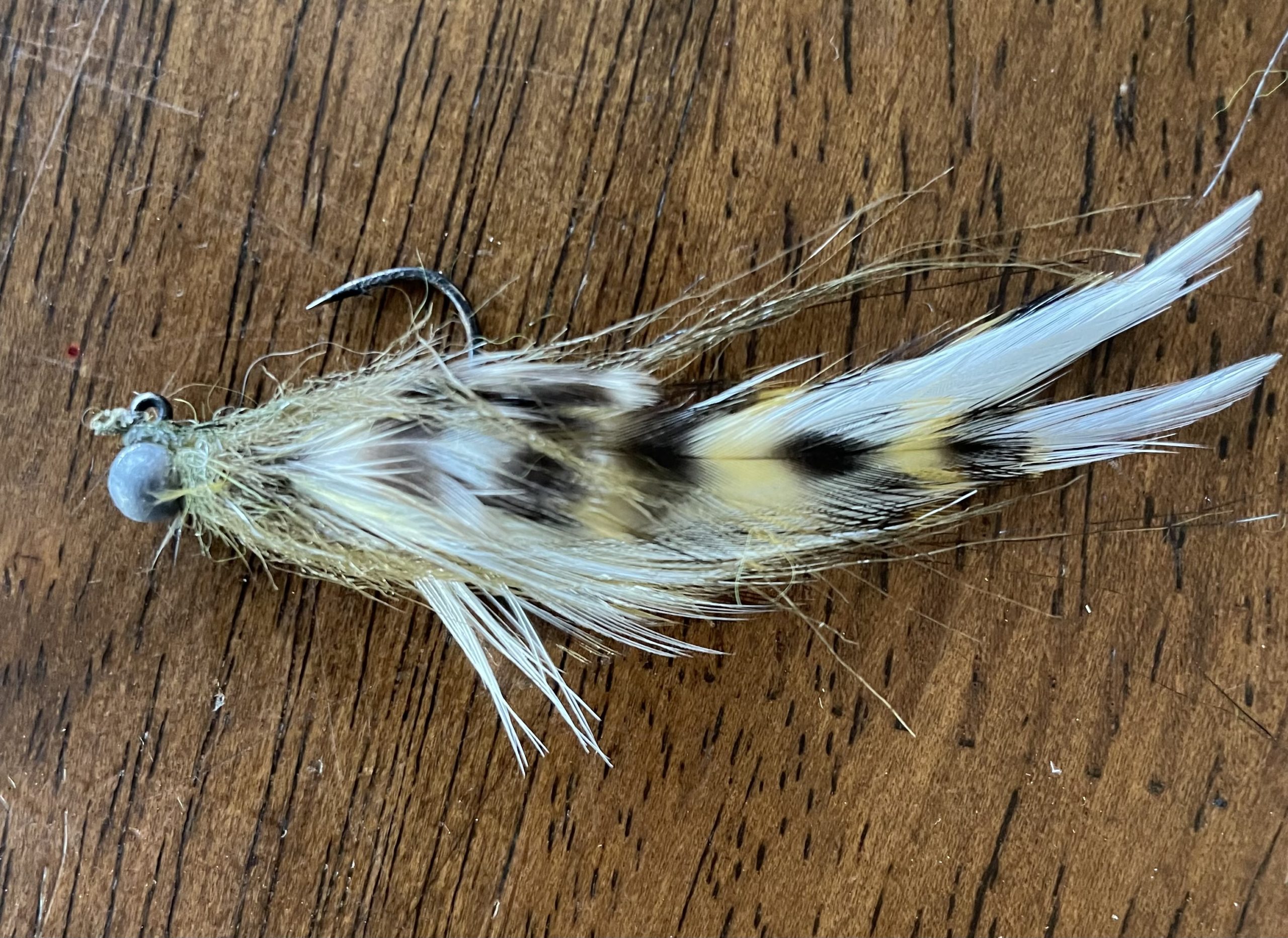
The Fluke Fly is a smaller adaptation of a deceiver. It is tied with deceiver hackle and synthetic materials, on a light jig hook for snag resistance, a slow fall and easy castability. Fished on a floating line near shore or structure, it will sink near the bottom of a lake or pond (where the fish are?) and rise and fall as it is stripped back. The target is black bass and sunfish.
Contact Greg Foy to attend the class. greg@foyconstruction.com
Future tying classes. Dates and subject may change, please go to URL to see the current information.
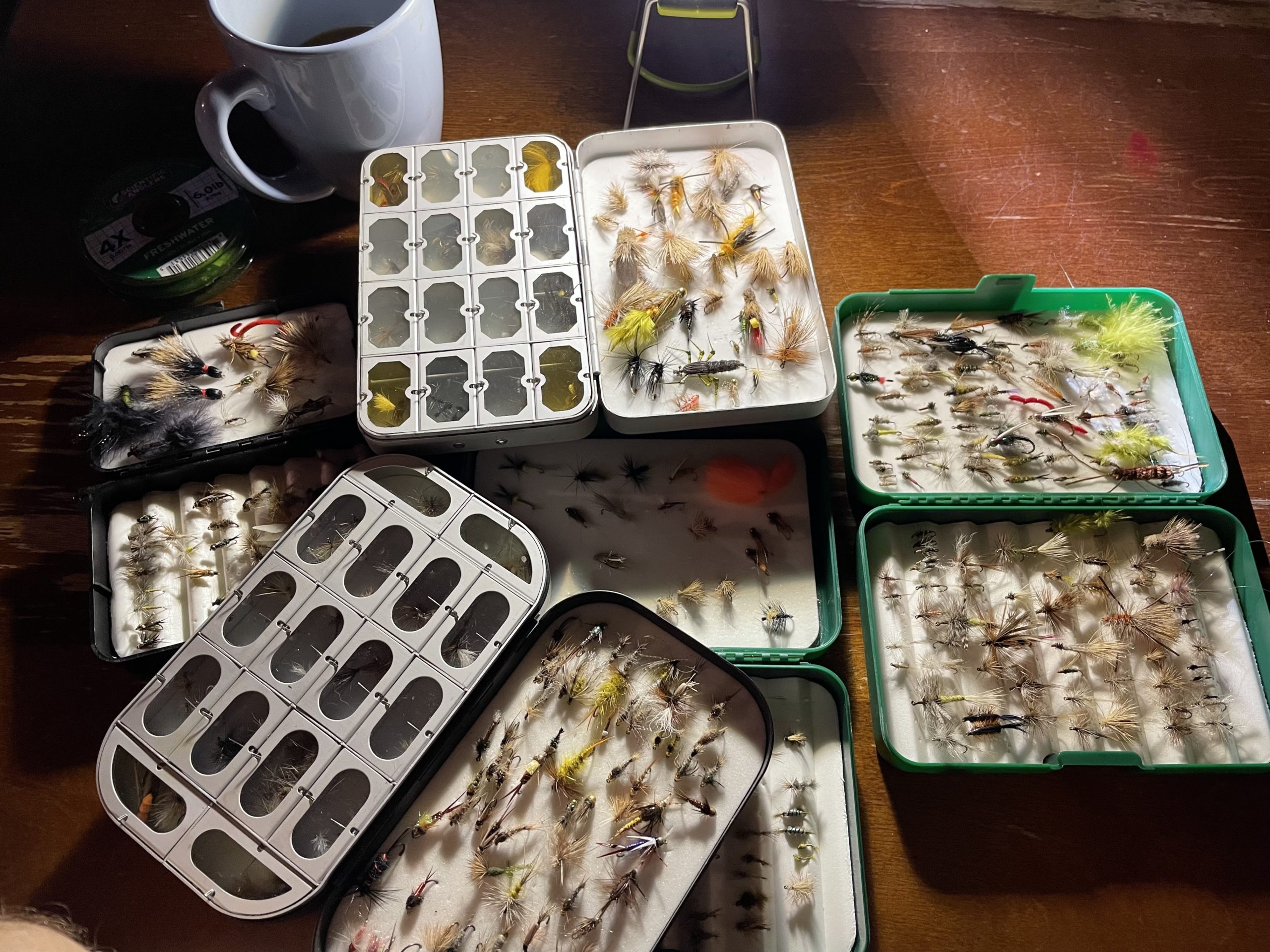
As I sat drinking my delicious coffee on our third morning at Kennedy Meadows, I had all my Trout fly boxes out to look at what I had left that I’d want to throw at the fish the next couple of days. Everything tastes and feels better when you’re in the mountains, especially the coffee. As we fished hard the last few days, the rewards were great, but the sacrifices many. For me it as a few wear marks on my feet from wet wading in sandals, and the loss of flies I’d been doing so very well with.
I love the mornings up here, especially early before anyone else is awake. The only technology to behold was the lantern, the coffee pot and my fly boxes. No rushing to respond to anything. Just the contemplation of what will work next.
This trip was even nicer with the addition of some of our club members and good friends. Scott, Bob, Cecilia, Sophia, and Kathryn. The opportunity to fish together, laugh, eat, and chill by the campfire or coffee together in the morning. We are nominating Kathryn for both the Otter and Alligator award at our Annual Dinner in January. This gal out-fished all of us and carried the battle scars to prove it, first day getting a black eye, from a fall. The next day attempting to cause yours truly to pass out with a hook deep in her finger and that barb she thought was pinched, wasn’t completely, scaring all the bears in the forest as Cecilia tried to help with that pull it out quick with some leader looped around it trick. Then, after landing yet another sizeable fish in a challenging piece of water, decided to go for an early morning swim after nearly donating her rod and reel to the Stanislaus in homage to the fish she caught. The most beautiful spirit and super fun person, who would have stayed the duration if not for the untimely, but perhaps timely, passing of her father who would have wanted her to be fishing and to keep fishing when he departed – which she did, but then headed home as anyone would have done. I am so looking forward to next year already. What a blast we had.
Cecilia using a dry fly
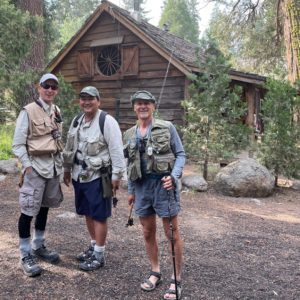
Bob, Scott, Tom
Kathryn Y
A fly box can tell you a lot about yourself, or someone else. It’s not just a box that holds your flies. It could possibly be a reflection of you. At least that’s my observation as I stare into these somewhat organized but deliberate assortments within. Then there’s those other folks. You know; you’ve seen those meticulously organized boxes with dry flies, hoppers, nymphs, perfectly arranged by type, size, weight. Maybe six or more of the same flies all in a row, color coordinated, labeled on the outside, some even stacked in their own fly box holders, ready to be selectively stuffed into a vest depending upon what body of water is being fished. Hundreds of them. And I’m just talking trout boxes. If you’re like me, and you see these fly boxes in a raffle, scoop them up, and after a few years, they never look that way ever again!
My fly boxes are somewhat organized but are a scattered collection no less. Nymphs, attractors, dry fly, wet fly, fly flies and un-fly flies, all together. And while I may have originally had six or more all neat in a row, I’ve fished them, lost them, and usually replaced the empty spaces with different flies. And I don’t have just one box like this. They’re all that way. Probably because if I only had one box, I’d want it to cover top, sub-surface and dredging. Some are even flies I’ve acquired, but never used. Or flies I’ve used and purposely tried not to lose, an attempt to keep at least one of them in the box so I know to either tie some up on a cold rainy winter night or buy some at the next fly shop I visit. Some I’ve used just for teaching because they really look like the bugs they are imitating, or a frog, a mouse. Kid’s love to see that when you open the box and a fly is tied like a mouse – I guess it isn’t a “fly”, is it?!
I know all the flies in the boxes, which ones I’ve used where, and even remember fish they’ve caught. In the latest instance, I had these quite favorable BWO’s (Blue Wing Olive’s) with a trailing shuck for a tail. They were terrifically effective, and I felt they could catch a thousand fish. But I lost my last one on a fish this week, and I couldn’t tell you where in any of my fly boxes there was a space for one, let alone six of them in anymore but one size or two.
Your fly box is also a memory holder. When you open each one, a flood of memories embraces you – hopefully most of them good memories. If you’ve had that fly box for as long as you’ve been fly fishing, the box alone is a memory. You remember when you got it, why, from whom, and with all those flies, you remember the fish, the day, the experience casting that fly, the take, the play, landing that beautiful specimen, and its safe release back into the wild. The high-five you had with the friend with you, or the extraordinary gratitude you had for the gift, the peace and tranquility as you look at all the beauty around you.
No doubt the next time I see a Blue Winged Olive in my fly box, I’m going to remember this trip and especially those who were with us who made it most enjoyable.
See you Wednesday at the Barbeque and Swap Meet – Sherriff’s Posse Hall, Ocean Street Extension.
Hopefully, the 2022 Roster is going to the printer this week and maybe be available WED August 3. The Roster is also available in a pdf file now for those that would like an electronic version for their iphone or computer. Please email me @ robert6367 if interested in a hard copy or the electronic pdf file. We are also planning to add the Roster to Google Drive and it will be available online thru our website . Membership continues to grow with 2 new members a month and is @ 195 current members
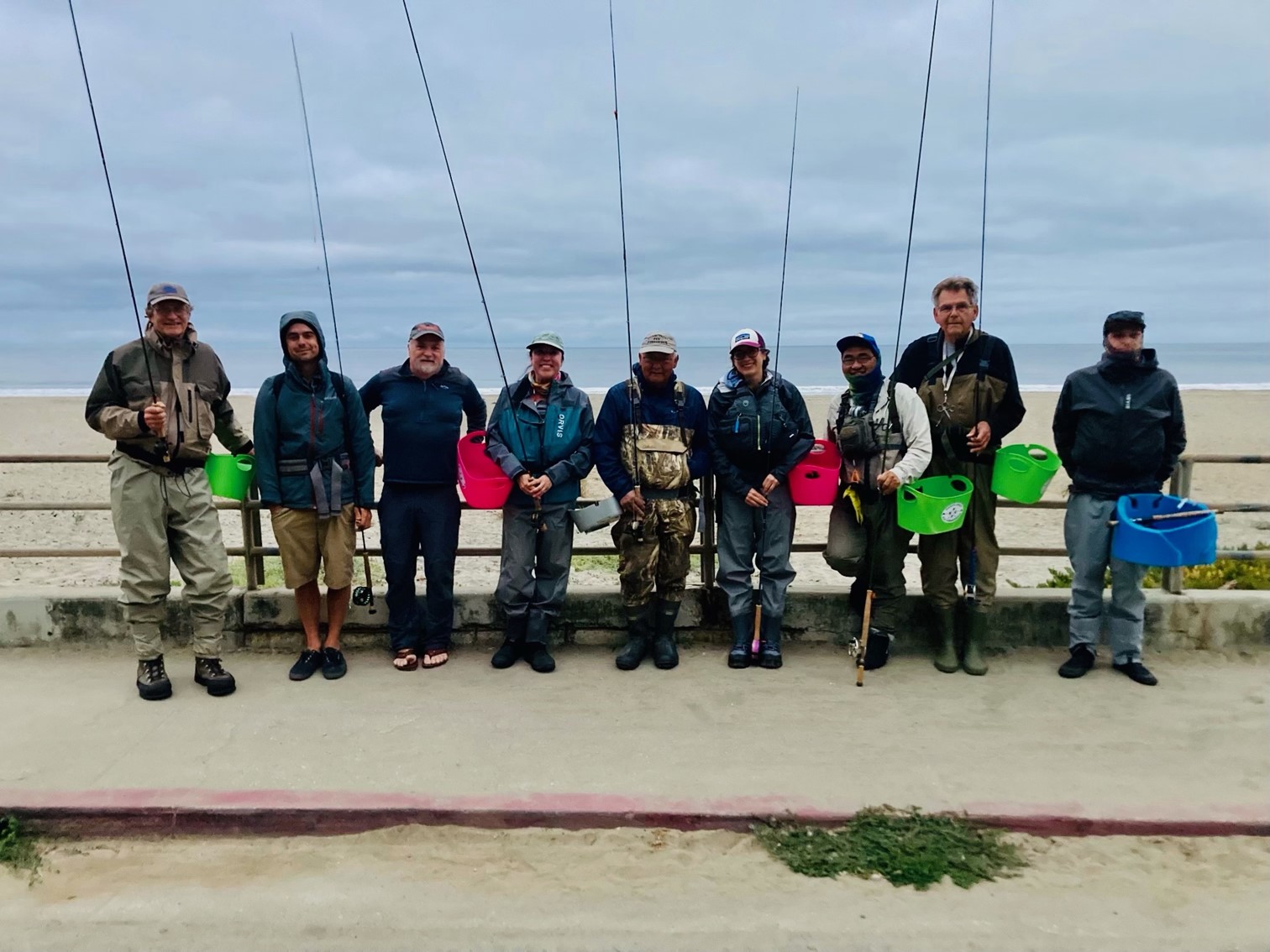
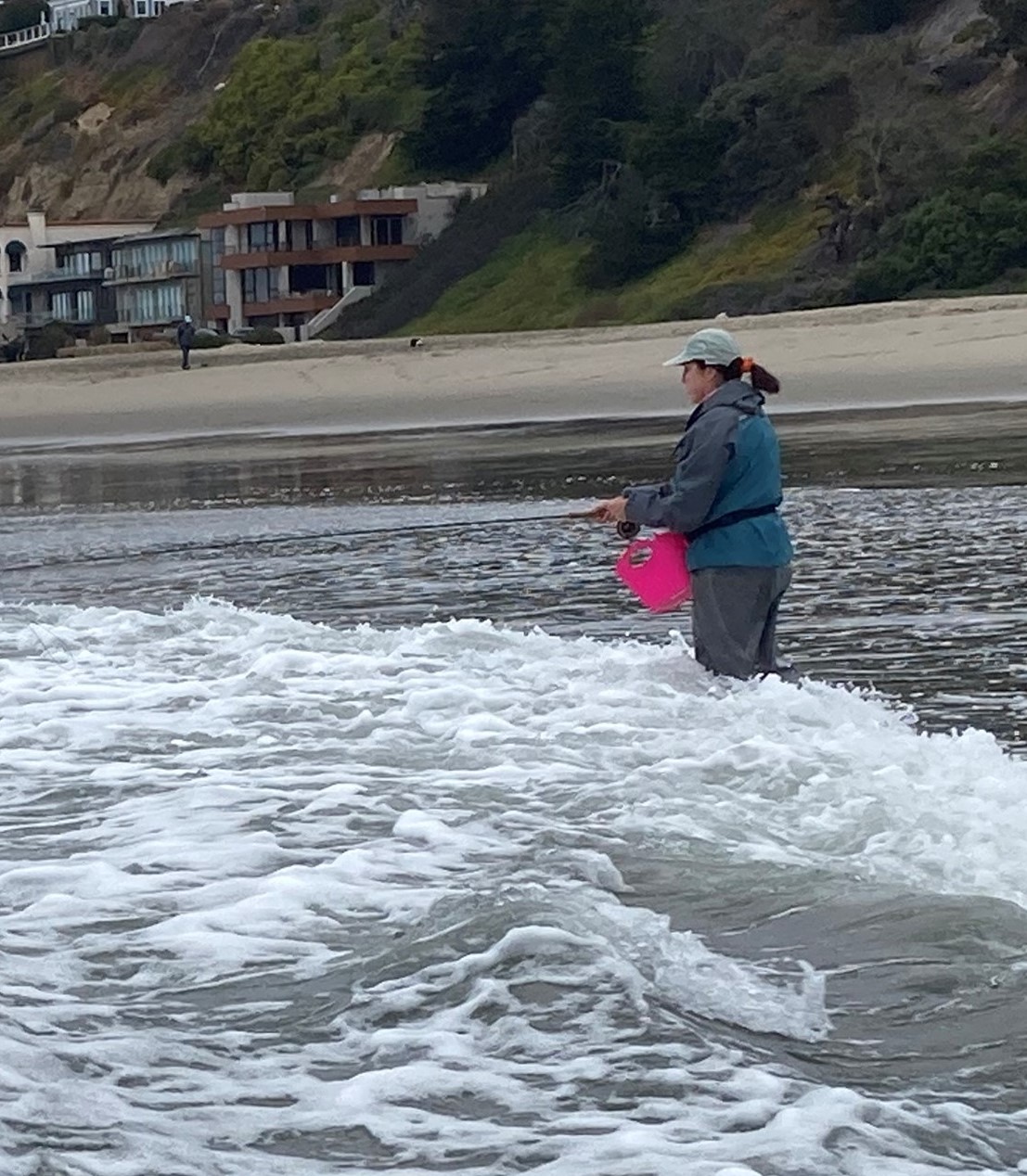
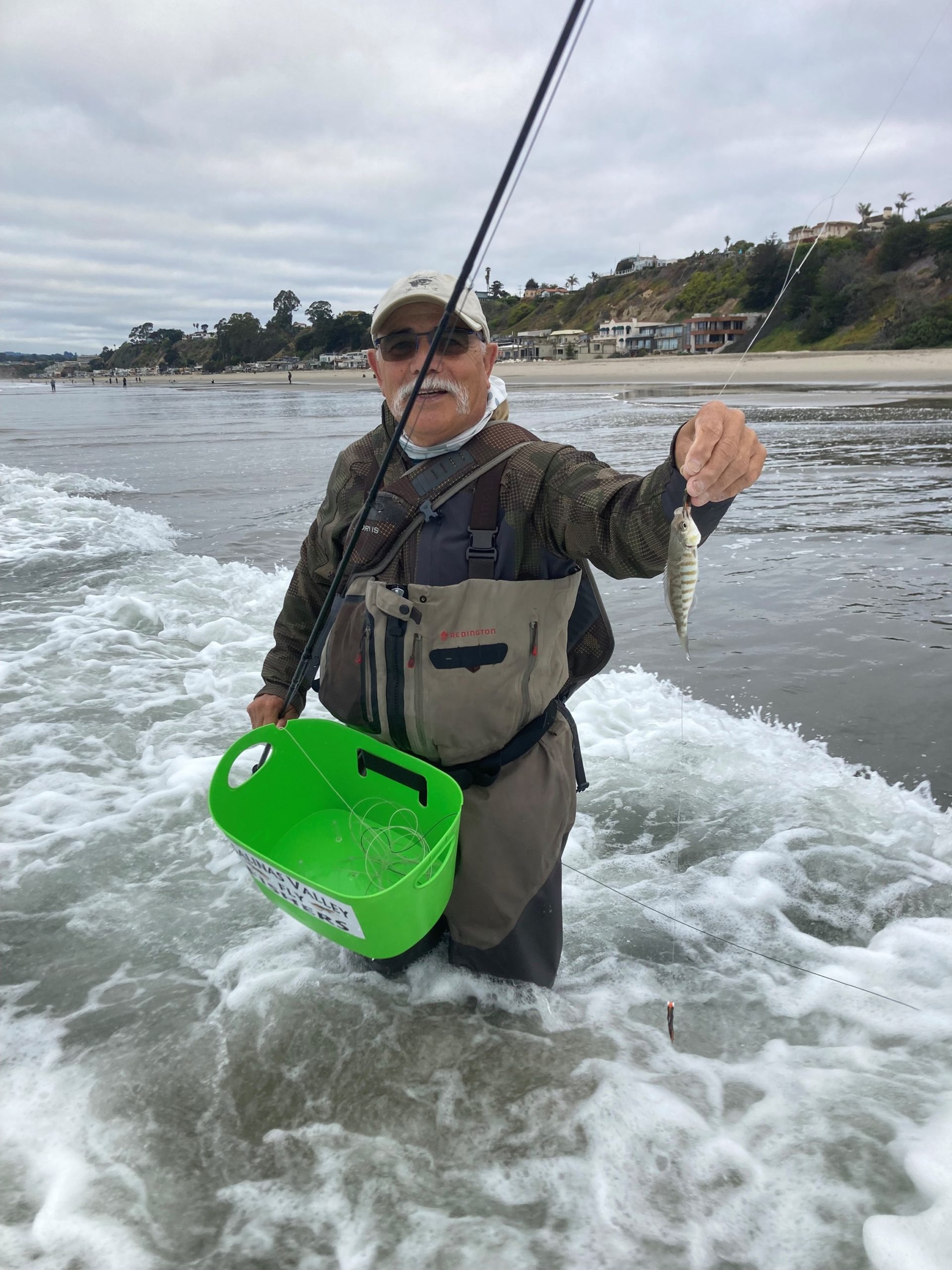
The fish were mostly small, but the dozen fly fishers that came to Rio Del Mar on the Friday before the 4th of July holiday had a good time and most had hookups or fish. Afterwards a few of us had a social time at the Pixie Deli, known for its good breakfast burritos. Three members from the Salinas Club were happy to be with us too, including their President, Elizabeth McCarter (pictured). She and our own Emily Marriott were the damsels amongst us, trying the surf for the first time. Jeff Slaboden is moving to Florida, which is sad for us, because it is likely we won’t see him often for our local fishouts.
Elizabeth (Salinas Fly Fishers)Fred (Salinas Fly Fishers)
Tommy Polito and Scott Kitayama are leading up the August fish-out. Stay tuned for that one!
I think I missed a name or two, but here is the gang that went fishing: Peter Swarzenski, Gordon Cummings, Emily Marriott, Jeff Slaboden, Scott Kitayama, Josh Wilkens, Tommy Polito, Koney Eng, Sam Bishop and from the Salinas Club, Elizabeth McCarter, Wilson Taguinod and Fred Farias
There is a dam on the Truckee River just upstream of Pyramid Lake near the town of Nixon. Numana Dam was built in 1971 to divert water from the river to be used by the Paiute Tribe for irrigation on their reservation. However, this dam was not originally constructed to allow the cui-ui fish to migrate up the Truckee toward Lake Tahoe to spawn. The cui-ui is an endangered fish only found in Pyramid Lake and the Truckee River.
In April the Interior Department approved $8.3 million to support Lahontan cutthroat and cui-ui recovery. The project will include installation of screens to allow the fish to move down to Pyramid and an underwater ramp to migrate up past the dam. For more information on this and how climate change is having a negative impact on fish populations in our rivers, go to the web page.
Planning to travel and fish during Covid has been more challenging due to so many folks choosing an outdoor vacation experience. So we find timing of locations, and reservations a necessity. We so much prefer being nomads. Our first destination in Wyoming, a place we have been to many times, is a sweet lake that we have camped at and fished for many years. It always provides us with wonderful, powerful rainbow trout up to 22”. 2x tippet and 6 wt. rods are a necessity if you plan to land any. No reservations are available on BLM land so timing was imperative. RV and forest service reservation we made in route and arrival late on the 4th was perfect. A short wait and we hade the whole campground to ourselves. Few people fished the lake all week. What makes the lake even more special is that it’s catch and release and when we go a massive damsel hatch occurs. Adult damsel fly patterns are the ticket. The insects are crawling out and hatching all over your tube, and clothing as well on vegetation and the sandy shore. Adults are everywhere and in times in swarms where numerous males are in per suit of a few females. The pursuit is on, looking for backs and tails of sipping trout and getting a fly into their path and fooling them. Such fun! Now just to be different, John likes using big flies, so he wants the wind to come up which is when they will take something different. Well this year he decided to be ridiculous and use a mouse pattern. Oh my, it actually worked!!
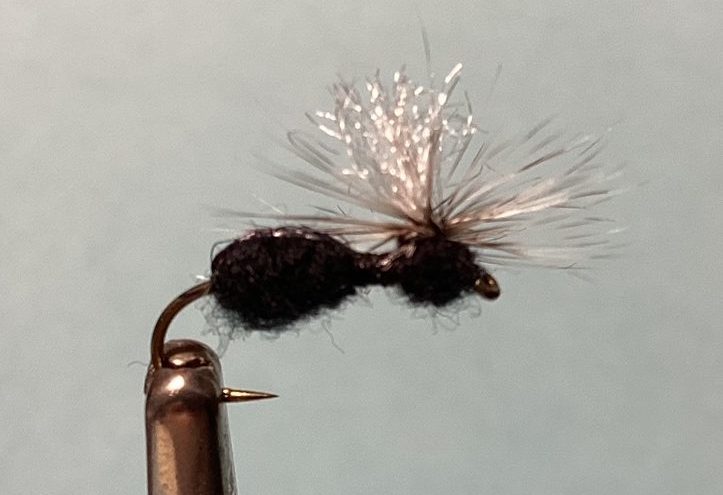
There are many and patterns, most of which are hard to see on the surface of the water. Here is one with a nice white post. Ants are most effective mid summer on and are more available to fish on windy days. Add floatant and fish with drag free presentation. They are good on lakes as well.
HOOK: TMC 100 Sizes 12 to 16.
THREAD: Black 8/0. Attach mid shank OVER BODY: White Antron yarn
Attach Antron to back half of shank and extending to the rear of hook. Note: Antron pieces need to be long enough to go over rear back body and then up as post. REAR BODY: Black super fine dubbing and black permanent marking pen.
Dub a bulbous rear body up to mid shank, no further. Pull Antron snuggly over rear body and tie down. And attach Antron to top of shank with touching wraps forming a narrow mid body, about 1/4 of shank. Note: if tying a size 12 hook, additional touching thread wraps back to rear body then forward again. POST: Continuation of white Antron
Hold Antron upright. Make 4 to 5 thread wraps upward around Antron. Then make 4 to 5 wraps down to base.Make a couple of wraps in front of post to hold upright. HACKLE: grizzly barbs equal to 1 1/2 to 2 times hook gap
Prepare hackle by cutting off fuzzy end then cutting 4 to 5 barbs short at base of stem (crew cut).
Identify shiny dark side of hackle. Position on your side of hook, shiny side facing you, tip to rear, and crew cut at base of post. Tie in place in front and behind post. FORWARD BODY: Black super find dubbing. And some ants have a red forward body, so thread can be changed to red and red superfine dubbing used for this section.
Wrap a small bulbous forward body from eye back to midsection. HACKLE: same feather from above
Wrap thread behind post, then forward, then in front of post, then allow to hang on your side. Using hackle pliers, wrap hackle around base of post about four times , then allow to hang on your side. Bring thread up in front of hanging hackle till parallel to table. Wrap around post and under parachuted hackle about three times. Several half hitches behind hook eye. Cut thread. Cut excess hackle. Cut Antron so that it equals hook shank length. Push up on heckle from beneath hook to be sure it is parallel to table. Trim any barbs that hang below.