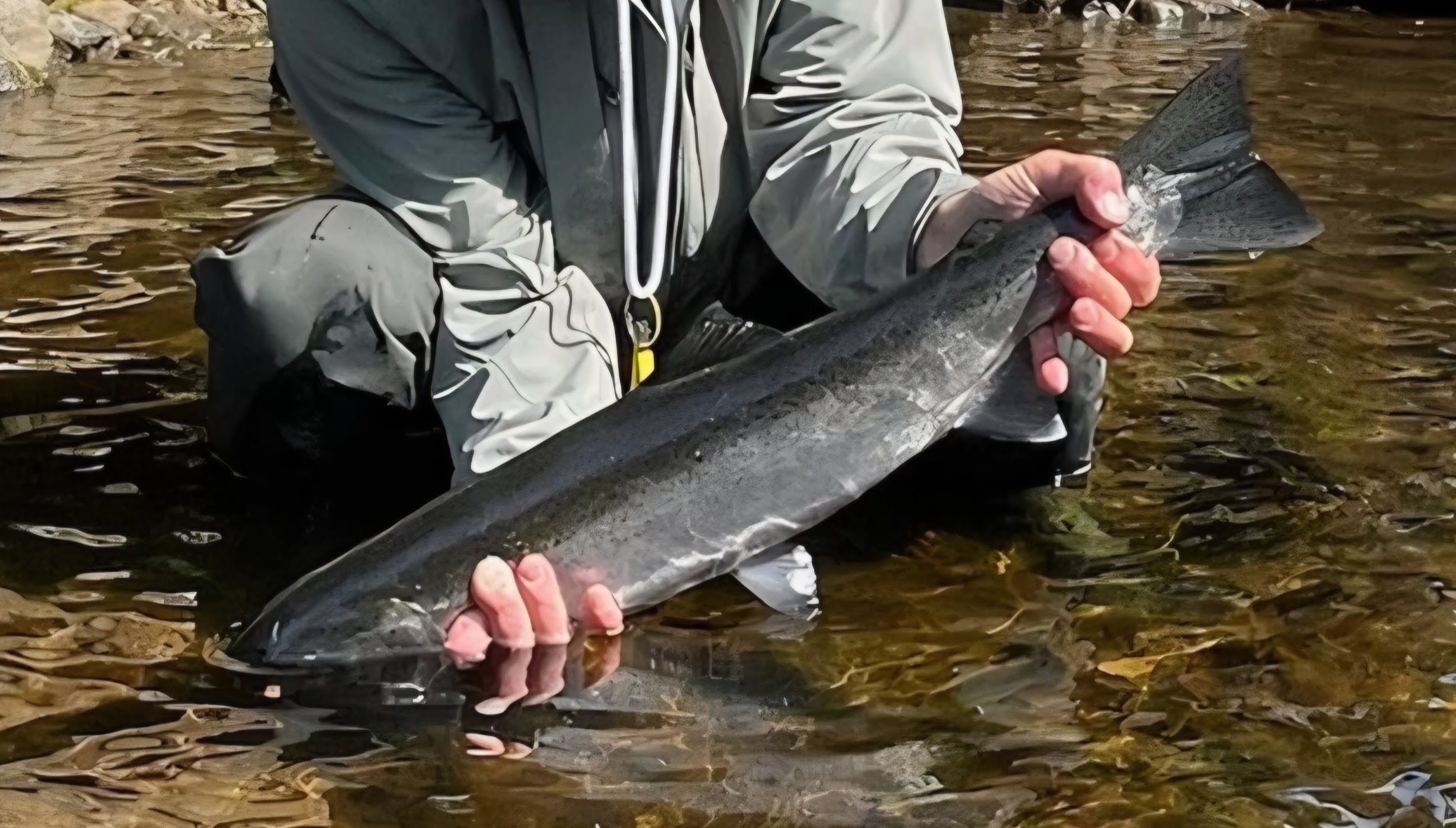
Since the audience of this article is mainly our fly fishing club, I know I’m preaching to the choir. But since steelhead season is approaching in our local waters, I thought I’d advocate for a regulation change. If you’ve put in the hard work and have been fortunate to have hooked up with a wild steelhead on the San Lorenzo River or Soquel Creek, you undoubtedly appreciate how important it is for these amazing fish to be returned to and hopefully continue their journey. A threatened run of coastal steelhead, in an urban watershed with a lot of pressure, is trying to hold on. Our rules already require barbless hooks and release of every wild steelhead. That was a good call. It’s time to finish the job by requiring artificial lures with barbless hooks.
What the rules say now
Per the CDFW regulations, “Only barbless hooks may be used.” Nothing in that wording keeps bait off the water, and this practice has been and is in use: drifting roe, casting spinners, and fishing a pink worm under a float. Every fish is catch and release (the regs allow two hatchery fish to be kept, but there are no hatchery fish), so the question isn’t who keeps what. The question is how many of the fish we release survive.
What the science says
The research on hooking mortality is consistent, and bait is the problem.
- A review of trout studies found that bait-caught fish die at much higher rates than those caught on flies or lures. A secondary summary reports about 31.4% mortality for bait versus 4.9% for lures and 3.8% for flies. A later review put bait mortality at 5 to 10 times higher than flies and lures. nwcouncil
- The anadromous data tell the same story. In compiled steelhead studies, flies came in under 1.0% mortality and artificial lures at 3.0%, while bait fished on barbed hooks reached 9.1% and bait on barbless hooks 5.6%. In Washington, one study of steelhead caught on bait reported 11.0% mortality. alaskaalaska
- Sea-run cutthroat, a close ecological cousin, fared far worse. One study found 40–58% mortality for fish caught on baited single hooks. alaska
The cause is mostly deep hooking. A fish that takes bait often swallows it, and a hook in the gills or throat is far more lethal than one in the jaw. Barbless hooks help, but they can’t fix a hook set in the wrong place. Barbless hooks significantly reduce handling time and damage before release, but don’t significantly change hooking location or wound severity. Lures and flies keep hooks in the jaw. northwestfishingreports
This is a modest, proven rule
We aren’t proposing anything radical. California already uses this exact wording on other waters. Just to the south on the Carmel River, for example, the rules allow only artificial lures with barbless hooks.
We’re also not asking for a fly-only rule. Spinners and other lures carry somewhat more risk than flies in some studies, but the gap between artificial gear and bait is the big one. Lure anglers can keep fishing, and nobody loses access.
Why these two streams
Steelhead here are already struggling with low flows, warm summers, and habitat limits. The Department of Fish and Wildlife already closes these streams when flows drop too low for fish passage, which tells you how thin the margin is. A catch-and-release rule only conserves fish if the fish live. Rules that let a meaningful share of released fish die undercut the purpose of catch and release.
What we can do
- Contact the Fish and Game Commission about a regulation change, or support a petition.
- Talk to your fishing partners. Most of us have seen a fish bleed out on a bait rig.
- Show up and speak at commission meetings.
We hold ourselves to a higher standard than the legal minimum. Let’s make the minimum match.
Posted on October 29th, 2026