Posted on Leave a comment

Locations For Getting Fly Tying Materials

by Elaine Cook – fly tying chairman

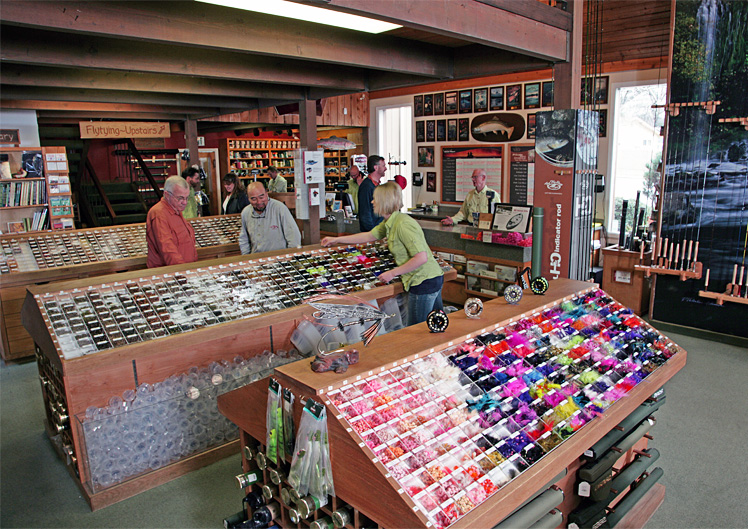
Club members often ask where they can get the materials they need to tie flies. It’s always best to acquire things in person so that you get exactly what you’re looking for. Make a shopping list to use on the road. There are two places that are somewhat local.

  1. Bass Pro in San Jose, but minimal inventory and don’t take orders for other items.
  2. Central Coast fly shop in Seaside. Jeff Malloy is the owner. He relocated his store at the beginning of March 2026 so best to call ahead to check on inventory. 831-298-0690.  Jeff can usually acquire other items that his customers request. His prices are usually very reasonable for local club members. For other companies ordering items over the phone as opposed to online gives you the opportunity to find out if they have  the item in stock and you can ask questions about what you’re looking for. I find that most helpful. Get phone numbers online. List includes amount to spend for no shipping fee.

Other great options that are non-local you can find below:

  1. The Fly Shop, Redding California. Excellent service, large inventory, sell TFS Hooks that are the same as TMC but less expensive. Their thread is not UNI thread instead they sell a flat thread that guides prefer. Quick delivery. $50.
  2. J. Stockard, Connecticut. Excellent service, allow a week for delivery, very large inventory, reasonable prices . $100.
  3. Caddis Fly Shop, Oregon. Excellent service. Moderate inventory, but can usually acquire items in 24 hours and ship right away. No sales tax. $75.
  4. Wind River Outdoor Co., Wyoming. Excellent service , ask for fly tying person. Moderately quick delivery. Large inventory. $50.
    Lost Coast,San Francisco. Excellent service. Very fast delivery. Expensive.
    $100.
  5. The Slide Inn, Montana. Excellent service. Fairly quick delivery. very large inventory. No sales tax. $100.
  6. Blue Ribbon, Montana. Excellent service and guidance when selecting types of hair. Small inventory, but they will take orders over the phone and fill them promptly. Allow a little time for delivery. Always a shipping fee except before Christmas. no sales tax.
  7. Ye Olde Florida Fly Shop, Florida. Good service, small inventory, slow delivery. $15.
  8. Dakota Anglers, South Dakota. Excellent service, quick delivery, always charges for shipping. No sales tax.

Posted on Leave a comment

Joe’s Grey Midge

by Elaine Cook – fly tying chairman

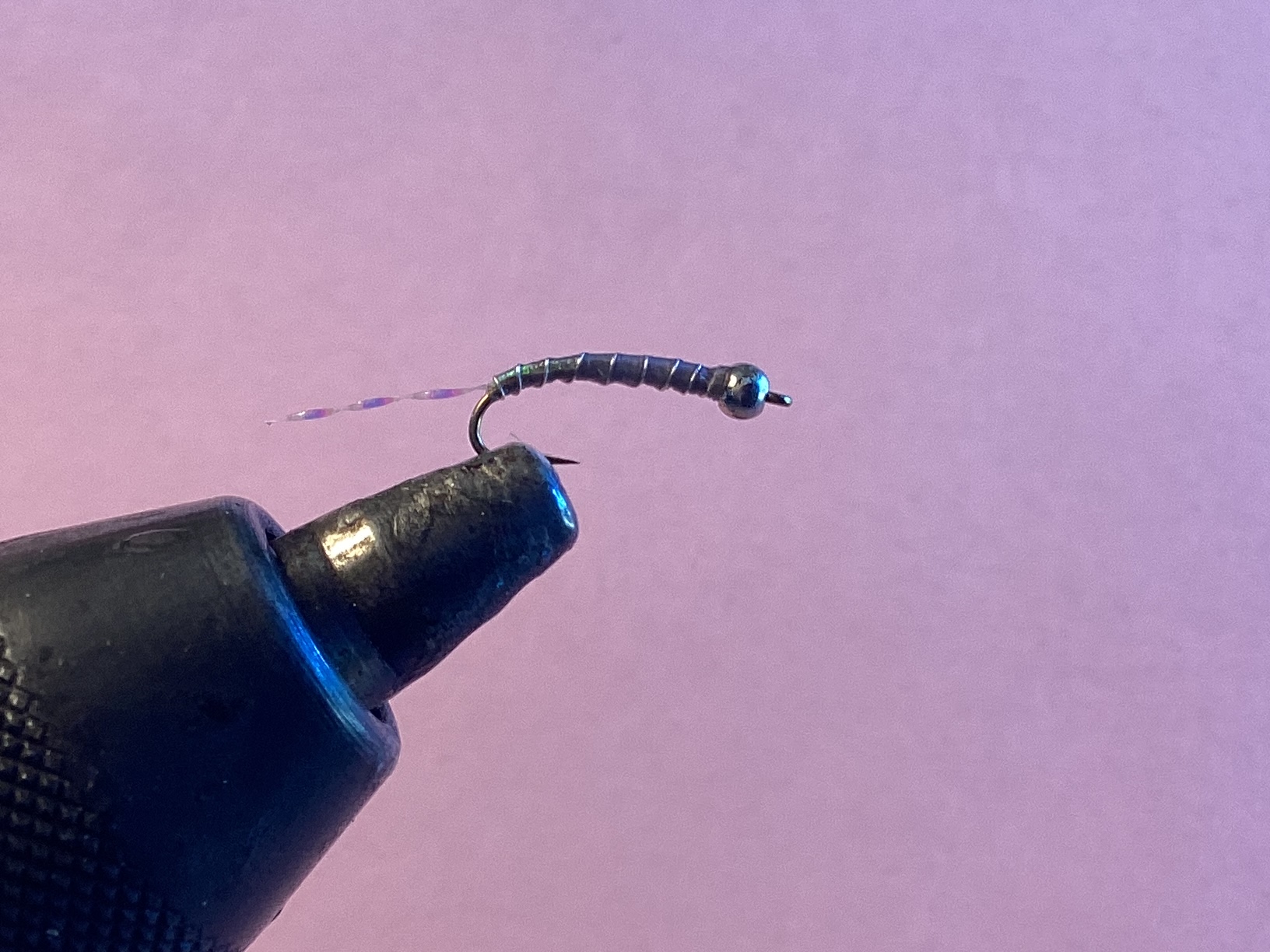
This is an easy fly to tie, so you beginners should feel comfortable attempting it. This fly was designed by Joe Contaldi who is a well-known guide in the Mammoth Lakes area and the fly pattern is used in Crowley Lake. So this should come in handy at the Mammoth fishout next month in September! Midges are a significant source of food for trout, so don’t hesitate to use the fly in other Stillwaters. It is usually fished under an indicator and often with another fly.

  1. HOOK: TMC, 200R.  sizes, 14-16 Crimp barb.
  2. BEAD: small silver.   thread bead onto hook, smaller hole first.
  3. THREAD: grey 8/0.  attach behind bead
  4. WIRE: silver size, small.   Lay on top of shank with butt end into bead.
  5. BODY: thread,  keeping wire on top of shank, touching thread wraps Over wire and shank ending 1/3 around bend of hook.
  6. TAIL: pearl Krystal Flash     With strand extending to rear, tie in tip with a couple thread wraps. Make one thread wrap under extending wire, then one thread wrap between wire and tail, then one thread wrap in front of tail.
  7. BODY CONTINUED: Touching thread wraps back to bead, making a SLIGHTLY tapered body. Spiral wrap wire forward to bead with about 8 wraps. Wrap wire around shank twice then twist wire to cut. Tie off thread behind bead, but don’t bulk up. Cut thread.
  8. TO FINISH FLY: Cut tail to 2/3’s the length of body. Apply  Loctite Superglue to entire body.

Posted on Leave a comment

Guest Article From Friends of the Eel River

by Alicia Hamann (from Friends of the Eel River)

This month’s article was provided by Alicia Hamann, the executive director at Friends of the Eel River–one of the organizations SCFF supports.  The work they are doing is especially important as they are deeply engaged in the effort to remove the Scott and Cape Horn Dams on the Eel river.  Please help their cause by making your comments to the FERC in support of removing the dams:  Caltrout Action Alert.  Be aware that the deadline for comments has been extended to September 18th (not July 24th).

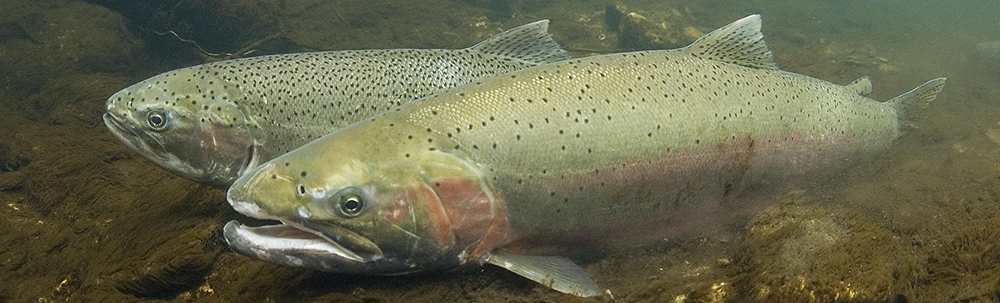
Friends of the Eel River was founded just over 30 years ago to pursue recovery of the Wild and Scenic Eel River, its fisheries, and communities. The Eel is the third largest watershed in the state of California, draining about 3,600 square miles of vast roadless areas and wild landscapes that provide high quality, connected habitat for many species of native fish. Of particular interest to both fishing communities and conservationists are the California Coastal Chinook, threatened under the Federal Endangered Species Act; Southern Oregon Northern California Coho, threatened under both the California and Federal Endangered Species Act; and both winter and summer run Northern California Steelhead, winter run listed as threatened under the Federal ESA and summer run listed as endangered under the California ESA.
The abundant, high quality habitat in the Eel offers incredible potential for restoration of these once abundant fish runs. Over a century ago, at least a million anadromous fish returned to the Eel each year, today annual returns hover around 20,000 fish.
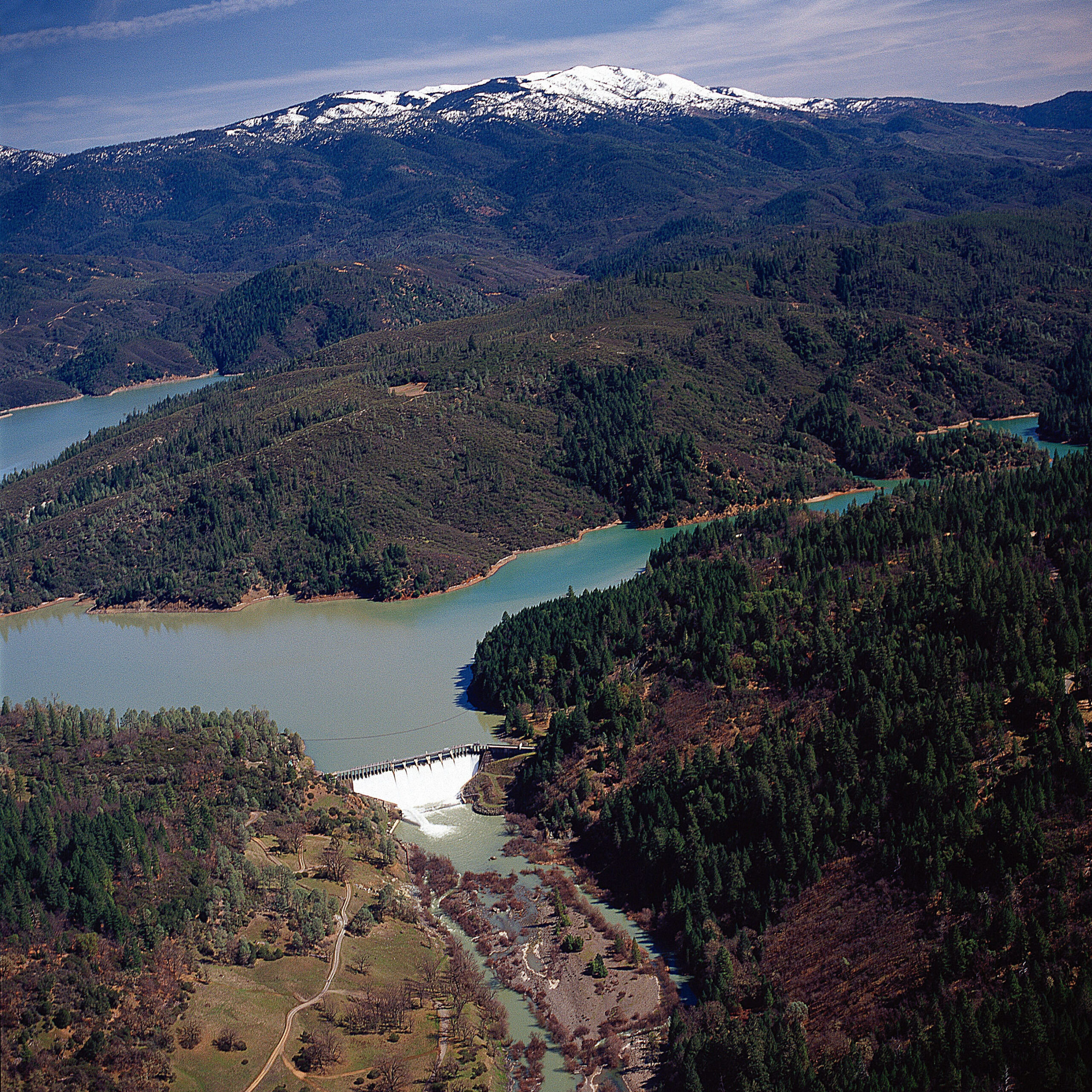
Friends of the Eel River has long focused on removal of the two dams in the headwaters of the mainstem as the most important restoration opportunity in the entire basin. The dams, Cape Horn and Scott, along with an interbasin diversion and a small powerhouse, make up PG&E’s Potter Valley Project. This failed hydroelectric project has blocked fish passage to over 280 miles of high quality, cold-water steelhead habitat since Scott dam was constructed without a fish ladder in 1922. The Potter Valley Project causes harm to the river ecosystem in a number of ways including disruption of the natural flow of sediment, accumulation of methylated mercury in aquatic organisms living in the reservoir, increasing water temperatures in the upper basin, and supporting proliferation of the invasive and predatory Sacramento pikeminnow.
The good news – PG&E is eager to decommission this liability-ridden hydroelectric project. It has not generated electricity since 2021, and even then cost PG&E rate payers far more to operate than the value of the small amount generated. The dams also pose a significant safety risk. Not only are fish living in the reservoir contaminated with dangerous levels of mercury, the century-old Scott dam sits on a major fault complex capable of generating up to an M 7.2 earthquake. This is why PG&E now manages the reservoir at a 25% reduced capacity, in the hopes that it will reduce the risk of downstream fatalities in the event of a major earthquake.
As part of our decades-long work ensuring the Eel River dams will one day be removed, Friends of the Eel River has successfully petitioned to list Northern California summer steelhead under the California ESA, we have led fishing derbies to help eradicate Sacramento pikeminnow (our friends at TRIB Research are hosting one now through Aug 31!), we’ve filed two ESA lawsuits against both PG&E and the Federal Energy Regulatory Commission (FERC), and we have filled the federal record with boat loads of evidence detailing the harms the dams cause and the opportunities presented by their removal.
Despite the ill-conceived interventions of the Trump administration and two Southern California water agencies, the regulatory process for dam removal is moving along. FERC has just commenced its National Environmental Policy Act process to assess the impacts of dam removal and was quite clear in their scoping that there is no realistic possibility to retain the dams.
Friends of the Eel River’s work to protect and recover the Eel extends beyond dam removal. We are also leading efforts to enact meaningful regulation of groundwater use in the lower basin where surface flows are strongly connected to groundwater. We occasionally engage in advocacy or policy work intended to improve water quality, including addressing pollution, inadequate flows, and violations of the Clean Water Act. And of course, we recruit new Eel River fans by doing public education at community events, leading hikes, hosting podcast episodes, and collaborating with a wide network of allies.
In the past year we’ve launched two new programs, first the Eel River Native Plant Network which seeks to connect Tribal Nations, restorationists, and others to collaborate on increasing regional production of native plant materials. When the Eel River dams are removed, restorationists might need as much as 300,000 lbs of seed to revegetate the project footprint. We’re trying to get a head start on collecting and amplifying seed, as well as advocating for the use of native and culturally significant plants sourced from within the region. We’ve also just begun a 3-year planning project to assess and repair crumbling road networks in four areas spread throughout the Eel basin. This project includes training for Tribal staff, NGOs, and rural residents to build capacity for infrastructure maintenance.
You can learn more about FOER or join the tide of dam removal supporters at eelriver.org.

Posted on Leave a comment

Two Good Conservation News Sources

by Bob Garbarino

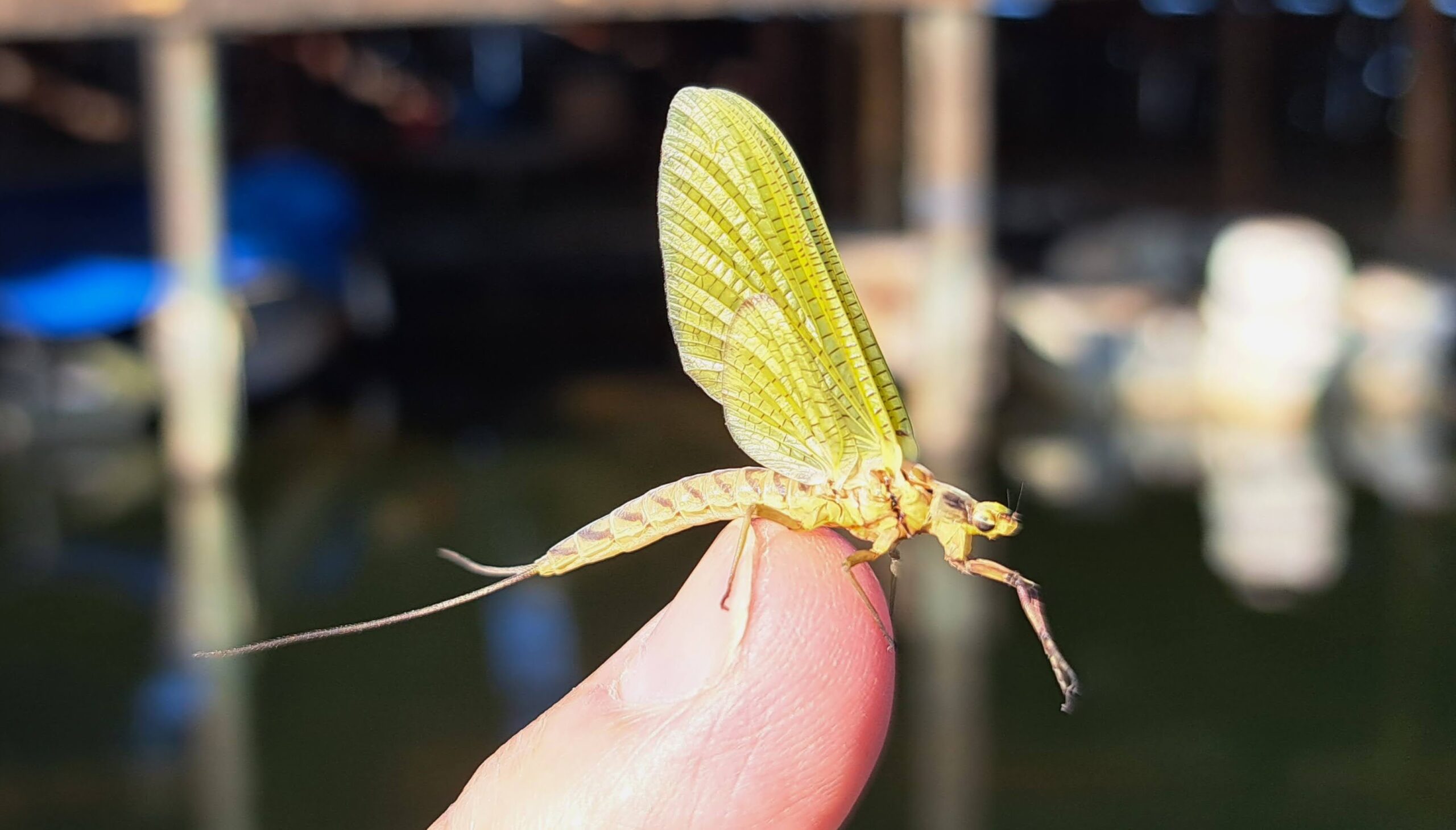
I’m taking this month off as I’m going on a last minute trip to Lake Almanor to get in on the hex hatch. For those not familiar, hex refers to the Hexagenia mayfly.   That yellow bug in the photo for this month’s article is a Hexagenia.  The photo was taken a few years ago at Lake Almanor.

https://en.wikipedia.org/wiki/Hexagenia

I will pass on a couple of sources of information regarding conservation. This one focuses on water issues in our state, Maven’s Notebook…..lots of good articles.

https://mavensnotebook.com/2026/06/19/weekly-water-news-digest-for-june-14-19-is-climate-change-supercharging-el-nino-californias-shifting-snowpack-and-the-growing-water-gap-water-commission-increases-potential-funding-for-sit/

Here are some more fishy conservation article from Fishbio:

https://fishbio.com/blog/

I hope you are able to get out and enjoy some time on a river, lake or the ocean.

Take care,
Bob

Posted on Leave a comment

Trout In The Classroom Project

by by Board Member David South

Trout In The Classroom Project

Are you looking for a chance to be a SCFF volunteer? Would you like to impart some of your knowledge about trout to 4th graders? If so, this program is for you.

Scott Kitayama and I both signed up for the program this year, and I was assigned to Bradley Elementary school in Corralitos and teacher Jen. SCFF members Michael Sherwood & Kaydin Carlsen helped with casting practice at Loch Lomond on fish release day.

Early one morning in February, Joely (a UCSC student volunteer) and I drove up to the Berkeley Marina to pick up the trout eggs for our county. We were met by 300 wild turkeys who hang out there, and a parking lot of full of other fly fishing club members from around Northern CA ( Santa Cruz Co. was the least represented). We met with CA Fish and Game and were given our little pouch of eggs to be kept on ice until distributed to others in our county.

Teacher Jen already had her aquarium up and running for two weeks at the right temp and aeration levels. When Joely and I delivered the eggs some of the kids got to gently place the eggs in the aquarium. Joely and I led the kids through a coloring book that showed the stages of development: spawn, eggs, alevin, fry, to adulthood, and tried to answer all their questions.

The full program set up by SCMBAS (the local chapter of American Fisheries Society) includes, over a period of about 6 weeks, how the classroom can imitate nature: life cycles of trout and other Salmonids, anatomy, diet, habitat, etc.

Mid-April we got the call that the fry were hungry and big enough to release, so I met Jen, her classroom of about 25 fourth graders and some of their parents at Loch Lomond Lake. After a brief talk from the Park Ranger and instructions from Jen, the kids in pairs released a fry in the lake (only about 25 of the original 50 eggs survived to release.).

The children spent the rest of their day having lunch, and a scavenger hunt for other things in nature like birds, banana slugs, insects, reptiles, etc.

If interested, next January/February look for notices in our club newsletter for volunteers, or contact the program directors:

Abigail Ward, Ecology & Evolutionary Biology Dept., UCSC.abeward@ucsc.edu or Sara Hocevar, NOAA QEST Research Fellow. shocevar@ucsc.edu

David South, Board Member

Posted on Leave a comment

Woolly worm

by Elaine Cook – fly tying chairman

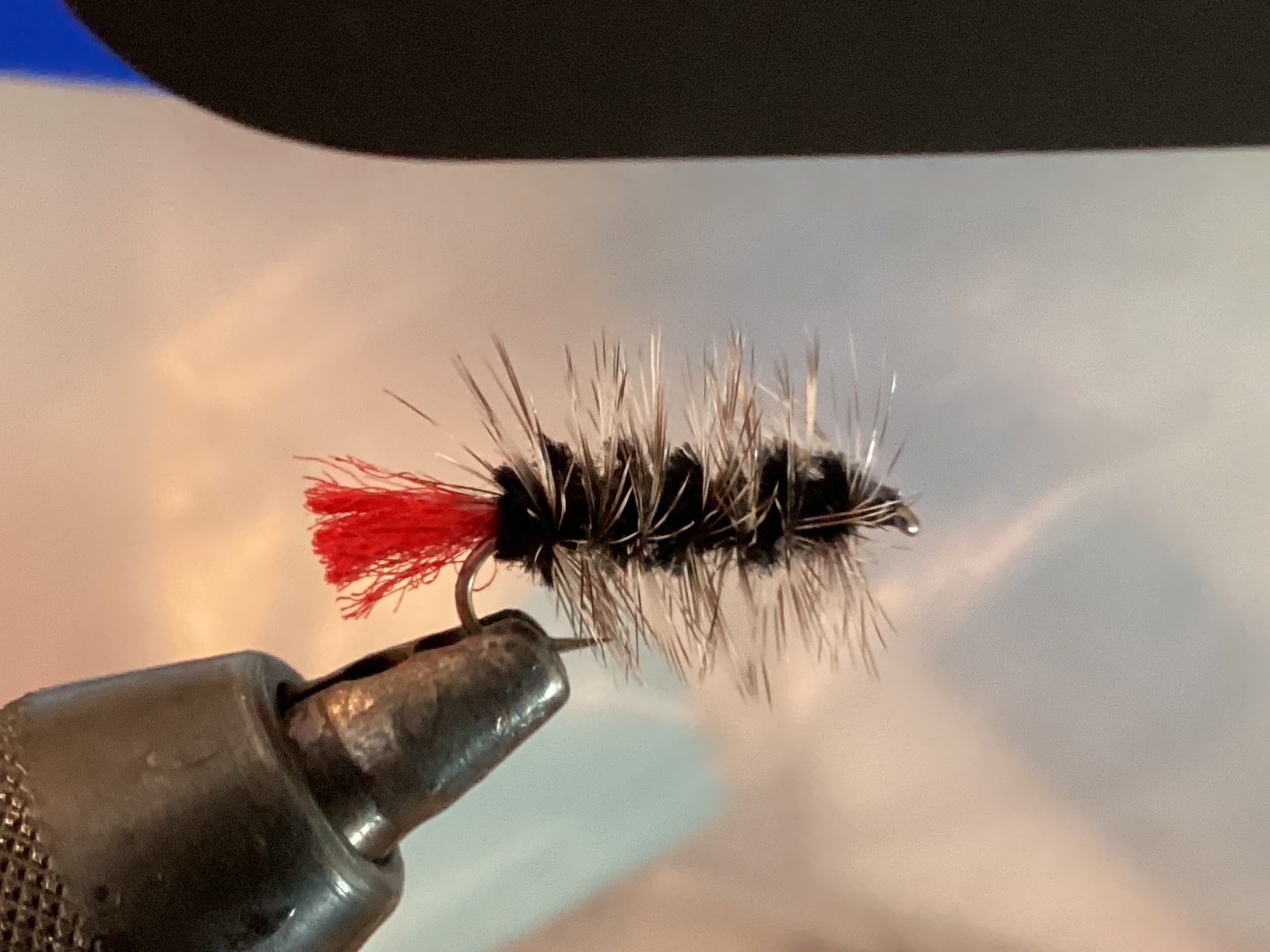
As promised, here is another easy fly to tie. Our focus remains such for several months for you beginners. This fly was originally designed to be fished on the surface for large mouth bass and bluegill. If you add weight, it can be used sub surface for a variety of fish.

HOOK: TMC 5262. sizes 8 to 14.  Crimp barb.

THREAD: Black 6/0 or 8/0 depending on the size of the hook. Attach one eye length behind hook eye. Touching wraps to above hook tip.

TAIL: Red yarn.  Place strand on top of shank with butt end at thread tie in. Tie in place up to butt end and back again to above hook point.

HACKLE: Grizzly (Barbs slightly longer than hook gap). Cut off fuzzy end,/Barbs and butt and against the grain, cut 4 to 5 bars, short on each side of the stem (Forms a crew cut). Lay crew cut on top of tied down yarn, dark side upward, tip to rear. Tie crew cut in place.

BODY: Medium sized chenille, Black or yellow. Pull fibers off end exposing about 1/4 inch of threads. With chenille extending to the rear, tie in exposed threads on top of Crew Cut. Advanced thread to one eye length behind eye.  around shank with touching wraps up to hanging thread. Tie off, cut excess. Spiral wrap hackle forward 6-8 times. Tie off, cut excess.

HEAD: Holding barbs back, tie a small thread head. Tie off ,cut excess, Apply small amount of glue to head.

Posted on Leave a comment

Turning Anglers into Scientists: The Work of The Conservation Angler

by Bob Garbarino

For many of us who have had the opportunity, a day on the water chasing steelhead is measured in memories — the arc of a spey cast at first light, the electric jolt of a grab, the brief, shimmering moment before a wild fish slides back into the river. But what if that encounter could mean something more? What if every fish you touched could become part of a living scientific record helping to protect wild steelhead for generations to come?
That’s the animating idea behind The Conservation Angler (TCA), a nonprofit organization building the science that wild steelhead conservation has always needed — and doing it by putting anglers and guides to work as trained field researchers.
The Problem with Traditional Monitoring
Wild steelhead are an indicator species for the health of entire Pacific Rim watershed systems. But monitoring them at the scale they require has always been beyond what traditional science programs can sustain. Many of the rivers these fish depend on are too remote, too vast, or too lightly resourced to monitor through conventional means. The data gaps that result aren’t just inconvenient — they leave managers and conservationists making critical decisions without the biological evidence they need.
TCA’s answer is to close those gaps by leveraging the people who are already there: the guides, outfitters, and passionate anglers who spend season after season on these rivers and know them as well as anyone alive.
Angler Science in Practice
The key to TCA’s model is that it doesn’t ask anglers to change how they fish. When anglers and guides encounter wild steelhead on partner rivers, trained guides record length, condition, and sex, and collect scale samples for age and life-history data along with DNA clips for population genetics. All sampling is non-invasive, standardized, and consistent across every river in the network. Those samples travel from streamside to laboratory, where scientists analyze them and share findings with agencies, tribes, and resource managers across the Pacific Rim.
Every fish sampled feeds four distinct streams of biological data. Size and condition measurements track growth rates and health trends over time. Scale samples, read like tree rings, reveal how many years a fish spent in freshwater before migrating and how many seasons it logged at sea — a life-history record that documents the structural diversity that makes populations resilient. Genetic samples identify population structure and the mixed-stock risks that can undermine management decisions. And standardized location and timing data reveal how fish are responding to warming rivers, shifting ocean conditions, and altered flow regimes.
Thirty Years of Proof
TCA’s model was built and proven over thirty years and thousands of fish on the intact rivers of Russia’s Kamchatka Peninsula, one of the last places on earth where wild steelhead populations remain largely intact. There, TCA observed that overharvest could overwhelm even the best rivers — but also watched recovery take hold when scientists, guides, and anglers worked together, gathering the long-term data that proved conservation efforts were actually working. The lesson was clear: rigorous science and people on the water, working in partnership, can achieve what neither can accomplish alone.
The Northern Crown
That proven framework now powers TCA’s flagship initiative, the Northern Crown — a coordinated monitoring network spanning wild steelhead strongholds from California to Kamchatka, transforming fishing lodges into research stations and guides into field technicians, creating a permanent scientific presence on rivers that no traditional science program alone could sustain at scale.
The Northern Crown also addresses what TCA calls the “black box problem” in conservation funding. Habitat restoration, barrier removal, and watershed investment require enormous resources and genuine commitment — but without independent biological monitoring, there is no way to verify whether those investments are actually moving the needle for wild fish. TCA provides that audit, translating well-intentioned conservation spending into measurable, documented results.
How You Can Be Part of It
Participation in TCA’s network is open to lodges, guides, and individual anglers at every level. Lodges and outfitters can become official research stations, hosting field kits and contributing to a permanent scientific record for their home river. Guides can enroll in TCA’s field technician training program — no science background required. And anglers can simply book a trip with a partner lodge, fish with purpose, and sign up for TCA’s field data newsletter to follow the science as it unfolds each season.
The next time you feel that unmistakable pull on the end of your line, it could be more than a moment. It could be a data point in a thirty-year story about the survival of one of the most extraordinary fish on the planet.
Santa Cruz Fly Fishing club supports The Conservation Angler and by extension, journal known as The Osprey. Information for this article came from theconservationangler.org. If you know of any steelhead lodges, guides or anglers, pass this on to them.

To learn more or get involved, visit theconservationangler.org.

Posted on Leave a comment

The Other End of the Line

by Bill Seaman

I don’t remember when I started fishing but early family photos suggest I was 4 or 5 years old.  As kids in Coronado, we spent countless hours fishing the San Diego Bay at the boat ramp and numerous Navy piers for anything from bass to sharks. We peeled mussels off the rocks in front of the Hotel del Coronado for bait to catch perch in the surf. I bought a 12 foot aluminum boat in high school to patrol a greater portion of the bay for sand bass. My summer job during college was at Point Loma Sportfishing where boats were sent half day to the kelp beds or all day to Mexican waters for yellowtail, bonito, barracuda and others. Mid-summer, the all-day boats shifted offshore for albacore. My first career job took me to Chico where I took up flyfishing in 1984 and spent significant time on Sierra small streams far from any other people. Adulthood added numerous trips to Baja for tuna, dorado, wahoo and billfish as well as expanding my flyfishing from trout to stripers and largemouth bass.

What every one of these experiences share is the anticipation of participation by fish at the other end of your line. A nibble on bait, a trout rising for a dry fly, stripers stopping your strip with a jolt or unweighted live bait getting slammed and line screaming from your reel as a tuna tests your endurance. Our time on the water requires so much preparation of gear and travel planning, but more than anything, we anticipate that electric jolt that comes from any kind of a strike far from our hands.  We all know the saying, “The tug is the drug!” and how true it is that we keep coming back to experience that connection again and again.

My mother used to request pictures of me that did not include a hat, dark glasses and a fish but like most of us, my albums are loaded with pictures of success.  I sometimes think my most memorable fish are the massive strikes that were never landed. A bluefin tuna I could not boat at the Coronado Islands. An impact bite and screaming run in my kayak in shallow water off New Brighton–big striper, maybe white seabass? Several personal best trout at Crowley in my float tube. A huge Baja yellowfin tuna that spooled my 50 lb reel without ever slowing. And most recently, a striper at the Forebay who was very big and wiser than I. That extra level of what might have been plays over and over in my mind.

Fishing for me is about the outdoors, spending time with favorite fishing partners and catching fish in wonderful settings. But perhaps what constantly takes me back for more, is the anticipation of life impacting the other end of my line and the excitement of what it might be.

Posted on Leave a comment

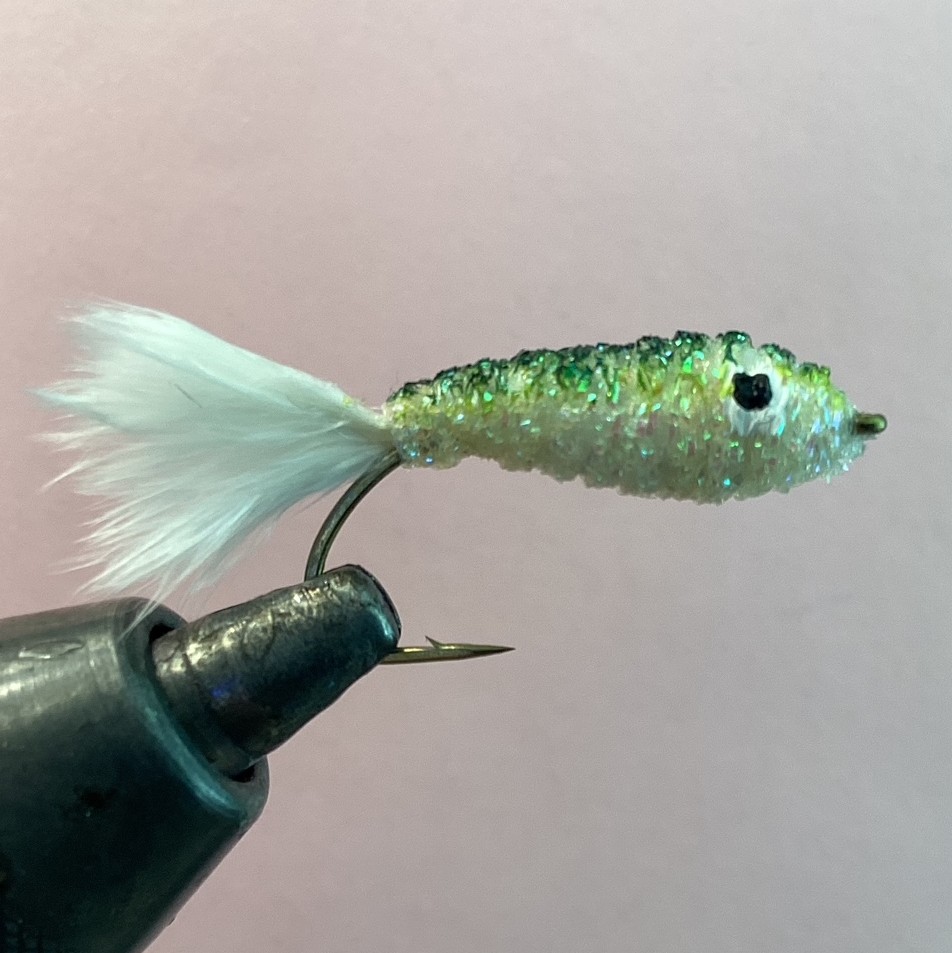
Pond Smelt

by Elaine Cook — fly tying chairman

If your plans are to go to Lake Almanor or Butt reservoir sometime this late spring or during the summer, you might take this fly along with you. This month I refer you to a YouTube demonstration done by Ed Huff, a member of the Mission Peak Fly Anglers. His demonstration is well done and he explains how to fish the fly under two different circumstances. He uses it floating on the surface when fish are pushing the bait fish to the surface and with a sinking line to go for primarily the bass. He has made some material changes which he says have really improved the performance of the fly.
MATERIALS NEEDED:
HOOK: TMC  8089 Sizes 10–12. Lighter weight with wider gape.
THREAD: White flat wax nylon.
TAIL: White marabou
BODY: 2 mm white foam.
AND FOR OUTER BODY: Pearl braid.

ALSO:
Loctite liquid supper glue, or similar.
Sally Hansens clear nail polish
Sharpie pens: olive and yellow
Round toothpick
Acrylic paint: white and black

.


Posted on Leave a comment

Locations For Getting Fly Tying Materials

by Elaine Cook – fly tying chairman

Club members often ask where they can get the materials they need to tie flies. It’s always best to acquire things in person so that you get exactly what you’re looking for. Make a shopping list to use on the road. There are two places that are somewhat local. (1)  Bass Pro in San Jose, but minimal inventory and don’t take orders for other items. (2) Central Coast fly shop in Seaside. Jeff Malloy is the owner. He relocated his store at the beginning of March 2026 so best to call ahead to check on inventory. 831-298-0690. Jeff can usually acquire other items that his customers request. His prices are usually very reasonable for local club members. For other companies ordering items over the phone as opposed to online gives you the opportunity to find out if they have  the item in stock and you can ask questions about what you’re looking for. I find that most helpful. Get phone numbers online. List includes amount to spend for no shipping fee.
The Fly Shop, Redding California. Excellent service, large inventory, sell TFS Hooks that are the same as TMC but less expensive. Their thread is not UNI thread instead they sell a flat thread that guides prefer. Quick delivery. $50.
J. Stockard, Connecticut. Excellent service, allow a week for delivery, very large inventory, reasonable prices . $100.
Caddis Fly Shop, Oregon. Excellent service. Moderate inventory, but can usually acquire items in 24 hours and ship right away. No sales tax. $75.
Wind River Outdoor Co., Wyoming. Excellent service , ask for fly tying person. Moderately quick delivery. Large inventory. $50.
Lost Coast,San Francisco. Excellent service. Very fast delivery. Expensive.
$100.
The Slide Inn, Montana. Excellent service. Fairly quick delivery. very large inventory. No sales tax. $100.
Blue Ribbon, Montana. Excellent service and guidance when selecting types of hair. Small inventory, but they will take orders over the phone and fill them promptly. Allow a little time for delivery. Always a shipping fee except before Christmas. no sales tax.
Ye Oled Florida Fly Shop, Florida. Good service, small inventory, slow delivery. $15.
Dakota Anglers, South Dakota. Excellent service, quick delivery, always charges for shipping. No sales tax.

Posted on

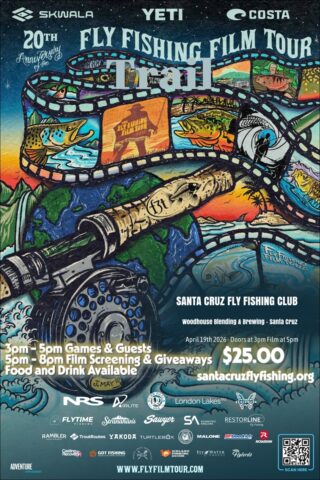
F3T Film – Santa Cruz, April 19, 2026

Apr 19, 2026 3:00 PM at the Woodhouse Brewery
Fly Fishing Film Tour 2026

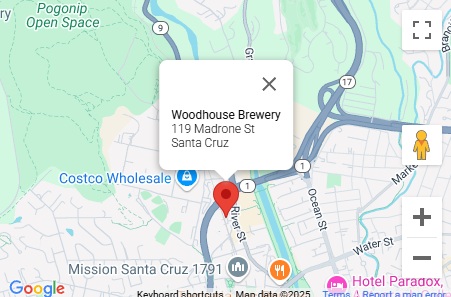
Woodhouse Brewery
119 Madrone St, Santa Cruz, CA 95060
April 19th from 3:00 to 8:00 PM
The 2026 Tour is Proudly Presented by the Santa Cruz Fly Fishing club

The 20th annual FLY FISHING FILM TOUR (F3T) is back on the road for 2026 with a top notch selection of short films that are sure to get you fired up for the season ahead!  The F3T is the original and largest fly fishing film event of its kind and we are proud to be an annual community event for all anglers. Come for the action,  buy a beer and snacks,  and stay for the prizes.  (door prizes and give aways require proof of purchase and or door ticket)

ONLINE PURCHASING IS COMPLETE. TICKETS WILL BE AVAILABLE AT THE DOOR.


More info: https://flyfilmtour.com

Ticket Purchasers:  (as of 4/19)

Andersen,S.,3
Baginski,M.,2
Bishop, S, 1
Bohn,M.,1
Burt, B, 1
Codiga, C, 2
Collins, J, 1
Crosby,M.,1
Dahl, P, 2
De Guzman, N, 1
Del Core, B, 1
Egelhofer, B, 1
Garbarino, B, 1
Gosciminski, J, 1
Goyert, J, 1
Hammig, M, 2
Harris, B, 2
Holombo, R, 1
Hogye, T, 1
Ice, J, 1
Ingraham, M, 1
Johnson, N, 2  (SQ)
Kitayama,S,3
Lavin, C, 3
Lindberg, B, 2
Loomis, T, 1
Lovejoy, M, 2
Malloway, G, 1
Marden,A.,2
Matteson, B, 3
McKee, D, 1
Murdock, K, 2
Naghshineh, D, 1
Nelson, K, 2
Nguyen, C, 1
Quail, G, 1 (purchased by South, D)
Ramsey, R, 3
Salgueiro, J, 2
Schork, L, 1
Severs, C, 1
Smith, N, 2
Wilson, I, 1
Winters, V, 1,
Wright, C, 1
Young, K, 1
Zigman, M, 1


Posted on Leave a comment

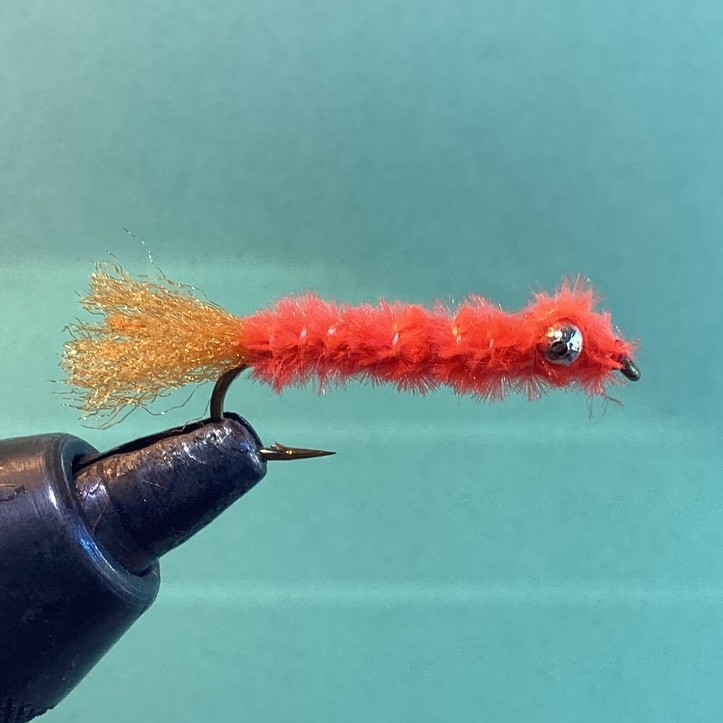
Orange Stick

by Elaine Cook – fly tying chairman

This pattern is a big hit in our local surf. It’s also easy to tie.

HOOK: TMC 5263. Size 6. Crimp barb.
THREAD: Red 6/0. Attach behind eye. Touching wraps to 1/3 back on shank. Then forward to two eye lengths behind eye.

EYES: Silver bead chain, small or medium size, Zap-A-Gap or similar glue.
Cut bead chain into two ball sections. Attached to top of shank with multiple crisscross wraps then circular wraps around under each side of balls but on top top of shank. Pull tight. Then repeat several times. Apply drop of glue. Position thread above hook point.

TAIL: Orange spooled Antron. Using a 3 inch piece, cut in half and stack. Tie in center with two thread wraps. Fold forwards strands to rear. Tie in place back to rear of shank. Cut tail length equal to 1/2 hook shank.

BODY:  Orange medium chenille. Remove fibers from 1/4 inch of center threads. Tie threads to top of shank. Reposition thread to in front of bead chain eyes. Wrap forward with very closely, touching wraps up to big chain eyes. Using snug wraps: wrap forward between top of eyes and down the other side, then under shank to your side, then back over top between eyes, and then down on the far side of shank, then forward under shank between the eyes. Tie off behind hook eye. Cut excess. Cut thread. Apply glue to threads.


Posted on Leave a comment

Caltrout and Its Science Commitment

by Bob Garbarino

In looking for a timely and relevant subject for this month’s Conservations Concerns article, I came across a statement from Caltrout regarding their deep concern over the current administration’s EPA decision last February to repeal the so-called “Endangerment Finding” that was established in 2009. Born out of a robust, comprehensive review of peer-reviewed science, the Endangerment Finding states that greenhouse gases (GHGs) threaten public health and welfare. it concluded that six key GHGs—including carbon dioxide and methane—contribute to climate change, causing severe heat waves, wildfires, and rising seas. This finding serves as the legal foundation for EPA regulation of GHG emissions from motor vehicles, power plants, and oil/gas operations under the Clean Air Act.  The Endangerment Finding gave the EPA the authority to and responsibility to set and enforce the GHG emissions standards. This repeal essentially removes any obligation by the EPA to enforce limits on GHG emissions, which flies in the face an overwhelming body scientific evidence.

I could go on with this and other appalling grievances, but I want to circle back to Caltrout, as it point out climate change is at the top of the list of threats to native California Salmonids. “The endangerment finding reflects decades of rigorous scientific research showing that climate change poses clear risks to both human and ecological systems,” said Darren Mierau, Director of Science at California Trout. “Science continues to demonstrate that warming temperatures, altered hydrology, and declining snowpack are already reshaping California’s rivers and with them our native wild fish. Moving forward, it’s critical that we continue to rely on sound science to guide climate and water policy to protect California’s freshwater ecosystems and the animals and people that depend on them.”
According to Redgie Collins, Vice President of Legal & Government Affairs at California Trout, “Eliminating the endangerment finding is bad policy. Decisions on climate action must be grounded in science and law, not the political whims of those in power.”

Caltrout has a strong commitment to science in guiding public policy endeavors and in implementing projects to revitalize watersheds for wild fish. In August of last year they announced the launch of an new statewide Science Program. This program will add resources to build upon CalTrout’s existing foundation of scientific monitoring and restoration work. The program will be led by a team of four scientists.

The first assignment for the Science Program team will be to update Caltrout’s Status of our Salmonids (SOS) report. This will be the third SOS report which first took place 2008 and repeated in 2017. The SOS report is a rigorously researched assessment of all 32 of California’s native salmon, trout, and steelhead species, resulting in peer-reviewed biological and ecological species accounts.

Key findings by the 2017 SOS Report Caltrout and U.C. Davis :

  • 45 percent of California’s salmon, steelhead and trout are likely to be extinct in the next 50 years if present trends continue. 74 percent will likely be extinct in the next 100 years if present trends continue.
  • Only coastal rainbow trout have a good chance for survival if present trends continue.
  • The number of species likely to be extinct in 50 years increased 180 percent in the last 10 years — from just 5 in 2008 to 14 today.
  • Of California’s remaining salmon, steelhead and trout, 81 percent are worse off today than in 2008.
  • California will lose more than half (52 percent) of its native anadromous (migratory) salmonids, and over a quarter (27 percent) of its inland salmonids in the next 50 years if present trends continue.

It will be interesting to see what the SOS III report reveals when it is published in 2027. Although the challenges are great–especially with the continuing worsening effects from climate change–I’m encouraged by the work of dedicated conservation organizations like Caltrout. Santa Cruz Fly Fishing club supports them with annual contributions and they have been generous with some donated items for our annual fundraiser.

Information for this article was partially drawn from the following sources:

https://caltrout.org/news/endangerment-finding-repeal/

https://caltrout.org/news/california-trout-launches-state-of-the-salmonids-iii-a-once-a-decade-scientific-assessment-to-guide-the-future-of-californias-rivers/

https://www.ucdavis.edu/news/nearly-half-californias-native-salmon-steelhead-and-trout-track-be-extinct-50-years#:~:text=The%20University%20of%20California%2C%20Davis,off%20today%20than%20in%202008.

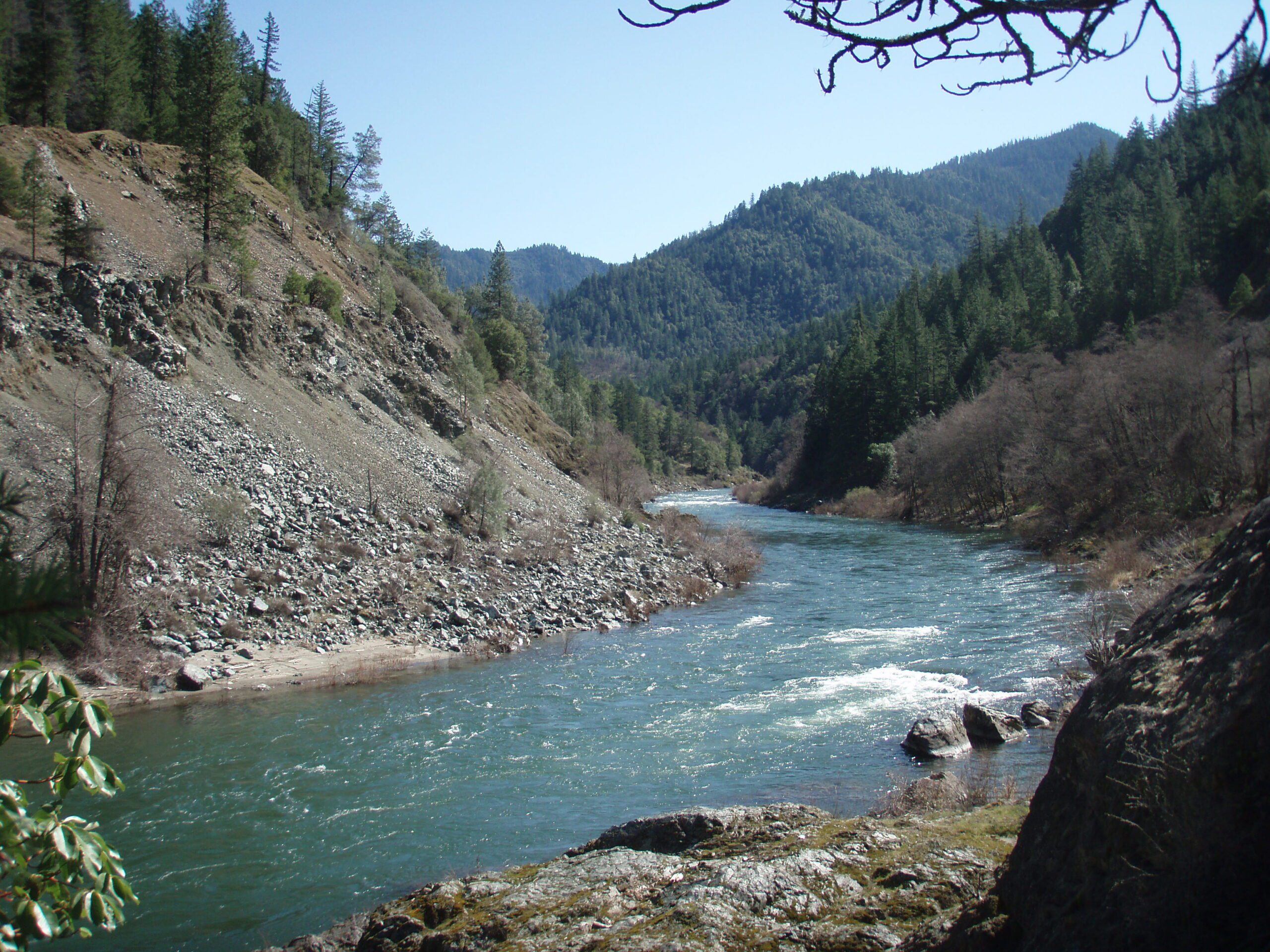
Photo credit: USGS Public Domain

Posted on

F3T Film – Santa Cruz, April 19, 2026

Apr 19, 2026 3:00 PM at the Woodhouse Brewery
Fly Fishing Film Tour 2026

Woodhouse Brewery
119 Madrone St, Santa Cruz, CA 95060
April 19th from 3:00 to 8:00 PM
The 2026 Tour is Proudly Presented by the Santa Cruz Fly Fishing club

The 20th annual FLY FISHING FILM TOUR (F3T) is back on the road for 2026 with a top notch selection of short films that are sure to get you fired up for the season ahead!  The F3T is the original and largest fly fishing film event of its kind and we are proud to be an annual community event for all anglers. Come for the action,  buy a beer and snacks,  and stay for the prizes.  (door prizes and give aways require proof of purchase and or door ticket)

ONLINE PURCHASING IS COMPLETE. TICKETS WILL BE AVAILABLE AT THE DOOR.


More info: https://flyfilmtour.com

Ticket Purchasers:  (as of 4/19)

Andersen,S.,3
Baginski,M.,2
Bishop, S, 1
Bohn,M.,1
Burt, B, 1
Codiga, C, 2
Collins, J, 1
Crosby,M.,1
Dahl, P, 2
De Guzman, N, 1
Del Core, B, 1
Egelhofer, B, 1
Garbarino, B, 1
Gosciminski, J, 1
Goyert, J, 1
Hammig, M, 2
Harris, B, 2
Holombo, R, 1
Hogye, T, 1
Ice, J, 1
Ingraham, M, 1
Johnson, N, 2  (SQ)
Kitayama,S,3
Lavin, C, 3
Lindberg, B, 2
Loomis, T, 1
Lovejoy, M, 2
Malloway, G, 1
Marden,A.,2
Matteson, B, 3
McKee, D, 1
Murdock, K, 2
Naghshineh, D, 1
Nelson, K, 2
Nguyen, C, 1
Quail, G, 1 (purchased by South, D)
Ramsey, R, 3
Salgueiro, J, 2
Schork, L, 1
Severs, C, 1
Smith, N, 2
Wilson, I, 1
Winters, V, 1,
Wright, C, 1
Young, K, 1
Zigman, M, 1


Posted on Leave a comment

Lardo’s Ant

by Elaine Cook – Fly Tying Chairman

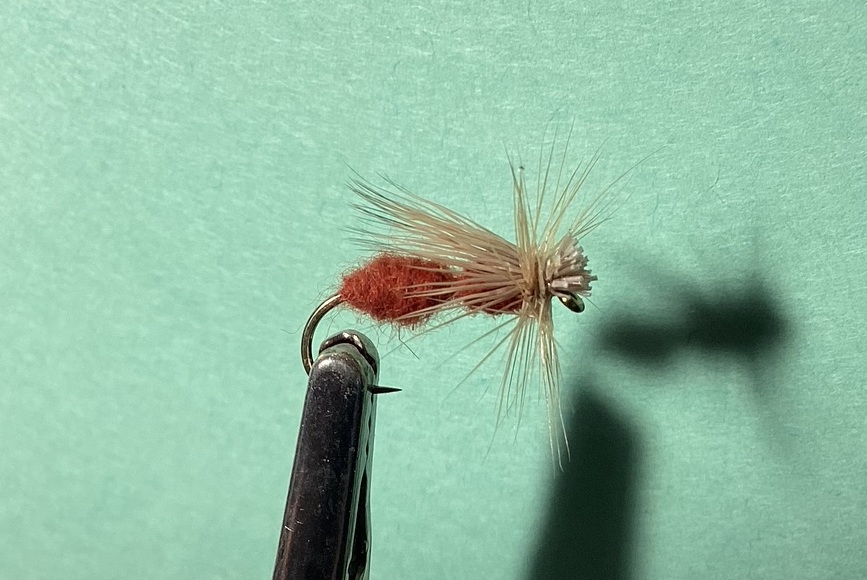
Trout readily eat ants that accidentally end up in the water. There are many patterns around but are often difficult to see. This one will catch your eye because of the deer hair.

1. HOOK: TMC 100 Size 12–14.    Crimp barb.

2. THREAD: 8/0 Cream or tan.   Attach behind eye. Touching wraps to rear of shank.

3.  REAR BODY: Reddish brown, super fine dubbing. If unable to find mix the 2 colors.   Dub and eye shaped round body 1/3 the way up the shank. See diagram for size and shape. Make two touching thread wraps forward.

4.  FORWARD BODY: Same material as rear body. Wrap around body up to one and an half  eye lengths behind eye. Don’t crowd eye. This will be smaller than the rear body. See diagram for size and shape.

5.  WING: Light fine, deer hair. Cut small clump from hide. Clean out under fur. Stack tips. Position bundle on top of shank with tips to rear and above center of rear body. Tie in place with first loop of thread around hair only and second around both hair and shank. Make a couple of snug wraps. lift butt ends of hair and make one wrap under hairs behind eye. Then one more wrap around hair and shank. Cut but ends at an angle. See diagram for the angle and length.

6.  HACKLE: Light ginger, barbs equal to one and a half hook gap. Stroke barbs against grain at butt end. Cut about five or six barbs short on each side of the stem forming a crew cut. Put small drop of glue on top of shank where hackle was tied down. Place crew cut on top of glue, tip of feather to rear and dull side  facing upward. Wrap around shank several times. Tie off, cut excess. Whip finish behind eye underneath deer hair.

Posted on Leave a comment

AI Making It’s Mark on Fish Conservation

by Bob Garbarino

It seems like we are increasingly bombarded with news about artificial intelligence and how it is becoming more a part of our lives. For me, it can be mind boggling and overwhelming how fast AI is growing in capabilities, both useful and downright creepy. Without going too deep into this subject—where there appears to be no bottom—I want to share some news about some useful data collection is being done in the field of fishery management with AI used as a tool.

Klamath River
It’s been about a year and a half since the last dam was opened up to remove barriers to fish passage from the Pacific Ocean to the headwaters above Klamath Lake in Oregon. As part of the comprehensive plan, one of the ongoing efforts is to monitor and measure fish migration in the watershed. To achieve that objective, a diverse group of tribes, CalTrout, California and Oregon Departments of Fish and Wildlife, university scientists , and nonprofits have collaborated to collect data to measure the effects of the dam removal and to help them make decisions on adjustments to their plan as they move forward. Of primary interest of course is information on fish species, numbers, size, and when they pass a given location on the river. CalTrout and members of the Fisheye Project (a group of scientists from Caltech, MIT, and UMass Amherst) are collaborating to use sonar to continuously capture movie-like recordings that are analyzed with the power of AI to produce more accurate data at a faster rate. The Fisheye Project is leveraging off the Visipedia project which was part of the photo ID aspect of the Merlin application that is used to identify birds. The power of the use of AI on this project thus far is to do the manual work which is reviewed by experts in the field. As the machine learning aspect keeps refining, the results are improving where best case accuracy is over 98% and processing speed is about 2 times faster than other methods. In the future the team aims to expand its capabilities to include estimate fish length so they can distinguish between Chinook, Coho and steelhead/rainbow trout. They also are working to achieve real-time updates remotely and improving accuracy.
During the 2025 fall run, over 10,000 fish over two feet in length passed a checkpoint at the former Iron Gate Dam site—a 30% increase from the previous year. While this is just one facet of a complex effort to restore a massive watershed to a free-flowing river, it is a crucial part of the process. One of the vital partners in this effort is CaTrout, which Santa Cruz Fly Fishing supports with annual contributions. SCFF would not be able to do this without all our member support. Thank you for helping revive and protect our precious waters.

Photo credit: Summer Burdick, USGS

Article source and related information:

https://caltrout.org/news/klamath-dam-monitoring-december-2025/

https://wildlife.ca.gov/News/Archive/salmon-everywhere-one-year-after-klamath-dam-removal

Posted on Leave a comment

Western Coachman (aka: Mr. Bill)

by Elaine Cook – fly tying chairman

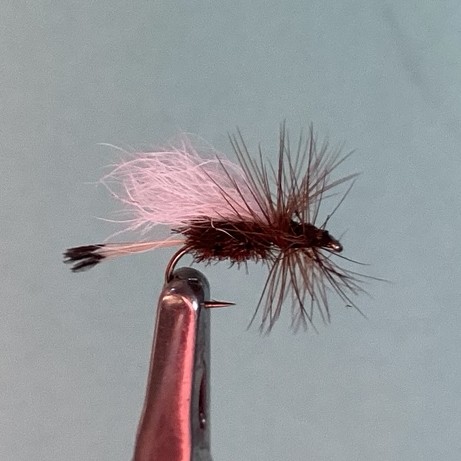
This dry fly for trout is considered an attractor.  It doesn’t look like a specific insect, but resembles many and triggers the fish to feed.  It’s a high floater and very easy to see.

HOOK :   TMC 100 or other standard dry fly hook.  Size 8-16.  Crimp barb.  Directions are written for a size 14 hook. Adjust materials accordingly.

THREAD:   Black or red 6/0 or 8/0.  Apply mid shank, then wrap to rear of shank.

TAIL:   Golden Pheasant Tippets.  Select six tippet fibers.  Lay on top of shank, extending hook shank length beyond hanging thread.  Tie on with two thread wraps, then one under tail fibers, then wrap thread forward to mid shank. Cut excess.

BODY:   Peacock herl.  Two strands, three for larger hook.  Place tips on top of shank where thread hangs.  Thread wraps to rear of shank.  Use dubbing tool to form a chenille. Wrap chenille forward, making a generous body up to mid shank.  Tie off, cut excess.  

WING:  Crinkly white calf tail.  Cut a bunch of hair from hide.  Hold tips and pull out under hair.  Stack hair tips.  Place on top of hook shank with tips halfway between rear of body and tips of tail.  Wrap in place with first wrap around calf tail only then  subsequent wraps snuggly around shank.  Cut calf tail butts at a slant.  Tie down tightly up to eye then back to wing. Apply drop of glue.

HACKLE :   Brown saddle.  Barbs equaling one and a half times hook gap.  Cut 4 to 5 barbs short on each side of stem end.  Tie in place with dull side facing you.  Wrap thread forward to one eye length behind eye.  Wrap hackle about 4 to 6 times forward.  Tie off cut excess.  Using bodkin, place opening over eye pushing back against hackle tips until they are at right angles to the shank.  Make two thread wraps in front of tool.  Remove tool.

HEAD:   Black thread.   Wrap a small thread head.  Whip finish, cut thread, apply glue.

Posted on Leave a comment

Record Salmon Return to Putah Creek

by Bob Garbarino

I never thought of Putah Creek as a salmon stream. I’ve fished it a few times for it’s wild trout it never occurred to me that salmon could also be be found in this watershed. Well, I just found out that last year a record 2,100 Chinook salmon returned to spawn in Putah. As it turns out, Putah has supported a small salmon return over the years. But 2025 was exceptional. So, what were the contributing factors?

  • A 25 year collaborative effort with key partners UC Davis and Solano County Water Agency funded with a $20 million grant.
  • Work to create a salmon passage in the lower creek that was funded by California Department of Fish and Wildlife and Wildlife Conservation Board.
  • Pulsing of creek flow that appears to attract more fish to make their way into the stream to spawn.
  • Habitat enhancement including adding gravel that is required for salmon spawning.
  • Years 2023-2025 were “wet” years in our region, which typically favor increased salmonid numbers.
  • The commercial salmon fishery has been shut down for the last three years.

Most of salmon found in Putah Creek last year originated from the Mokelumne River Hatchery. The team would like to see increased numbers of returning of adult wild salmon.  The hope is the robust 2025 spawn will achieve that goal.

There are other early reports coming out with increased Chinook returns in the Sacramento, Feather and Klamath Rivers. One of the Klamath River tributaries—Fall Creek—had about 65,000 juvenile Chinook counted.

While we can’t control the weather, those that are committed to protecting and growing healthy populations of salmon and other fish recognize that projects to improve floodplain connectivity, provide cold water and habitat improvement (like clean spawn gravel and large wood refuge) can help mitigate the periods of dry years.

Information for this edition of Conservation Concerns was found in the two articles below. For more details, check them out.

https://www.ucdavis.edu/climate/news/record-returns-2100-salmon-spawned-putah-creek?utm_source=The+Fish+Report&utm_campaign=28d2aba8b6-EMAIL_FR_2025_salmon_returns_2026_01_12&utm_medium=email&utm_term=0_4a3609ac31-28d2aba8b6-579602216

https://fishbio.com/right-as-rain-salmon-surge-after-consecutive-wet-years/

Posted on Leave a comment

Introducing Crew26: A Tribe for New Fly Fishers

by Scott Kitayama, incoming Membership Chair

Every fly fishing journey begins the same way—with curiosity, a bit of uncertainty, and the excitement of learning something new. To better support members who are just getting started, the Santa Cruz Fly Fishing Club is launching a new group within the club: Crew26.

Crew26 is designed to be a welcoming “tribe” for those who are beginning their fly fishing journey. Whether you’re brand new to fly fishing or still finding your footing, Crew26 is a place to ask questions, learn together, and connect with other members who are at a similar stage.

What Crew26 Is About

Crew26 will use a mix of informal tools and gatherings—a WhatsApp group, ad-hoc meetups, and occasional Zoom calls—to share information, encouragement, and real-world experience. Topics we hope to explore throughout the year include:

  • Basic equipment without breaking the bank – what you actually need to get started

  • Where to find good online instruction – trusted videos, courses, and learning resources

  • Water safety tips – staying safe while wading and fishing

  • Beginner-friendly club fishouts – what to expect and how to prepare

  • Recommendations of places to fish – local and regional spots suitable for beginners

  • Good catch-and-release practices – caring for the fish and the resource

  • How to take a good fish photo without hurting the fish

  • Recommendations of guides that club members have personally used

  • And anything else the group wants to discuss

This is meant to be a flexible, member-driven space—if there’s a question, challenge, or success you want to share, Crew26 is the place for it.

How to Get Involved

If Crew26 sounds like a good fit for you, here are two easy ways to jump in:

  1. Join the WhatsApp group
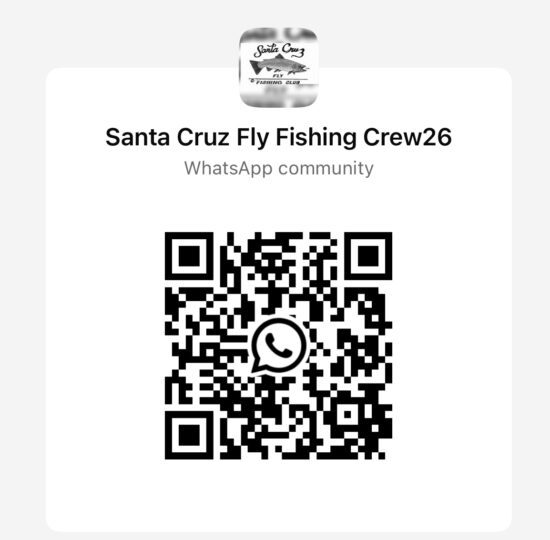
    Scan the QR code included with this article to join the WhatsApp group called
    “Santa Cruz Fly Fishing Crew26.”

  2. Attend the New Member Orientation
    Join us on February 4 at the Aptos Grange for the New Member Orientation meeting. It’s a great opportunity to meet other Crew26 members and learn more about what’s ahead.

More Than Just Fish

Learning how to fly fish—and catching that first (or fiftieth) fish—is often what brings us to the club. But over time, most of us discover that the biggest gift the Santa Cruz Fly Fishing Club offers is to find great fishing buddies and a welcoming community. 

Crew26 is about building those connections early—learning together, supporting each other, and finding your place within the club. We hope you’ll join us and become part of the Crew.

Posted on Leave a comment

Mercury Black Beauty

by Elaine Cook – Fly Tying Chairman

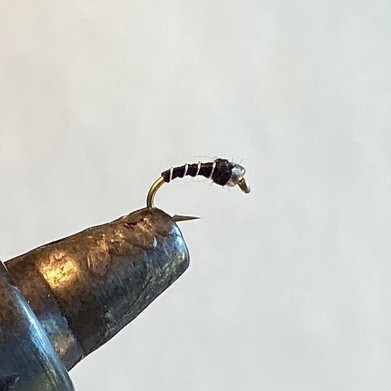
This fly was originated by Pat Dorsey, and represents a midge pupae just before emergence. You would fish this under an indicator in stillwater for trout.

HOOK:  Tiemco 2457 or 2488. Dai-Riki 135 or 125. Sizes number 16–24. Crimp barb.

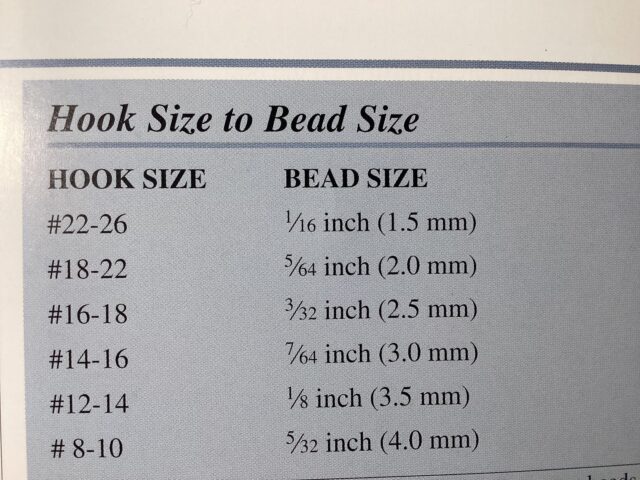
BEAD:  Spirit River Mercury clear glass. The directions clarify the type of bead names and sources. Spirit River Hi-Lite Glass Beads in silver-lined metallic, or transparent finishes. Waspish markets glass beads under the name Killer Caddis. Feed bead onto hook, up to eye.

NOTE: See chart for hook size to bead size:

THREAD:  Black 8/0 or 70-denier Attach behind bead. Touching thread wraps to mid shank, then back to bead.

RIB:  Silver wire, small or fine. Position wire behind bead, leaving an a tag and extending below the fly. Tie in wire, with touching wraps to about halfway back to mid shank. Slowly pull on wire until tag and slides underneath the tying thread. Continue wrapping wire to shank with touching wraps back to above barb.

BODY:  Same thread. Touching wraps back to bead. Touching wraps back-and-forth from mid shank to bead, forming a tapered body. Leave thread hanging behind bead. Spiral wire forward in five wraps the last behind bead. Tie down wire and twist to cut wire short.

THOAORX/BEAD:  Black super fine dubbing. Dub small thorax behind bead. Whip finish, cut thread short.

Posted on Leave a comment

A Plan for Native Fish In Our Local Watersheds

by Bob Garbarino

Water and Native Fish In Our Local Watersheds

Happy Holidays!
After a few weeks of beautiful weather—warm days with nary a cloud in the sky—I must say it’s been wonderful to enjoy these days outdoors, even though there hasn’t been steelhead fishing in our local coastal streams. Even though the flows are low, it’s a good thing the fish aren’t pressured (legally, that is) on streams with low flow restrictions. But we do need rain and so do the fish. So, by the time this article gets published, I hope we’ve had a few good storms. What does the have to do with conservation? If you get where I’m going with this, it’s about water. And when it comes to fish, the abundance and quality of water means just about everything. With this in mind, I have some news I’ve come across recently about a water issue related to native fish in our area that is interesting.

Santa Cruz Watersheds
Last September, the Santa Cruz City Council approved the Anadromous Salmonid Habitat Conservation Plan that was a collaborative effort led by the City of Santa Cruz Water Department, with significant contributions from the Coastal Watershed Council, County of Santa Cruz Water Resources, Resource Conservation District of Santa Cruz County, and San Lorenzo Valley Water District. This plan has been in the works for about two decades. Some of the key aspects of the plan are:

Conserve and restore steelhead and coho salmon populations in the project area in Santa Cruz County.

Restore fish habitat. Examples are the placement of logs in San Vicente Creek and removal of invasive plants by the Resource Conservation District of Santa Cruz County.

Increase flows in streams to allow fish safe passage.  Under the plan the water department will be allowed to take less water from the San Lorenzo and other area streams. Included in the water diversion plan are limits on the amount that can be drawn based a number of factors that are tied to the flows and the fish life cycles. The plan also calls for the sharing of water between Santa Cruz, Scotts Valley and Soquel Creek water districts. Well and aquifer storage is also part of the plan.

Mitigate negative impact of maintenance and other water department activities on fish.

Repair and improve water diversion infrastructure.

The plan is a thirty year strategy budgeted at $36 million.

There have been some encouraging observations of steelhead and coho in Mill Creek and San Vicente Creeks after the removal of the dam on Mill Creek in 2021. However, we’ll see if there are any appreciable improvements in the San Lorenzo River watershed in the future. With all the large scale housing projects that are being built and planned, more demands for water use are inevitable. And we can surely expect drought years will occur and possibly increase. So, as the Anadromous Salmonid Habitat Conservation Plan is well intended, there are still significant headwinds facing our native fish.  I do appreciate the efforts led by Chris Berry, watershed compliance manager for the Santa Cruz Water Department who has been working on this plan since 2001. Some of the local organizations like the Coastal Watershed Council and RCD of Santa Cruz County and the work they do also gives us reason for optimism.  Let’s hope they succeed!

Some of the information in this article came from:
https://www.santacruzsentinel.com/2025/12/11/santa-cruz-rethinks-water-use-to-conserve-coho-salmon-save-steelhead/


Posted on Leave a comment

2026 Dues Reminder

by Bob

Three ways to renew 2026 dues.
1.  Online  at santacruzflyfishing.org—can use email and password. Email me if you need help with password.
2.  Can always mail check to SCFF, PO Box 2008, Santa Cruz, Calif, 95063
3.  Can invoice you if you email me at Robert6367@aol.com.
New members from 7/1/2025 do not have to renew for 2026 and have 18 months of membership
To date, less than 50% of members have not renewed and should you need help please contact me.
Posted on Leave a comment

December is open membership dues renewal

by Bob

Just a reminder 2026 dues can be renewed online  at santacruzflyfishing.org
Also members who have paid will receive a thank you email from WordPress(our technical portal support software) and a reminder email if you have not renewed.
Please email/ text me if you have any questions.

Bob/Membership/ robert6367@aol.com cp831-251-8655

Posted on Leave a comment

Thankful Conservation

by Bob Garbarino

Because this newsletter is going out around Thanksgiving, I thought it would be a good time to write about being thankful with a conservation twist. Often when I’m out fishing, I’m so focused on all that goes into the goal of catching, I forget to stop and take a deep breath and take in the amazing environment surrounding me. And as I get older, I recognize that it’s a good idea to be thankful for just being able to get out and enjoy the outdoors. For me, thankful conservation comes from recognizing the benefits nature provides and expressing gratitude for nature by engaging in conservation efforts. Here are a few thoughts to consider.

Reasons to be thankful for conservation
Habitat and fishery protection: Conservation groups work to improve and protect streams and rivers, which is essential for healthy fish populations.
Education and mentorship: Organizations help educate new anglers on the sport and the importance of conservation.
Public access: Many conservation efforts focus on protecting and maintaining access to public lands and waters for fishing.
Sustainable practices: Conservation promotes practices like catch-and-release, which helps ensure fisheries remain viable for future generations.

Support Conservation organizations (good examples are the ones SCFF supports-here are a few)

Trout Unlimited (TU): Works on stream restoration, habitat improvement, and engaging new generations of conservationists through programs like 5 Rivers.
CalTrout: Works to revitalize waters for resilient wild fish in California.
Coastal Watershed Council: Mission is to transform the lower San Lorenzo River into a community destination by inspiring people to explore, enhance and protect this critical natural resource.
Monterey Bay Salmon and Trout Project: Dedicated to the recovery of native salmon and steelhead populations of the greater Monterey Bay region.
Carmel River Steelhead Association: Active in the restoration and conservation of the federally threatened steelhead fishery on the Carmel River and its watershed.

How to get involved
Donate: Support conservation organizations financially to help fund their projects.
Join a local club: Participate in local clubs like Santa Cruz Fly Fishing to contribute to conservation in your area.
Volunteer: Get hands-on experience by volunteering for stream cleanup or restoration projects.
Practice catch-and-release: Adhere to catch-and-release principles to help protect fish populations.


“If the only prayer you say throughout your life is ‘Thank You,’ then that will be enough.”–Elie Wiesel

Posted on Leave a comment

Annual fundraiser Sat Jan 31st, 2026

by Bob Peterson

Jan 31 5:00 PM at the Pajaro Rod and Gun Club

ANNUAL DINNER & FUNDRAISER
 Wild Alaskan Salmon BBQ
 with Hors d’Oeuvres to Start the Evening

Saturday, January 31
 5:00 – 9:00 PM 
Door Prizes and Silent Auction

Pajaro Valley Rod and Gun Club
   557 1/2  LAKEVIEW RD. , WATSONVILLE

Dinner Tickets

Tickets are $50 and can be purchased at the November, December, and January club meetings or online in the form below.
Capacity is limited to 180 guests, and we expect to sell out—please purchase early.

Alcohol

The venue offers a full bar with reasonably priced wine, beer, liquor, and soft drinks.
You may bring your own wine; however, a cash-only corkage fee will apply, which includes opening and glassware.

Volunteers

Many long-time members say volunteering is the most rewarding part of this event. To find out how you can help, please contact Elaine Cook at (831) 234-6515 or coookin@gmail.com (no texts, please).

Donations

We welcome donations for door prizes and the silent auction. Examples include:
• Flies you’ve tied
• Handcrafted items
• Business or personal services (e.g., fly-tying lessons, casting instruction)

If you’d like to contribute, please contact Scott Kitayama at (650) 279-5871.

About the Venue

The Rod and Gun Club is located in a peaceful rural setting overlooking Kelley Lake. The gravel parking lot is easy to navigate even in wet weather, with additional parking available in the lower lots around the left side of the building.

Please Note

Due to permitting limitations, we will not be running a raffle or any other “games of chance” this year. Door prizes and silent auction items will still be part of the fun.


Join us for a great evening, support your club, and don’t miss out on the fun!

We have sold out the event!  If you still want to try and go, we will have a wait list.  Please send a note to Bob Peterson at robert6367@aol.com and let him know that you want tickets and how many.  If you haven’t  heard from Bob by the EOD Friday, it isn’t going to happen.    Do not show up at the event without tickets, we have very little leeway on food and seating.

Ticket purchasers :    as of  1/23/2025 (182) 182 is sold out.

Ainsworth, J, 4
Alciati, M, 1 (cash)
Alcocer, D, 4 (cash)
Amirsehhi,R,2
Anderson, S, 1
Arena, R, 1
Badger, G, 1
Bishop, S, 4 (cash)
Bohn, M, 4
Bonano (Montagne), Eva Marie, 1 (cash)
Burt, B, 2 (cash)
Carlsen, K, 6
Cavanaugh, N,2
Chace, R, 3 (cash)
Codiga, C, 2
Coehlo, P, 4
Collins, J, 1 (cash)
Converse, M, 2
Cook,E&J,2
Dahl, P, 2 (cash)
Eaton, D, 2 (cash)
Eckert, T, 2 (cash)x
Ethrington, R, 3 (cash)
Farias, F, 2
Farley, E, 2
Garbarino, B, 1
Goyert,J,1
Hall, J, 1
Hammig,M, 2 (cash)
Hannon, E, 2
Herceg, G, 6
Hermansky, M, 1
Hernandez, D, 1 (cash)
Hogye, T, 3
Holcomb, D, 2, (cash)
Holombo, R, 1
Howard, J, 2
Hughett, R, 2
Ice, J, 2
Johnson, A, 1
Kemp, R,2
Kitayama,S,2
Kite,D,2
Loomis,T,1
Lovejoy, M, 1
Manzo, L, 2
Martinson, B, 1 (cash)
McClish, K, 1
McCombs, R, 2
McDonough, M, 2
McGibbon, M, 3 (cash)
Mello, J, 2
Morrison, K, 2
Murdock, K, 4
Myatt,P,1
Osman, F, 2
Palmer, B, 8
Pappas,S,2
Pisturino, J, 2
Peretto, E, 2
Peterson,B,1
Powers,K,3
Presser,A,2
Quail, G, 1 (Cash)
Ramaekers, A, 2
Ransdall, R, 1
Redfield, S, 1
Reed, R, 1
Rittenhouse, R, 2
Rosendale, J, 1
Seaman, B, 1
Schmida, D, 1
Schmida, S, 1 (cash)
Severs, C, 1
Sherwood, M, 2
Slay, D, 1
Slay, G, 1
Smith,N,1
Soderstrom, P, 2
South,D,2
Squires, R, 2
Stipes,C&R, 2 (cash)
Taguinod,W,4
Thompson,R, 5
Ticknor, B, 1
Tolonen,J,1
Twisselman, M,1
White, M, 2
Witmer, D, 2
Wolfe, J, 2