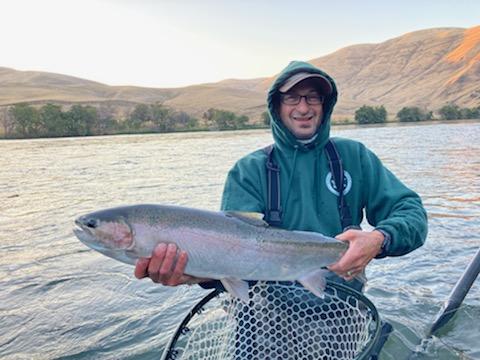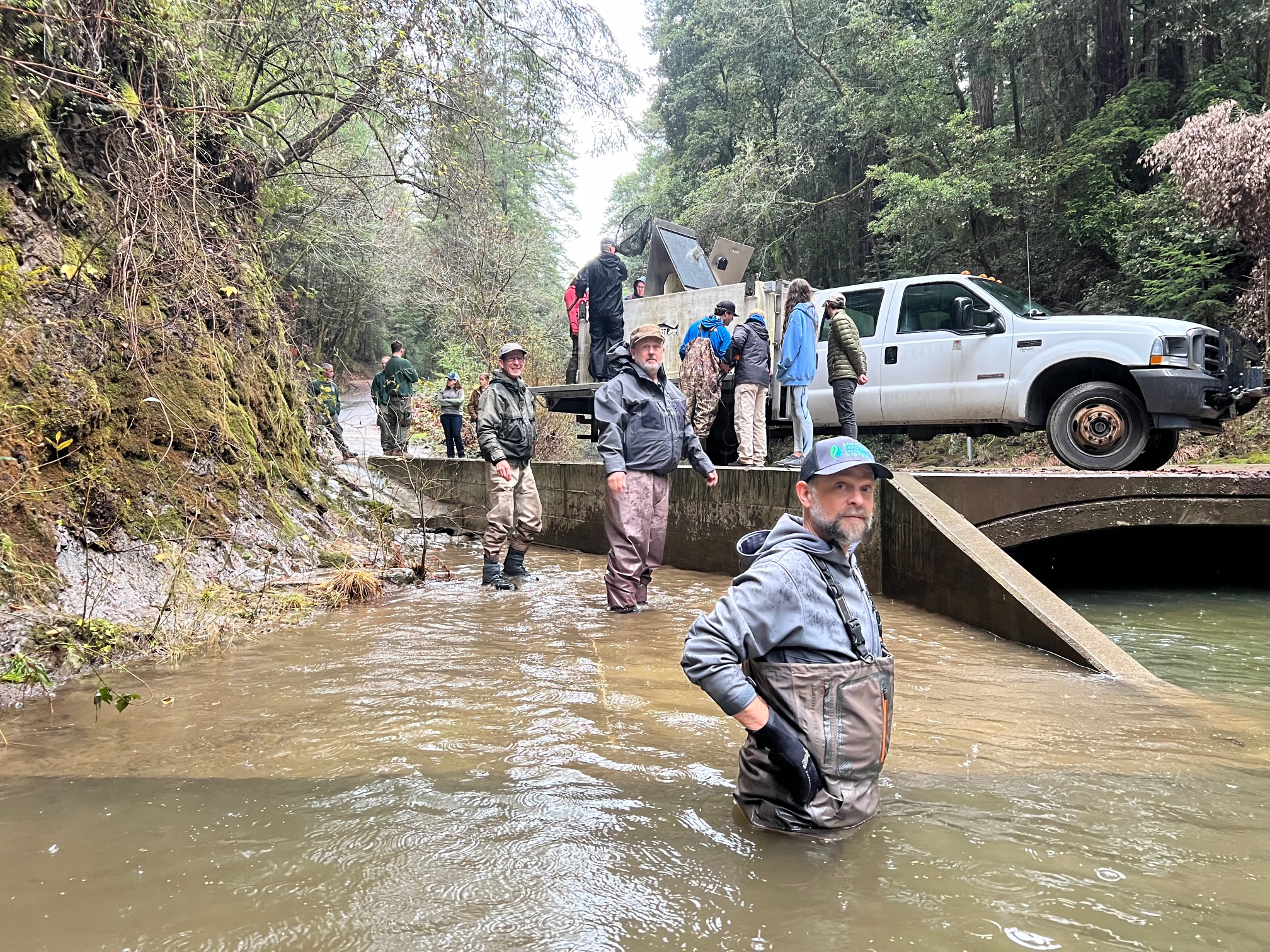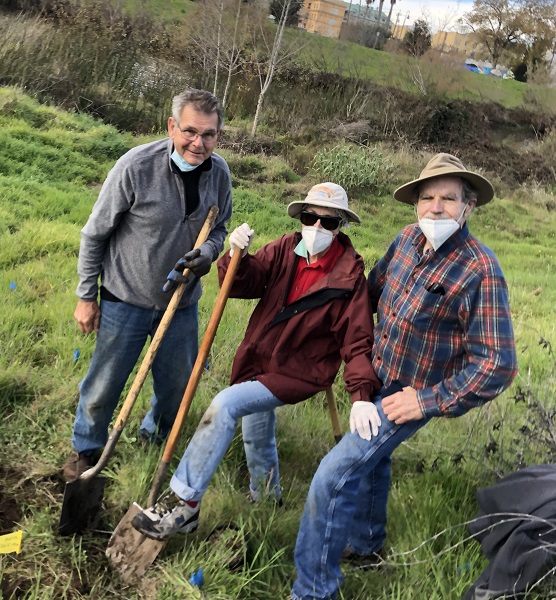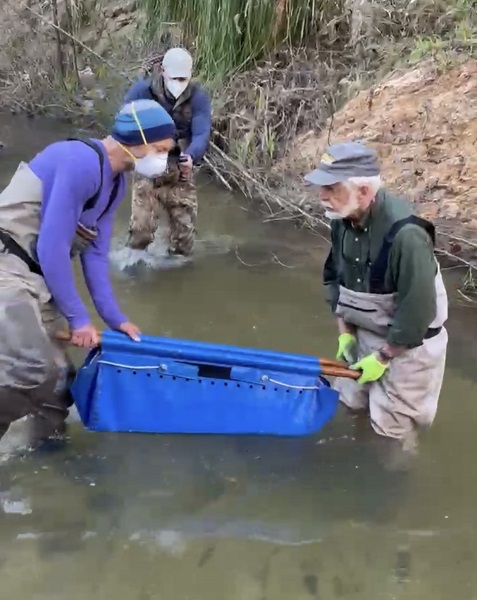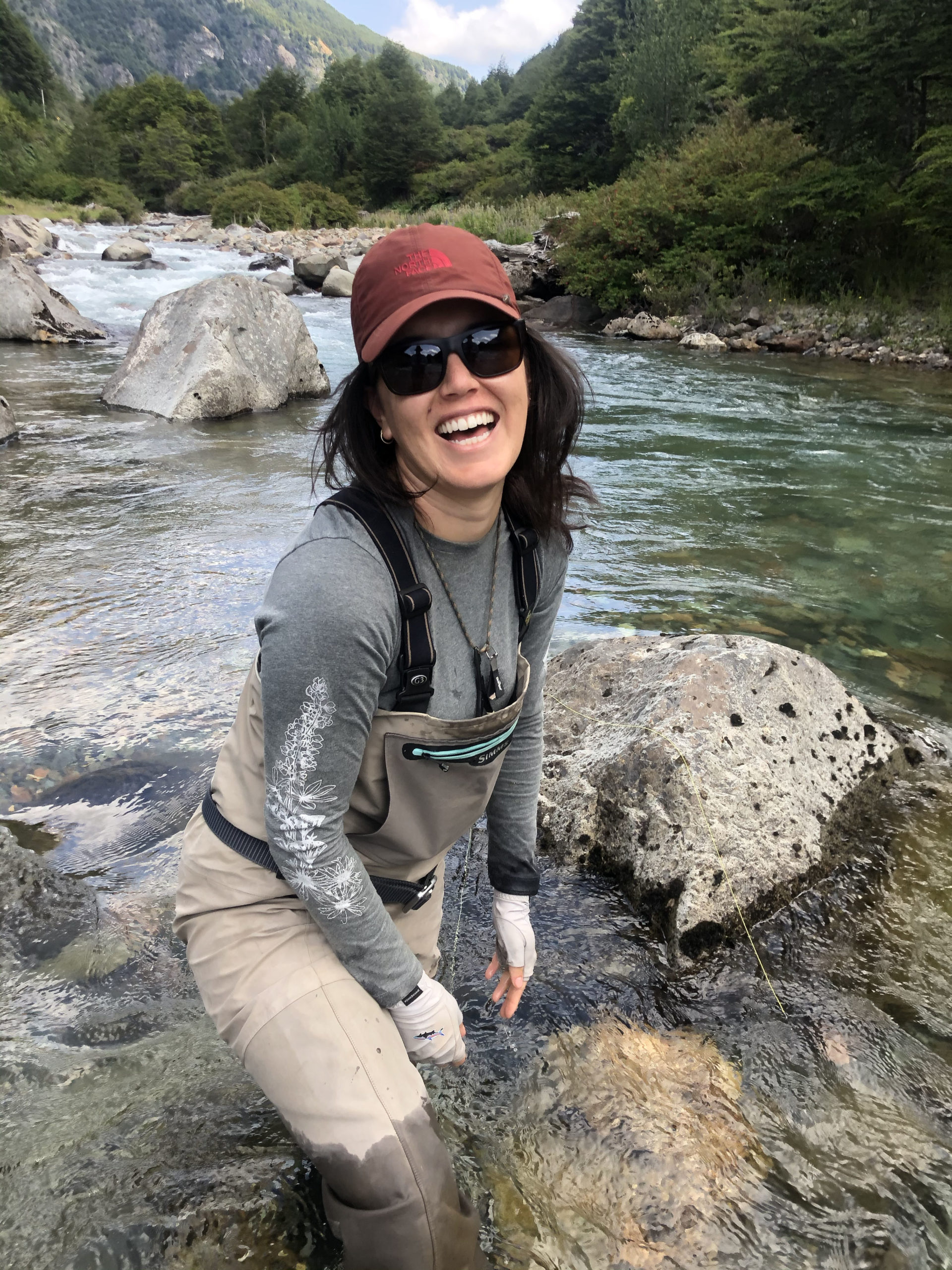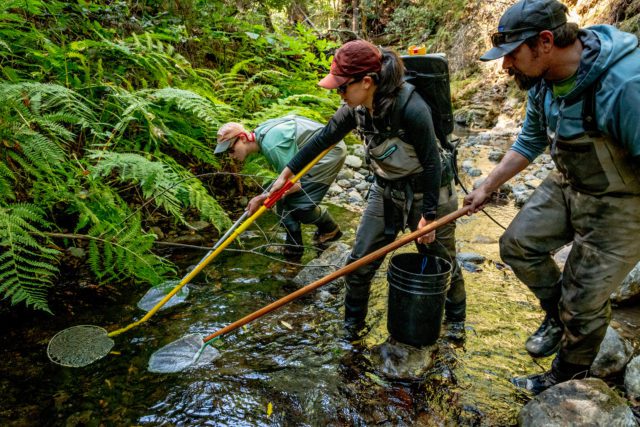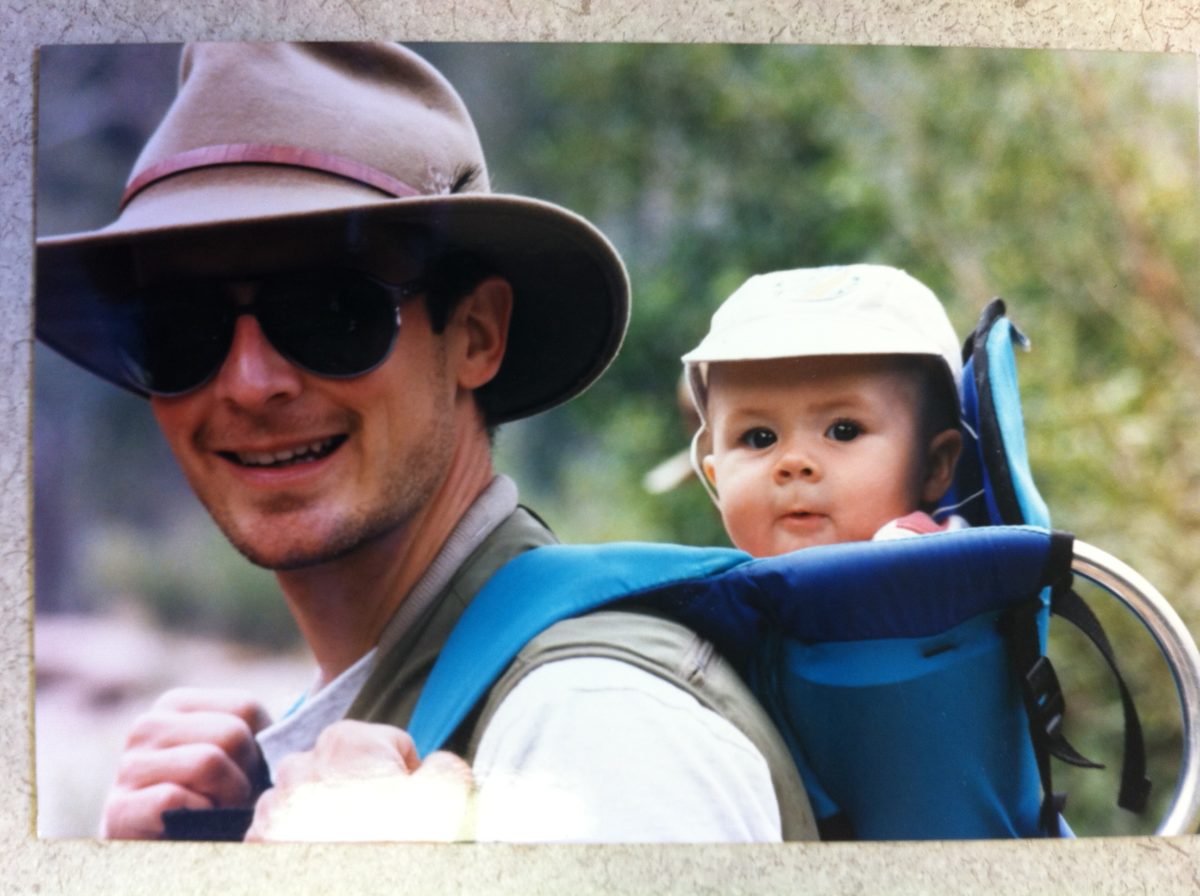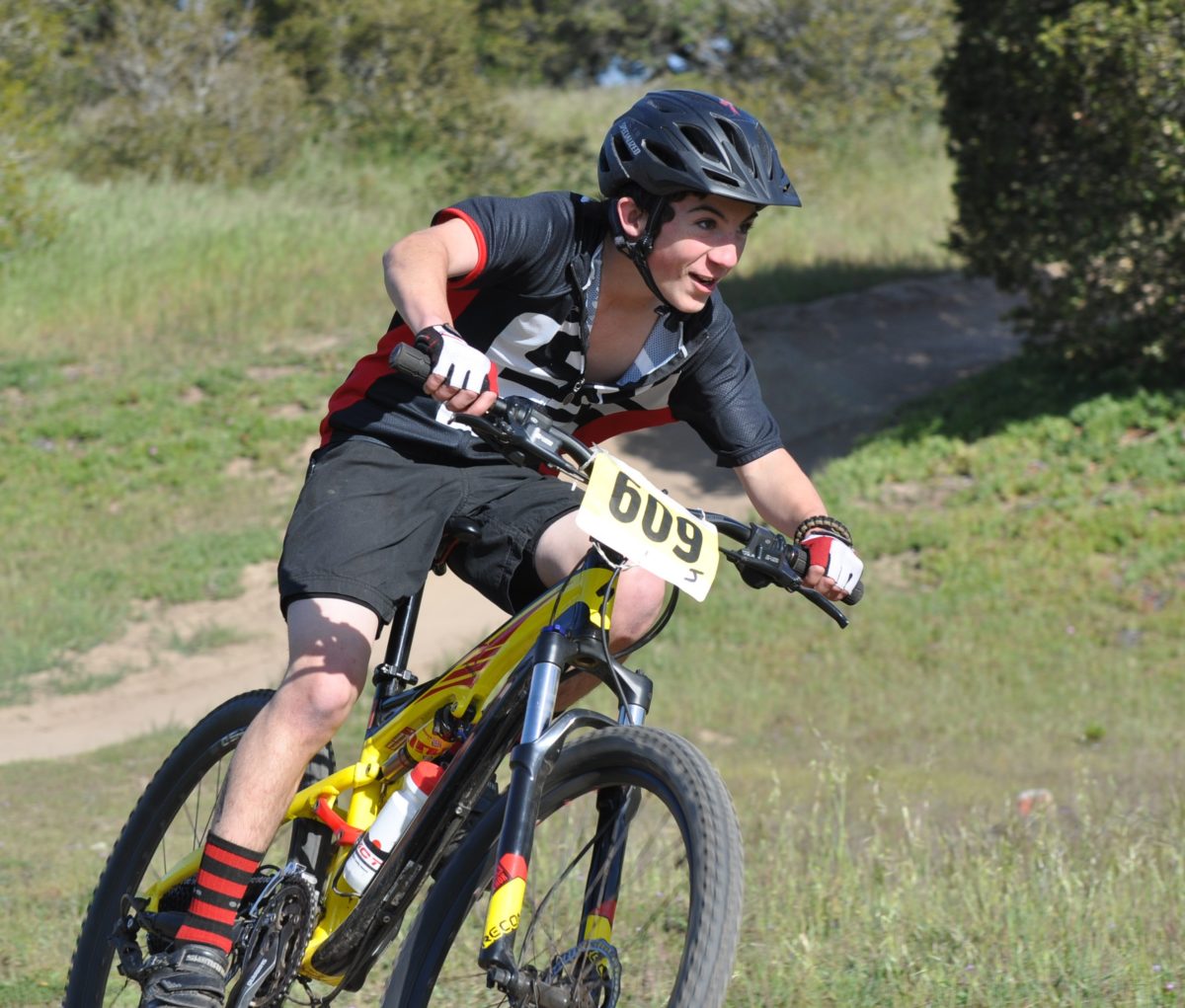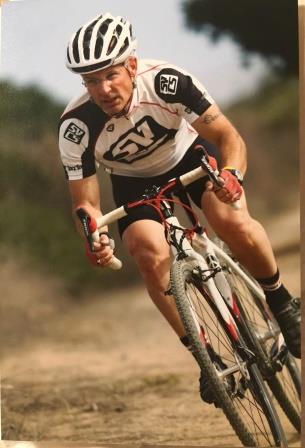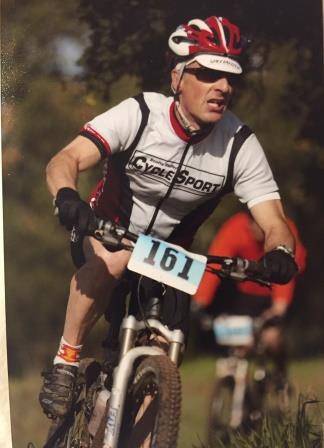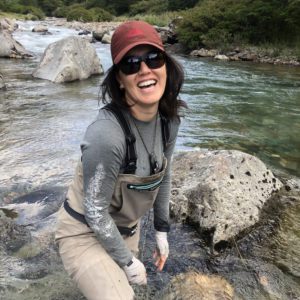
Katie’s passions for science and the outdoors first collided as a college student at UC Berkeley, where her studies took her to extraordinary field sites ranging from the crystal clear South Fork Eel River to the tropical streams of French Polynesia.
She quickly became motivated to apply her research experience to the salmon- and trout-bearing streams she had explored on fly fishing trips with her father. After graduating, Katie began working for the NOAA Southwest Fisheries Science Center—contributing to research and monitoring efforts for endangered/threatened coho salmon and steelhead trout across Santa Cruz and San Mateo Counties.
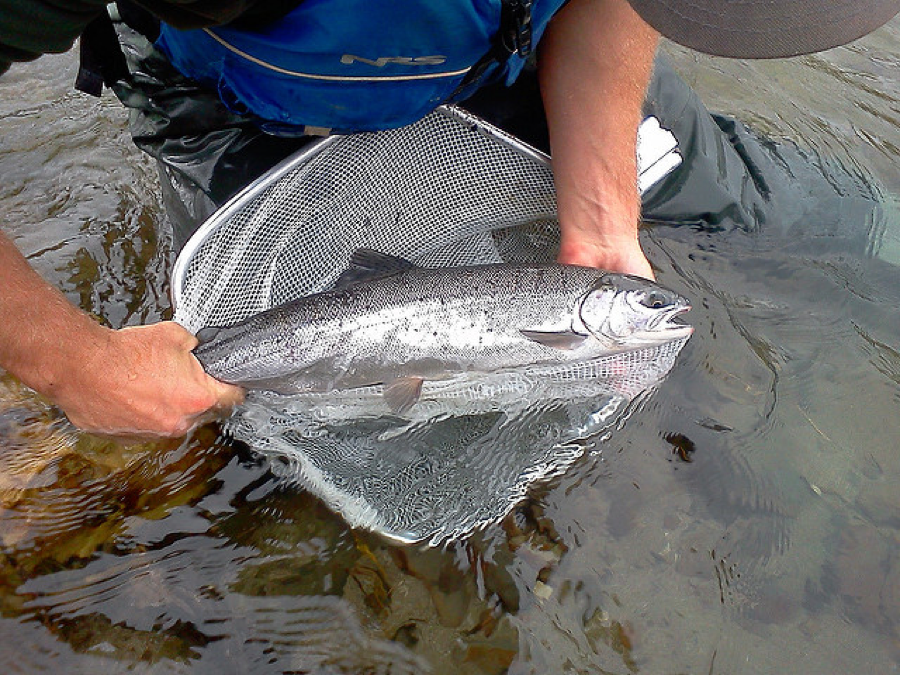
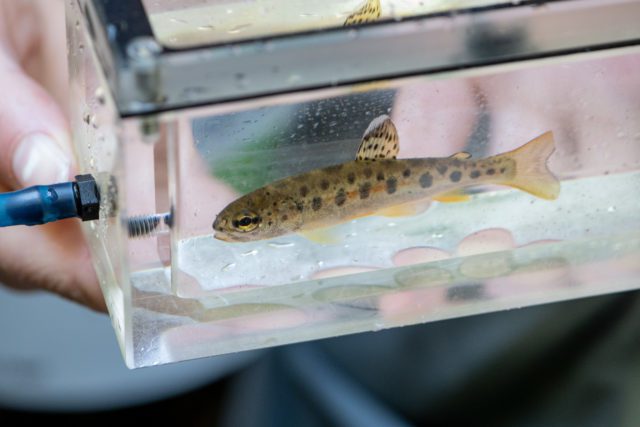
Katie began her PhD with the NOAA/UCSC Fisheries Collaborative Program in 2016. Her research examines the evolutionary differences between steelhead and rainbow trout (O. mykiss), their role in stream food webs, and the effects of escalating wildfire regimes on these dynamics. She manages a highly collaborative research project in Scott Creek (Santa Cruz County, CA), working with academic, agency, and NGO partners to draw connections between natural history, evolutionary ecology, and fisheries management.
Katie strives to communicate her research to both academic and local communities through her teaching, writing, and art. She is currently a graduate fellow with California Sea Grant and UCSC’s Center for Innovations in Teaching and Learning.
Future Speakers. Dates and speakers may change, please go to URL to see the current information.
Reservations can be made for national forest campgrounds and for other national recreational lands through recreation.gov. However, a much simpler way is to call on the phone ( 877-444-6777 ). You will actually get a live person. The website is extremely confusing as far as I’m concerned and many others I have talked to as well. The phone line is open from 9 AM till midnight (eastern time), every day including weekends. Give it a try, you’ll love it. Just a word to the wise, since Covid began there are way more people out there recreating, so make your reservations well ahead.
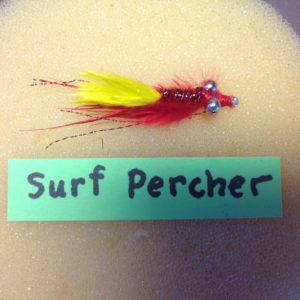
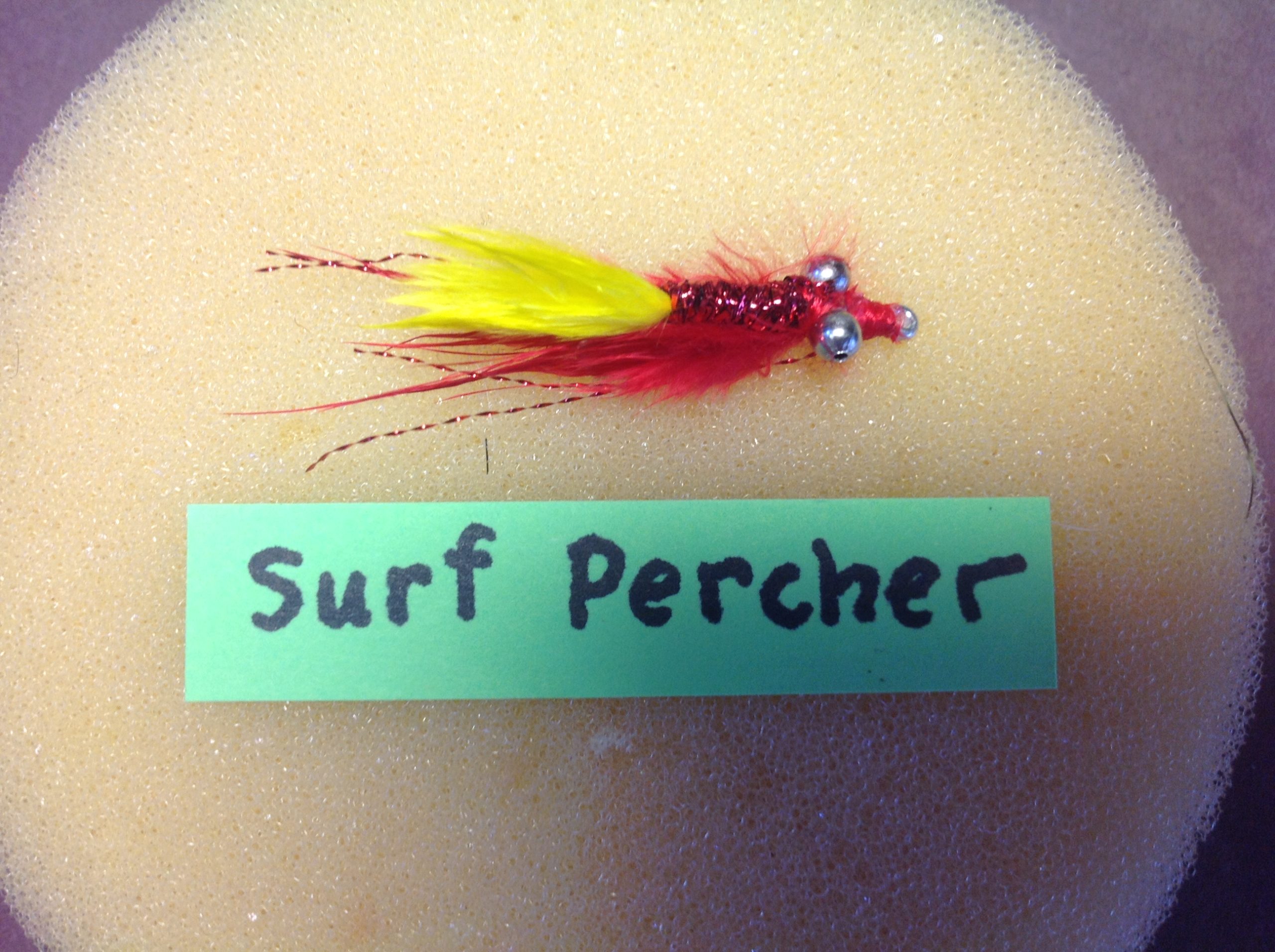
As the surf is just outside our back doors and Sam will be having club Fishouts in the surf before too long, we will be tying a fly to use for that endeavor. For you beginners this will be an easy fly. We will be using 6/0 red thread. The club has tools, vises and thread to borrow if you need them. There is no charge for the class and materials are provided. Give me a call to sign up and I’ll prepare a bag of materials and instructions for you, and put them at my front door. (831)688-1561
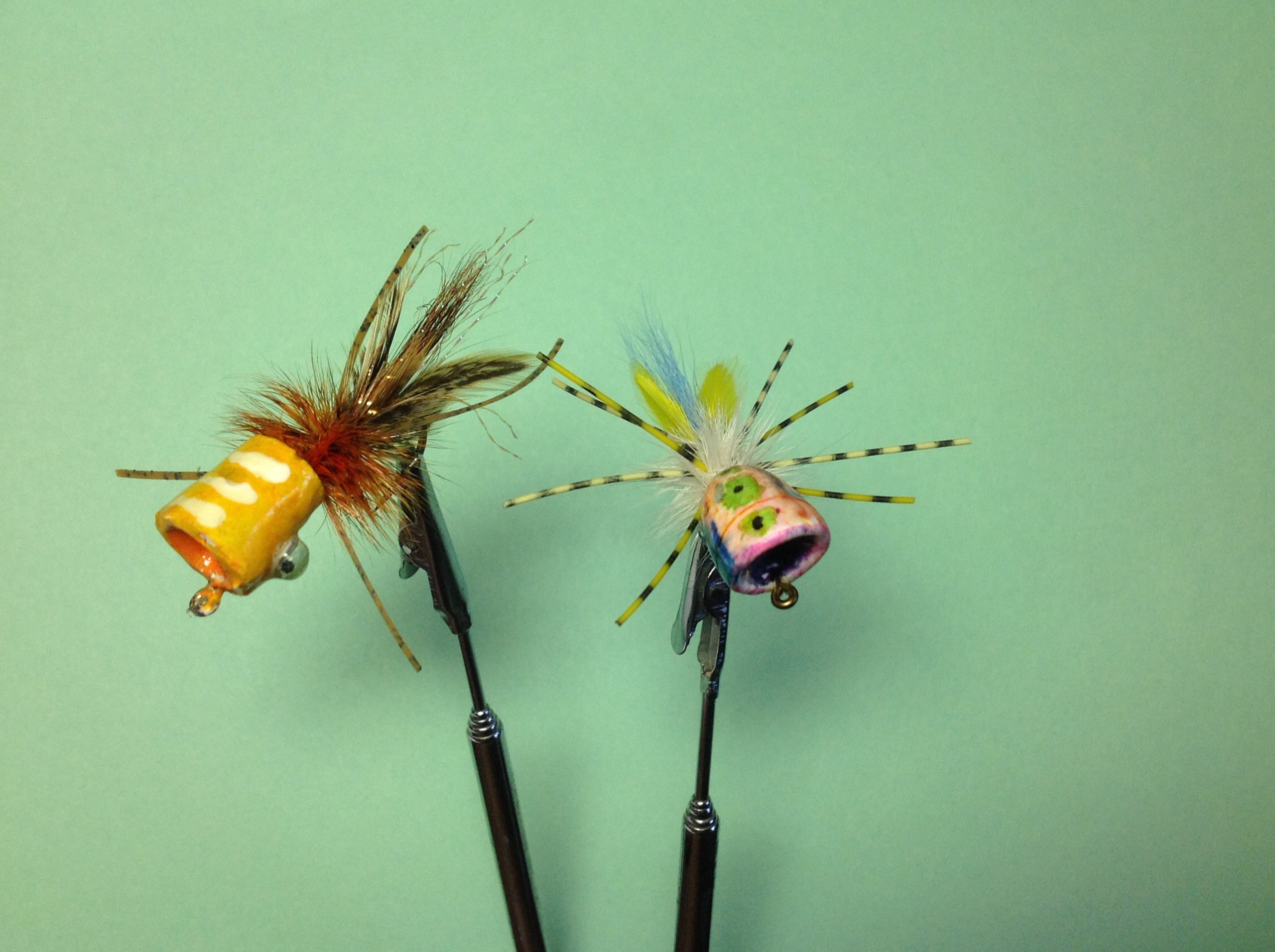
We will be making poppers so that we can go for those big mouthed bass. In the past the class has spanned over 2 days and involved lots of paints, epoxies, glues, solutions, along with various other supplies. It is not reasonable to assume that everyone would have everything that would be needed to craft these beauties, and not practical via Zoom. In order to not miss out this year, a simplified method has been devised which will give everyone reasonable and useful poppers. The only thing you will need to complete your popper fly is clear nail polish and Supper Glue or equivalent. If you have 30 min epoxi, a variety of acrylic paints and rubbing alcohol, your finished fly will be more like the ones we usually craft. Some lead time for prepping and putting supplies together will be needed. So please sign up soon but no later than Mar. 5th. It will still be a 2 day class, but fewer hours than usual. We’ll start at noon. Allow 2-3 hours each day. You beginners to fly tying should feel comfortable doing this class. As always, the class is free and materials provided. Very strong thread, any color, such as flat waxed nylon or monocord will be needed. If you need thread, or tools and vise if you are a beginner, the club can loan them to you. Materials , directions and tips for bass fishing will bagged for you to be picked up at my door. Call me to sign up @ (831)688-1561
Future tying classes. Dates and subject may change, please go to URL to see the current information.
If you were game enough to attempt to solve this riddle, I applaud you. Just remember if you solved it you’re fishing this year will be fantastic. You’ll find the solution below. I hope this was fun for you as it was for me. Do let me know if you were successful.
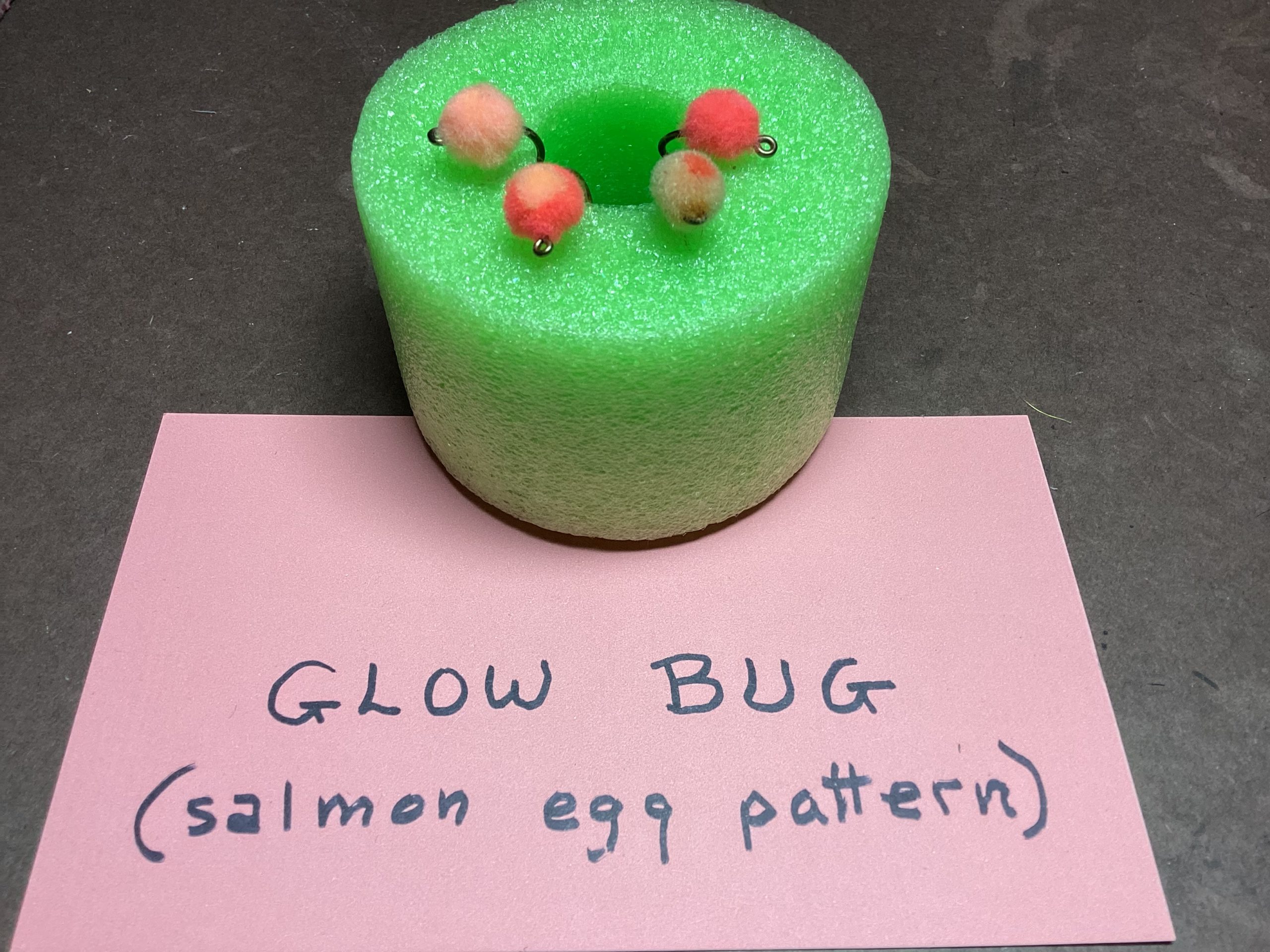
Steelhead and trout follow salmon as they spawn and readily eat their eggs. This pattern simulates them. The fly doesn’t sink well so use a sinking line, put weight on your leader, or trail the fly behind a fly that sinks well, or add a gold bead to the hook before tying on the yarn.
HOOK: Mustad 9174 or TMC 105 or Targus 105. Size 6 or 8
THREAD: STRONG: white, peach, salmon or other light color. Such As: flat waxed nylon, Danville 2/0, monochord, Gudbrod Gx2 or Ultra 149 denier.
EGG: Glow Bug Yarn: comes in both thick and thin strands. bright salmon, pale salmon, orange, peach, pale yellow, and pink
1. Crimp Barb. NOTE: a hook with upturned eye also works, but material is harder to trim.
2. Attach thread 1/3 back on shank. Cover center 1/3 of shake with touching wraps. Leave thread mid shank.
3. THICK YARN:
Cut 3 one inch or longer pieces.
(optional)to simulate a developing embryo, cut a 1 inch piece of contrasting color of thin yarn.
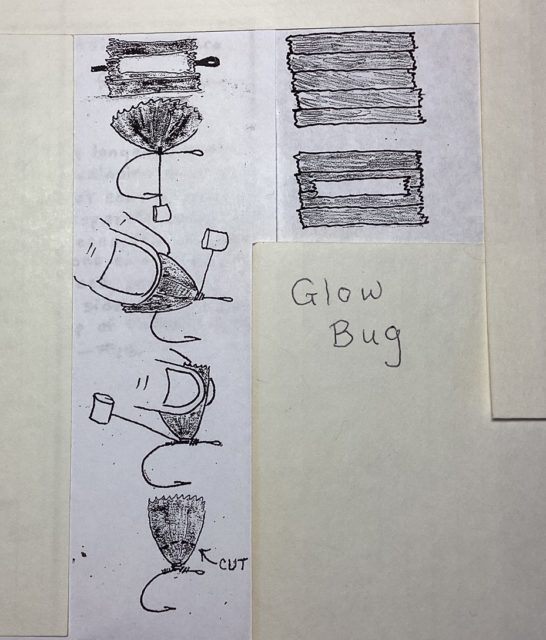
(See diagrams for upcoming steps.)
position thick yarn pieces side-by-side. If using contrasting piece, place it on top.
pinching center of material, place on top of shank so that they are not stacked but the three thick pieces are side-by-side and thin piece on top.
make three snug wraps, one on top of the other, keeping yarn on top of shank.
pull all material firmly upward to be sure it is all on top of shank.
tilt yarn to rear, make three wraps in front as close to yarn as possible.
pulling firmly up on yarn, make three snug wraps around base of yarn.
Advanced thread to eye.
whip finish, cut thread, apply super glue or equivalent to thread wraps ONLY behind hook eye.
Holding and pulling yarn upward, cut all at once in a single arc with a sharp heavy duty scissor, so that the cut corresponds to radius of egg.
stroke yarn downward and fluff to cover bottom of shank. Finger nail or Velcro can help.
trim yarn if needed to form a round contour.
THIN YARN:
Cut 5 inch or slightly longer pieces.
(optional) to simulate a developing embryo, cut one 1 inch piece of contrasting color of yarn or separate one piece of thick yarn into 2 pieces, and use one.
position all five pieces of one color side-by-side. If using a contrasting piece, position four pieces of primary color side by side and contrasting color on top of them.
Proceed as above with the step that starts with “pinching”.
In 2021, 12 club Members were nominated to receive the coveted John Steele Award. The reasons were as varied as they could be.
Sam Bishop was nominated for hosting the Beach Fish outs, described by one member as “The most important SCFF activity during Covid”.
Dan Eaton was nominated for hosting the Los Banos Creek fish out and giving largemouth bass fishing advice, and for hosting a fly tying class.
Robert Eberly apparently adopted a novice surf fisherman and schooled him throughout the day, eventually convincing our neophyte angler to join the SCFF club!
Jeff Goyert (Yog) helped a member get acquainted with the O-Neil Fore bay striper fishing techniques.
Scott Kitayama (Last year’s Steele award recipient) was nominated for helping a member while perch fishing, and again for just being friendly and helpful.
Phil Kowal has been helpful in e-mail and text for equipment questions and has also introduced club members to San Lois reservoir.
Jerry McKeon was nominated for his prodigious work on our Instagram account, which has grown both our membership, and our club’s reputation in the Fly Fishing hierarchy. He also received a nod for pitching in and helping set up Zoom Fly-tying.
Lord knows why Kevin Murdock was nominated; I suspect graft…
Steve Rudzinski (Stosh) was remembered for his work on the Jade St Park casting classes, and helping members with Pyramid and San Louis fishing techniques.
Bill Seamoa was able to facilitate transportation for one of our favorite couples to San Lois Reservoir when they were having difficulty driving in the dark.
Cecilia Stipes effervescent personality, and her willingness to share knowledge, as well as her efforts as one of our fish masters has made her a nominee again this year.
And finally, Mark Tragout was nominated for his casting classes in boulder creek, and for towing a tuber out of the weeds, and finally, for gifting the book “Home Waters” by John Mclean, to a member, which indirectly led to the marriage of a pair of our club members.
As you can see, Steele Award nominations can be for literally anything. We have numerous fish outs through the year where 20 or 30 of our members are present for up to a week. You can’t tell me that you can fish for a week without a club member sharing a tip, a fly, a spot, netting a monster, an incredible meal, emotional support or just plain good fellowship.
I should be getting 20 or 30 nominations after each fish out. The easiest way to make a nomination in this time of zoom and distance is to just e-mail me at troutdock89@gmail.com. That way I can just move the e-mail into my John Steele folder and count em up at the beginning of next year.
This year’s winner of the 2021 John Steele award is Mark Tragout.
Congratulations Mark. We are grateful to you and all our nominees.
Wow! Merry Christmas and Happy New Year to everyone and all you hold dear. I hope you got all those fly fishing, fly-tying, casting, wading and outdoorsy things you wanted for the holiday.
I first want to thank each and every one of you for your extraordinary support and participation in Santa Cruz Fly Fishing. I’m sure our founders, way back in 1977, would never have envisioned the fullness of our mission – “To Promote, Educate and Enjoy the sport of Fly-Fishing”. It might surprise you that many of our original founders are still members of this club. Yes, over 45 years. So if you’re new – think of the possibilities!!
As I begin my 5th year as President, this is unprecedented to say the least. But we’ve been dealing a lot with that word these last couple of years. When I first joined the club in 1992, I was a young enthusiastic, infected person. I had the bug badly. I’d take my fly-rod to work with me and practice casting in the park near my work more than a few days a week. I was tying the ugliest most unproportioned flies, but they were catching some fish, and I was getting better. All of this long before the internet, YouTube, cell phones, … Crazy to think of that. When I was Conservation Chair from 93-96, I typed letters and faxed them to hundreds of people, as I began my stead to change the mindset of in our anadromous fisheries because, even as fly-anglers, we were all still hurting too many fish and we needed to show the world that the anglers were going to be the people who saved the Coho and Steelhead. (Side note: – Keep your fish wet! In the water. With today’s cameras and our insatiable desire to get good photos of fish, it is clear that we are all keeping fish out of the water way too long – for that photo or video clip of a lifetime which is likely the next reason fish mortality could be on the rise. True! Keep the fish in the water.)
In ’96 I accepted my first run at being President and loved it. I suppose this is because, like today, I wasn’t alone. I had the most awesome support from the membership and most importantly, the board, who today, also do more to support these efforts than I could ever imagine.
When I was President the first time, I took on the mantra that every idea was a good idea. While we might not take on everyone of them, considering every idea gave birth to even more ideas that we put to work. It let you share your own thoughts and wishes and enabled us to take that which you felt as a good thing, mold it, refine it, give you ownership and make it happen. Like recently when Steve and Kevin did that pre-Christmas camping trip at New Brighton. Turns out that was a blast and will be something we do again – and might be something we can do in combination with a surfperch fish-out in the Spring or Summer! Or some of us who are looking for someone to resurrect the Pack Fish-out – where you get on a horse for a few hours, ride to remote mountain lakes and/or streams, stay a few days and pack out later.
I wasn’t always a member. After those first 12 years, my children, my job and building my home took over. Emily was competing all over the world and Tommy liked bikes, so we started riding together and I started racing. Yep – went from fly-fishing president to mountain bike racer. Then Tommy started racing and I was helping coach the team – which in mountain bike racing, means you ride as hard, or harder than these teenagers. Some of you remember when Tommy and Emily were tiny little tots running around the Grange during club meetings!!
All too soon, Emily was on her own and Tommy was now focusing on cars. Mona would always ask me if I’d heard from anyone at the “fly club”, or if I was going to a meeting. I’d always say that was a good idea, or that I was bummed because I just missed the meeting. I would still get Christmas cards from John and Elaine, John and Pat, and Kathy Powers – every year. Those tugged at my heart strings. Oh – I was still fly fishing every year – still going to Kennedy Meadows, but my mountain bike took me on the San Lorenzo trails more than my fly-rod did.
Finally, that September 2017 meeting came around and all the stars aligned. I was back.
I could not be more grateful for all of you. Many of you know exactly who you are and how we pulled together so much fun around fly-fishing, teaching, conservation, and more. Some of you have just joined and haven’t yet experienced the activities we do in the community and with other agencies such as the Coastal Watershed Council, Monterey Bay Salmon & Trout Project, the Kids Day at the Fair Grounds, our Public Day at Quail Hollow Ranch; Confab, fun with the Patagonia Store… Hang in there. We’ll be back to doing all of this and you’re not going to believe how much fun and how rewarding it is to share what you love with someone else.
As things get back to normal, and they will, our club meetings will be even more special, and we’ll still be able to engage those around the world – yes – really? Yes, Santa Cruz Fly Fishing club members who live in other places in our world, but support the work we do to – what? “Promote, Educate and Enjoy the Sport of Fly-Fishing”.
Our January meeting will be taking place at the Santa Cruz Sherriff’s Posse Hall on Ocean Street Extension the 5th of this month. It is our annual club slide show, where your photos are the show for this month. We will be having a Barbeque, with snacks and beverages, a super nice raffle, AND a swap meet. Many of us will be there early, so if you want to help in any way, please reach out to Kevin Murdock or myself between now and the end of this week!! Please RSVP through the form in the meeting article or email to scottkitayama@gmail.com
Location:
Pit River, close to Burney, California. The Pit river is located in the Shasta National Forest. Accessed via Hwy 299 and Hwy 89. Approximately 2 hrs east of Redding California
Lodging:
We will be camping at Ruling Creek Campground PG & E Campground – First come first serve ($15.00 daily cost subject to change). Located on the Pit 4 reach, below the Pit River 4 Dam. There are toilets, and fire rings. There usually is water available. The closest shopping is in Burney, about 1 hr away.
Description of the River:
The Pit river is a tailwater fishery, freestone in nature. It is accessed via a frontage road, maintained by PG and E. There is about 30 miles of river to explore. The river is well known for its wild and hard fighting Rainbow trout. It is fished mainly using nymphs, dead drifted under an indicator or using tight line techniques. On occasion fish will take dry flies, as well. These fish are pound for pound some of the hardest fighting trout you will ever experience. This boulder strewn river is notorious for its challenging wading. The nymphing can be quite technical, where getting good drifts will be rewarded with some awesome hookups. Typically this river is not terribly pressured. The river is in a beautiful, remote,wooded canyon, with some stunning views. The weather in May is very comfortable, typically in the 70’s.
Equipment:
9 ft, 5-6 wt rods, typically faster action work best. Typical nymph rig set ups, with lots of split shot. Felt, studded wading boots are essential. I would avoid rubber/Vibrum soles. This is a slippery river. This river has excellent Stoneflies, Mayflies and Caddis, so flies mimicking these bugs usually work well.
Skill Sets:
Strong wading skills are important. This river has tight quarters, so having a strong roll cast, and single spey casting techniques are very helpful in getting you bugs into position. There is some hiking, but most of the river access is right along the river.
Jun 06 : Pyramid Lake Floatie Fishout – June 2026 – UPDATED April 16
Pyramid Lake (Click for address and map) Fishmaster:
Fishmaster: Frank Gombos (Salinas Fly Club)
Update April 15 –
Due to low response, we have canceled the SCFF only fishout and will join the Salinas club on June Currently Jeff Goyert, Michael Sherwood and Scott Kitayama are going from the Santa Cruz club. If interesteed contact Frank @ 831 970 9623.
Two-Day Float Tube Outing Information:
Two-day Float Tube Outings
Our outings are the most popular thing we do and are a great way to spend a couple days on the water with our guides and chef and have a chance to experience our favorite times of year to be at the lake. Ever since the introduction of the Pilot Peak strain of the Lahontan Cutthroat Trout we have been targeting these enormous fish. Early in the fall and again late in spring these fish stage in areas that allow us to fish for them from float tubes and pontoon boats.
You will meet us at the lake the late afternoon before the first day of fishing. We set this time aside to go over everything you need to know before the fishing starts. We will do everything from rigging up rods, setting up our floating devices, if you are camping with us we help you get settled in for the event. We always have a camp set up at the lake so you can leave gear at the lake each night. We will have some type of comfort food available. If you cannot make the Pre-Trip gathering one of our guides will help you as much as possible the first morning to get rigged up and on the water.
We will have some type of comfort food available. If you cannot make the Pre-Trip gathering one of our guides will help you as much as possible the first morning to get rigged up and on the water.
We will spend two + days on the water fishing and learning. Our Team will accompany you on the water helping to fine tune the techniques we have developed to catch these fish. We will be there to help you land and take pictures of your fish of a lifetime catch.
A complete Pre-Trip Planner will be sent to you once you are signed up for the outing. Included in the planner are the things you will need to bring. Some of the items are pretty mandatory including a fly rod with a fast-sinking shooting head with a sinking running line and something to float in like a float tube, kayak, or pontoon boat, and a good anchor.
Gear – Equipment is not included in our float tube outings unless prior arrangements have been made. We do offer limited Pontoon Boat rentals which also need to be arranged ahead of the outing.
Accommodations – Deals at local hotels will be available and in our Pre-Trip Planner. Camping at the lake is a blast this time of your and we encourage you to join us at the lake. You can dry camp at the beach we are fishing or there is an R.V. park at the lake with full hookups. Camping permits are required and need to be purchased in advance.
Permits – You will need a fishing permit to fish on the reservation. You will also need a camping permit if you intend to camp. Links to both of these will be in our pre-trip planner.
Food – This is a fully catered event. During the outing we will serve dinner at our Pre-Trip gathering and also the next night for those who camp with us and also hot lunches both days. In the mornings there will be coffee and some snacks. Kicking back and having a meal served for you while hanging out on the shores of the lake is a big reason why we have such a high rate of return from our outings customers.
Cost of the Outing is $375– Not included in the price are Tribal Permits, gear and gratuities to the staff and guides.
PS. You must have your 50% deposit mailed to Rob Anderson by January 1, 2026.
How to get there: Take US 80 to Reno-Sparks, take the Pyramid Blvd. off ramp and go north about 35 miles. Crosby Lodge is at Sutcliff, near the Ranger Station.If you have any questions about equipment or how to get there, check the “Gearing up” columns in the March 2007-2009 archives on our great club website, or call Mike White at (831) 706-5556.If you are considering going to Pyramid again this year with the club and you have not already done so, please contact the person who is booking the trailer you stayed in last year. Trailer-masters, if your trailer has gaps or cancellations, you can call Mike so he can pass the names of members who don’t have lodging to fill the empty spots.
Regulations: Fishing and camping permits can be purchased online prior to the fish-out. We would highly recommend doing this. Go to www.plpt.nsn.us to obtain your licenses. There is also an RV Park available at (775) 476-1155.
As with any great fishery there are always a long list of rules and regulations. We would recommend you review them on the website above. Suffice to say those of us who have been go-ing to Pyramid Lake for many years are a good source of information as well. We will help inform and guide all newcomers.
Pyramid Lake Lodge at (775) 476-0400
NOTE: Due to insurance regulations, all attendees must be paid up members of Santa Cruz Fly fishermen, so get your member-ship paid up if you haven’t done so yet.
Jun 06 : Beer Can Beach Surf Fishing & Breakfast
(Click for address and map) Fishmaster:
Location: Beer Can Beach (AKA Summer Beach) – Staircase at 1191 Via Palo Alto, Aptos
Sunrise is at 5:48 and we are fishing a falling tide
Meet at the staircase at 1191 Via Palo Alto, Aptos.
Breakfast at Mike Lovejoy’s house, 115 Driftwood Ct, Aptos. Park on the street. Hot water available for hand wash. Hose available for rinsing equipment.
Santa Cruz Fly Fishing Club (SCFFC)Lower Yuba Private Water Camp & Fishout
June 19th-21st 2026
(Date subject to change due to weather and flows)
The information provided below has been modified from the Grizzly Peak Fly Fishing Club and Tri-Valley Fly Fishing Club (2022-23)
Special Notes
The outing is limited to 20 people. With a $50.00 buy in payable to the club. Reservations will be accepted via email to the Fishmaster (Justin Ice) only one person reservation per email (if you and your buddy want to go then 2 emails are needed). Due to the limited capacity, reserving your spot is first come first serve starting Feb. 4th at 9am Payment to the club by Feb. 13th if payment not received on this date your space will be forfeited. No refunds.
Camping will be available on the property beginning at 4 PM Friday and extending to Sunday evening. Fishing hours are dawn to dusk. Gate code will be sent out as we get closer to the Fishout date. Each angler will be responsible to close the gate behind them. The gate code will be emailed to us the week before the trip. Additional details to follow as we get closer to the date
The Lower Yuba is accessible from the sea – you must have a 2026 California Steelhead Reporting Card in addition to your fishing license. Unlike the license, the report card must be delivered in hard copy, either by snail mail or by hand from a fishing store. Plan ahead!
Location
University of California Sierra Foothill Research and Extension Center, 8279 Scott Forbes Road, Browns Valley, CA 95918. Meet at the gate to the river road (N39.24672°, W121.32222°), which is on your right about 1/3 mile before you reach the research center. Note that, misleadingly, there is a sign at the gate that says “No Fishing Access”. The gate will be opened and then locked behind us. 2.5 hrs from Berkeley. Take I-80 east to Sacramento, turn onto I-5 north, then onto Hwy 70 to Marysville. Pass through downtown Marysville on 70, and as you round the lake, turn right onto Hwy 20 east. Continue 15 miles, pass the Sycamore Ranch Campground. At the sign to the UC Station, turn left onto Peoria Rd, and then at another sign, bear right onto Scott Forbes Rd (also called Long Bar Rd). The gate is just past Sicard Flat Ditch. SCFFC strongly encourages carpooling.
General Notes
Our Club event on the Yuba will be on the private property owned by the University of California and is one of their Sierra Research facilities. We have contracted for TVFF’s exclusive use of the facility for the two days over the weekend. The river is about 1.5 miles above the highway 20 bridge over the Yuba and accessible only through a locked gate for a maximum of twenty (20) anglers per day. There is approximately 2.5 miles of available river that is the tailwater section a mile or so below Englebright Dam. The river has easy and level access, so it’s ideal for those less comfortable in heavy current wading situations, although that is also available for those Euro Nymphing.
The UC facility is on many acres in a pastoral valley leading down to the river. Most of the research here is for cattle, grazing land management, and erosion control so it is very quiet with no nearby roads, ranches, or houses. There is a covered picnic area that sits above the river with 8-10 picnic tables and a porta potty restroom with hand wash station that is also available on site no water on site, limited cell phone reception, no fires. All in all, it’s a very scenic and serene site.
Gear and Tackle Recommendations:
Yuba River fish are notoriously “hot” and frisky. They workout full time in the strong current and just love to play in it when disturbed by a sharp hook. Anticipate that you will see strong runs on hook ups and that the fish will feel like they are 4-6″ larger than you see in the net. So…
Rod & line weights/types: 5 or 6 weight rods, reels and floating lines are the norm to help control their runs. A 4 weight for Euro Nymphing should work well as long as it has a good stiff butt section to manage any runs.
Leaders and tippet: Fishing style dependent but normally I fish a 9’ 4X leader and adjust with added tippet of up to 4-6’ of 5 for the dry flies, and stick with 4X fluoro for the nymphs.
Other gear:
Note that we will not be using any watercraft as this is a walk and wade event with float takeouts way too far downstream to be of use for us.
Flies: Flies to match and we will send out a more current list as we get closer to the dates and better understand how the weather and water are impacting the hatches. Typically, you will need Skwala dries and nymphs, Pale Morning Duns, Baetis/Blue Wing Olives, Pink Alberts, Little Yellow Sallies, Pale Evening Duns, Golden Stones, and four varieties of Caddis.
Location / Date
University of California Sierra Foothill Research and Extension Center, 8279 Scott Forbes Road, Browns Valley, CA 95918.
June 19th – 21st 2026
Registration / Booking Info
February 4th (Wednesday) 9am
Email only, one reservation per email, first come first served
Payment to Santa Cruz Fly Fishing Club by February 13th . Payments not received on this date the space will be forfeited.
Payment details to follow
Jun 20 : Lake Almanor/Hex Hatch – Jun 20th – 27th 2026
Rocky Point Campground (Click for address and map) Fishmaster: Jeff (Yog) Goyert - Fishmaster (831)234-0033
The Lake Almanor Fishout is scheduled for June 20th thru 27th, 2026. This time period is, hopefully, the peak of the annual Hexagenia hatch that begins generally mid-June and runs through mid-July. The most productive fishing takes place early evenings on into past dark between Lake Almanor West to Canyon Dam on the Southwest side of the lake. Most of the fishing is done from float tubes as well as small boats or even from shore.
In addition to the evening “Hex” hatch, a multitude of opportunities exist for fishing throughout the day to include Little Crater Lake, Manzanita Lake, Baum Lake, Eagle Lake, Butt Valley Reservoir, Deer Creek, Clear Creek, Feather River, Yellow Creek, plus many more.
Lodging will be the responsibility of individual attendees. A popular campground operated by PG&E is the Rocky Point Campground, for reservation information call 916-386-5164. Many USFS campgrounds are in the area. Reservations are available through www.recreation.gov or by calling 877-444-6777. Make use of internet resources to acquire the actual campground names. There are also many resorts and rental cabins available in the area. A few examples are Wilson’s Camp/530-259-2267 and Plumas Pines Resort/530-259-4343. Other options are available via online research. Be advised that due to the popularity of fishing at this time of year reservations fill up early.
On Tuesday the 23th plan on breakfast with the club. Location TBD as Carol’s Café is under new ownership.
Sierra Fly and Tackle, stores in Chester and Hamilton Branch, is a great resource for current conditions and reports along with a large inventory flies and equipment. A must stop for all visiting fly fishers if only to get one of their cool tee-shirts. Both first time and veteran “Hex” Anglers could well benefit from the expertise provided by a knowledgeable and experienced guide. Lance Gray (530-517-2204) or Tim Loomis (831-345-8411) both offer instructional packages to help achieve success during the “Hex”.
Due to unforeseen circumstances, this Fishout has been canceled. Please stay tuned as there is a chance for rescheduling.
Fishmaster:
Alex Ferber
Location:
Lakes, rivers and streams of the Burney area
Species:
Trout
Date:
July 10th-12th
Cost:
No Cost
Meet Up:
Date of Fishout TBD and subject to change due seasonal conditions
Hat Creek Park off Hy 299 (See the map below). The park is approximately 10 minutes from the highway 299/80 junction. The park is on the left hand side going east on 299. If you google Hat Creek Park, it should show up.
This meet up will be a general discussion with your Fishmaster Alex Ferber. Here he will be discussing the local fishery, access points, general information and answering any questions you might have about making this a successful outing.
Meeting time to be updated as we get closer
Equipment:
Typical Trout Set Up 9′, 4-6wt Rods w/ Floating Lines Ideal
Euro Nymphing, and Trout Spey conditions available
Nymphs: Pheasant Tail, Hairs Ear, Prince Nymph, Wooly Buggers, Perdigon, Copper Johns, Zebra Midge, Micro May, Golden Stones
Drys: Caddis Patterns 12-16, Upright wing vs. Emerges, Missing Link, Stone Flys, Parachute Adams, Comparaduns (various sizes 16-12)
Misc.: Soft Hackles, Streamers, Leaches
What To Expect:
This Fishout is DIY Fishout with your Fishmaster acting as a resource person helping with any questions regarding where to fish, access, use of personal watercraft, fishery history, etc. Depending on interest there is potential of a pre Fishout presentation (TBD) and or tour of any one of the local areas with the most interest.
More information to be updated as interest develops. Please contact the Fishmaster if you are interested in attending.
Local Waters:
Hat Creek: Spring creek with plenty of easy access, walk and wading. There are 3 distict sections from the Power House Riffle, to The Lower Freestone Section. There are an abundence of hatches year round and daily from mayflies, caddis, and stone flies with the potential of a trico or green drake hatch.
Burney Creek: Spring creek with access around the McArthur Burney Falls State Park. The waterfall is a must see. This is great water for a dry/dropper set up as well as traditional dry and nymph fishing. Above the falls the creek is stocked and below the fish are wild.
Pit River: Classic tailwater freestone fishery. This river is known for its hard fighting wild rainbows. There is great walk and wade access but the terrain is difficult with large snot covered bowling balls covering the river bed. Those with strong wading skills and a stout wading stick only need apply. The river is broken up by multiple power houses each with their own characters. Primary a nymphing river either by indicator or tight line. Rubber legs and dark lords and lots of weight (bring lots of both).
BaumLake: Stocked and great for a small float tube or kayak. Excellent dry fly and streamer fishing.
Lake Britton: Primarily a motorized boat lake. Warm water fishery with small mouth bass, and potential for bull trout.
Ahjumawi / Big Lake Lava Springs State Park: Launch at “Rat Farm”
Fall River: Iconic spring creek with an abundance of large wild rainbows. No shore access. Non motorized boats can be launched at the Cal Trout public access or a kayak/motor boat at the “Rat Farm” (Big Lake/Ahjjumawi launch). Awesome dry fly, streamer and indicator fishing.
Lodging:
Camping – Too many to list, this is an outdoors paridise with options from unimproved to glamping. Plenty of places for RV hookups and KOA camping
Hotels & Motels: Various options available in the Burney area
Fishmaster: Scott Kitayama / scottkitayama@gmail.com
Location: Palm Beach
Target Species: Surf Perch and Stripers
Gear: 6-8wt. Rods with full sinking lines or shooting heads to match the rod. Polarized glasses (safety),
Mandatory Accessories: Wader Belt & Stripping Basket
(If a basket is needed, some maybe available to borrow or purchase. Please contact the Fishmaster ahead of time. Also there are many DIY Stripping Basket making tutorials online)
Single, double & triple fly rigs
Clousers to sand crabs
Directions: Take W. Beach St. in Watsonville towards Pajaro Dunes. Park at the end of W. Beach St. on the right side of the road outside of the entrance to Pajaro Dunes.
Tides for Santa Cruz, Monterey Bay August 1, 2026.
Day High Tide Height Sunrise Moon Time % Moon
/Low Time Feet Sunset Visible
Sa 1 Low 6:52 AM 0.0 6:14 AM Set 9:14 AM 95
1 High 1:35 PM 4.3 8:15 PM Rise 9:56 PM
1 Low 6:49 PM 2.3
September 8–15, 2026 (Additional week: September 1–8, 2026, if enough anglers)
Each week will be made up of 8 anglers, with Rick and Jesse serving as hosts. This document provides an outline of the fall Alaska fly fishing trip. All projected dates and plans are subject to change based on weather conditions.
Trip Structure & Expectations
For the first three days, anglers will be split into three groups:
Three anglers fishing with Jesse from a drift boat
Two anglers fishing with Rick from a drift boat
One group driving to a wade-fishing location
On the fourth day, the three groups will consolidate into two groups.
Groups will rotate daily to ensure all anglers have time fishing from the boats.
Wade fishing will take place every day, and anglers must be comfortable with wading and light hiking.
Recommended Equipment
4-5 wt. Rods (Switch / Spey / Single Hand)
Full Sink
Floating
Sink Tips
Wade Fishing Locations
Russian River – Rainbow Trout and Dolly Varden
Anchor River – Steelhead
Deep Creek – Steelhead
Daily Itinerary
Day 1 – Travel Day
Arrive in Anchorage. Groups will pick up Turo rental vehicles and drive to a rental cabin near Sterling (between Soldotna and Cooper Landing). Groceries and supplies will be purchased in town.
Day 2
Drift boat fishing on the Upper Kenai River with Rick and Jesse (weather permitting, possibly through the canyon). The third group will wade fish the Russian River.
Day 3
Drift boat float from Skilak Lake outlet to Bing’s Landing on the Middle Kenai for Rainbow Trout and Dolly Varden, with potential Coho opportunities. The wade-fishing group will travel south to the Anchor River for Steelhead.
Day 4
Rick and Jesse’s groups will either fish the Upper Kenai again for Rainbow Trout or float the Kasilof River from Tustumena Lake to the bridge for Steelhead and Silver Salmon.
Day 5
Groups consolidate into two groups of five anglers. Fishing will take place on the Anchor River and Deep Creek for Steelhead. If weather conditions prevent fishing, the group will fish the Russian River.
Day 6
Both groups fish the Upper Kenai and Russian River together. Optional hike to the Upper Russian River to view salmon jumping the falls.
Day 7
Optional saltwater fishing charter for one group while the other group fishes for Steelhead or Trout.
Day 8 – Departure
Drive back to Anchorage, return Turo rentals in daily parking, and depart Alaska.
Trip Cost
$700 Deposit per person (Non Refundable)
$1,400 per person (Total) — Includes:
Rental vehicles
Drift boat rentals and shuttles
U-Haul rental for towing one drift boat
Lodging
Fishing beads
Does Not Include:
Airfare
Fishing licenses
Rods and fishing equipment
Food
Estimated Additional Costs
Round-trip airfare (Alaska Airlines): approximately $612
Alaska fishing license: approximately $45
Estimated food and dining: approximately $300
Estimated total trip cost: approximately $2,500 (Not including optional saltwater charter)
Meals
The group will dine out in town for three dinners. The remaining four dinners will be prepared at the cabin, with two anglers paired each night to cook. Breakfast and lunch planning will be finalized once all anglers are confirmed.
Cancellation Policy
If an angler decides not to attend, they are responsible for selling their spot to another angler or forfeiting their portion of the rental costs (deposits & payments are non refundable).
Jesse & Rick will be hosting a table at the January SCFF meeting. At that time will take $700.00 deposits on the trip.
Sep 19 : Mammoth Fishout -Sept. 19-Oct. 3rd 2026
Mammoth Lakes (Click for address and map) Fishmaster: John Cook fishmaster-- (831)688-1561 or (831)234-6515
General: We will be staying in condominiums in the town of Mammoth Lakes (Max limit 8 per week). The condo complex has a lovely hot tub, so bring your suit. Two people per bedroom. Most people bring a sleeping bag to share queen size bed or a pad and sleeping bag to sleep on floor. A private room option is possible at an increased fee.
Cost: Shared single: $500/wk, $1000/2 wks.
Sign Ups: We will begin taking Mammoth reservations and money starting at 6:30 pm on Wednesday, March 4th (at the March Meeting). Please note that you are NOT on the list until I have your check, YOUR CHECK SAVES YOUR SPOT!
Check Payable to: Scott Kitayama. Mail: 36 Pima St, Watsonville, CA 95076
Group is limited to 8 in the condo per week. COST: $500/person . Please note that you are NOT on the list until I have your check, YOUR CHECK SAVES YOUR SPOT!
Payment of $500 is required to secure your spot. we need people to sign up as soon as possible. Should you need to cancel, you can find someone to take your place and get your money back.
Fishmasters:Scott Kitayama: scottkitayama@gmail.com , mobile: 650 279 5871 and Randy Saar: randy_saar@yahoo.com, mobile: 650 269 6138
Dates: This Fishout will take place over two consecutive one-week periods. You may sign up for one or both weeks. Week 1: Sept 19- Sept 26. Week 2: Sept 26 – Oct 3.
Location: The town of Mammoth Lakes is located on the eastern side of the Sierra, 6 or 7 hours drive from Santa Cruz. There are many lakes and streams in the area to fish.
Food Preparation: Breakfast and lunch items will be purchased by the Fishmaster ahead of time. Each person will be assigned a Kitchen Day. On that day, tasks will include setting out breakfast and lunch items, store unused food, and preparing the evening meal and clean up afterwards. Each person will be responsible for a dinner that you will need to purchase and prepare. You will then be reimbursed for the cost for the dinner.
Oct 15 : O’Neill Forebay ‘Stosh’ Memorial Fishout October 15-18th
These are primitive campsites so bring your own water. There are tables, sun pavilions, and chemical toilets, or outhouses and fire rings. No open fires are allowed outside of the rings.
Typically we will be camping as close to site 29 as we can get. This is a first come, first serve campground, so no reservations are accepted. Float tubes can be launched near the campsites, but boats must be first inspected, then launched from the San Luis Creek Boat launch. Boats may not be left on the lake overnight. Boaters would be wise to exit prior to the closing of the entry kiosk. The ranger can place a seal on your trailer, allowing you to bypass the inspection process the next morning.
The rangers at the kiosk by the Medeiros entrance may insist that your float tubes need inspection. make sure they’re clean & dry.
Equipment: 8wt rods with fast sinking lines. Some anglers will occasionally use a floating line with a ‘gurgler’ type fly
Flies: Lee Haskins San Luis smelt, ‘Deceiver’ type patterns in red, white, chartreuse, the aforementioned gurglers and poppers.
Float tubes (may require inspection for quagga and golden mussels)
There will be a signup sheet at our September meeting. We’ll also create a list for those hoping to participate in a pot luck in honor of Steve ‘Stosh’ Rudzinski.
Weather conditions can vary dramatically, so it would behoove members to check prior to departure. You could email me or just get conditions on-line. High winds can cause the lake to be closed to all vessels.
This is one of our nearest Fishouts, with the possible payoff of a double digit fish! Don’t miss out!
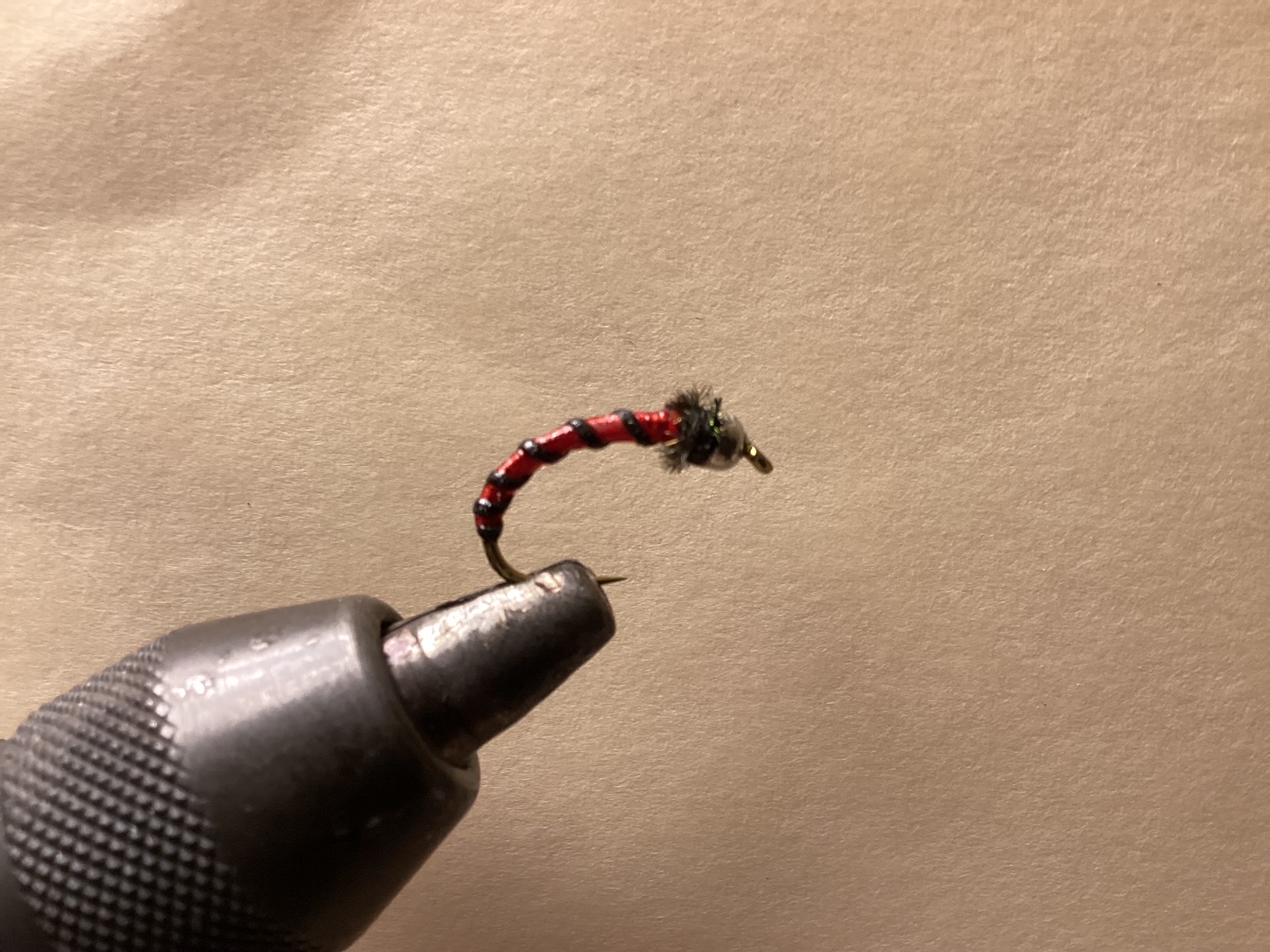
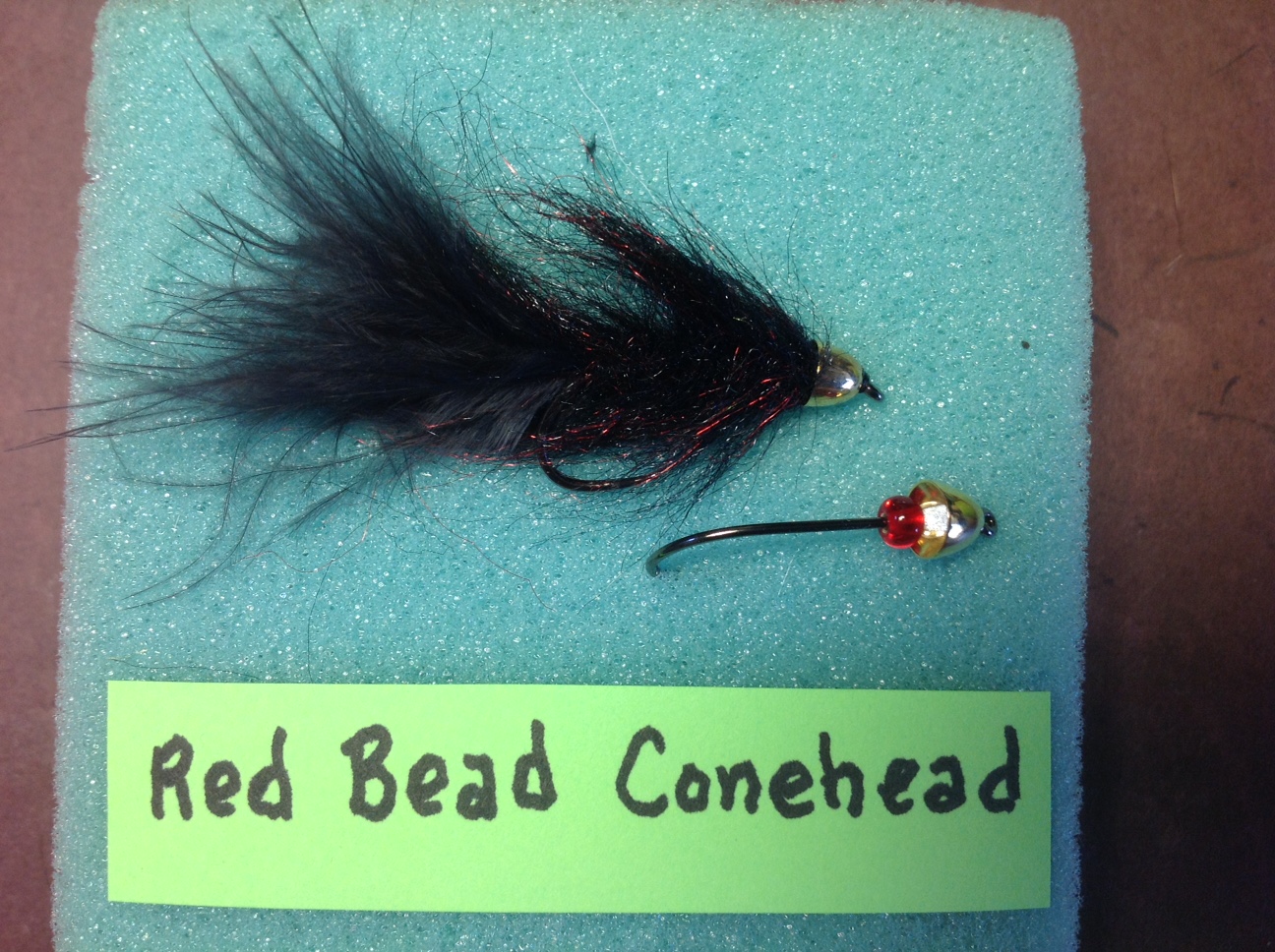
Here is a great one for you beginners. So get out that new vise and tools that you got at Christmas and join in. You can also borrow those as well as thread if needed. The thread this month is black 6/0. You may ask, after looking at the photo, “Where is the red bead?” When the fly gets wet it glows through the dubbing. You may have noticed a couple bass club Fishouts pop up on the fishout schedule for spring. Dan Eaton will be fishmastering them and he highly recommends this fly and the Fly Of The Month to target these fish subsurface. Give me a call to sign up and I’ll prepare a bag of materials for you and put it by my door. NO CHARGE FOR THE CLASS as usual. (831)688-1561
Future tying classes. Dates and subject may change, please go to URL to see the current information.
We are on schedule to meet our membership dues budget and are hoping for additional donations in order to offset the loss from our annual fundraiser dinner. At the end of December 150 members have renewed their 2022 dues membership. In addition donations of $2,000 have exceeded the prior year by 50% and continues to grow with members support.
In February, we will have final 2021 revenue and expense figures and update our 2022 Budget. We still have 25 members who have not renewed and we will accept renewals at the January BBQ and for the balance of January. Email reminders will be sent in early January.
For those that have already renewed and donated online, THANK YOU
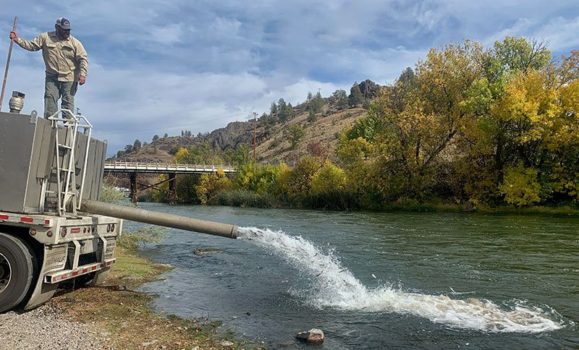
As of last month, the California Department of Fish and Game has released 1.1 million juvenile fall run Chinook salmon into the Klamath River. The goal is to release 2 million fish. These fish were hatched at the Iron Gate Hatchery on the Klamath River and were originally scheduled to be released last spring. However, due to drought conditions and a disease outbreak, the fish were relocated to three other locations over the summer. This is good news for a river that has seen its once-storied Chinook salmon runs decimated for a variety of reasons—including low flows and dams. The other positive news is the planned removal of four dams on the Klamath that will allow fish more access to spawning waters.
The club has had a great variety of Fishouts over the years. It’s planning time for 2022 and I’m encouraging you to think about planning one. It can be very simple or involved. And as fishmaster chairman, I’m here to help you with the decision to do one, choosing a plan, and guide you on how to organize the outing.
If you are hesitant, I would encourage something very simple. For example: making an announcement in the newsletter that includes, place, date and time, your name and contact info as fishmaster, type of fishing and equipment needed. Make it so sign ups are not needed, everyone is on their own for food and any fees required.
There is no need for you to be an expert in fishing that area and it is understood that you are not guaranteeing how good the fishing will be. It’s important to acquire basic information ahead of time, such as, how to get there, approximate driving time, any entrance fees, equipment inspections, PDF requirements, etc.
Please consider stepping up this year and help provide the opportunity for us to get together, have fun, find out about a new place to fish and the fishery, and learn from others. I’m waiting for your phone call. Please do call. John Cook — fishmaster chairman. (831)688-1561. (831)234-6515
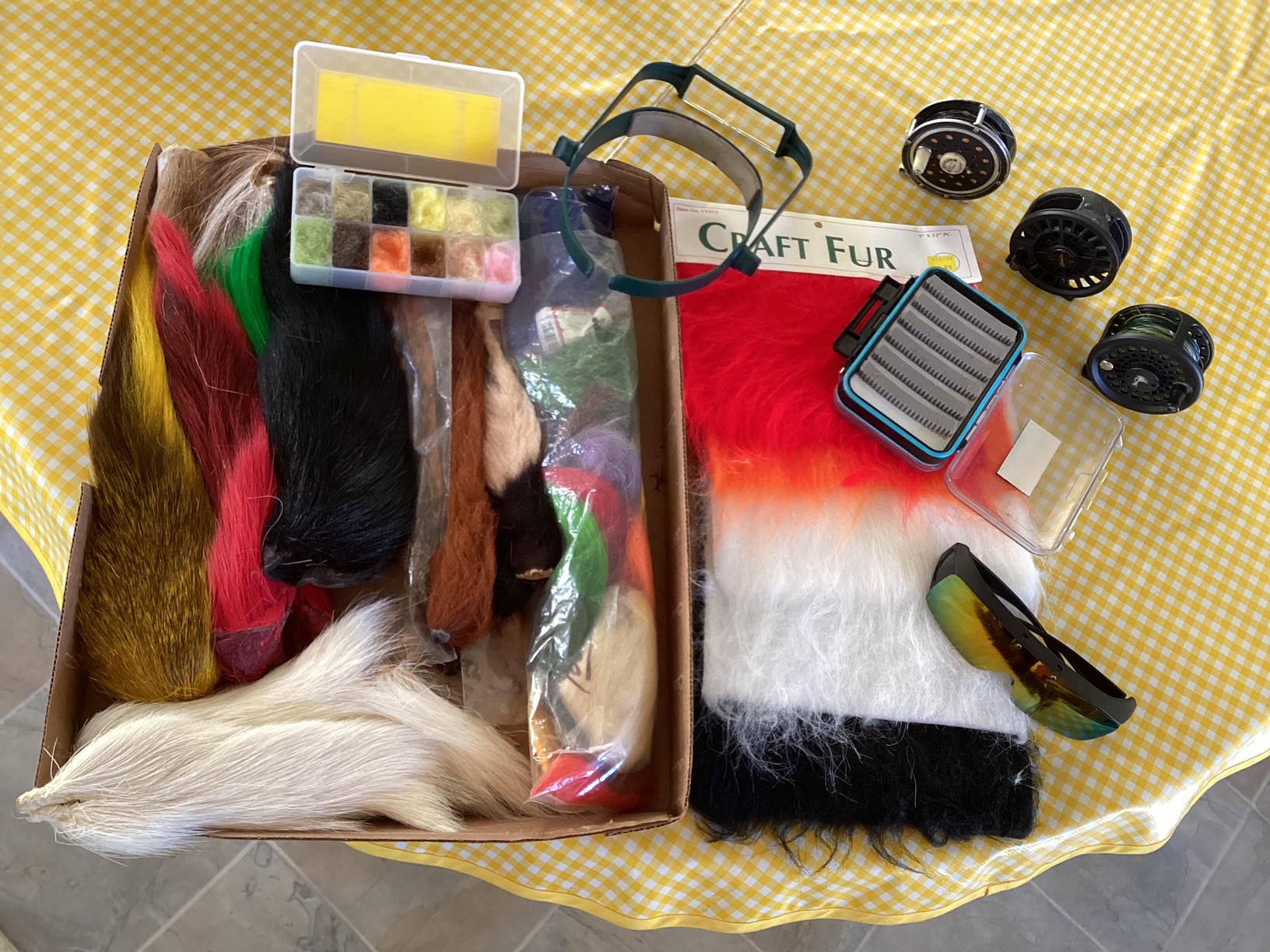
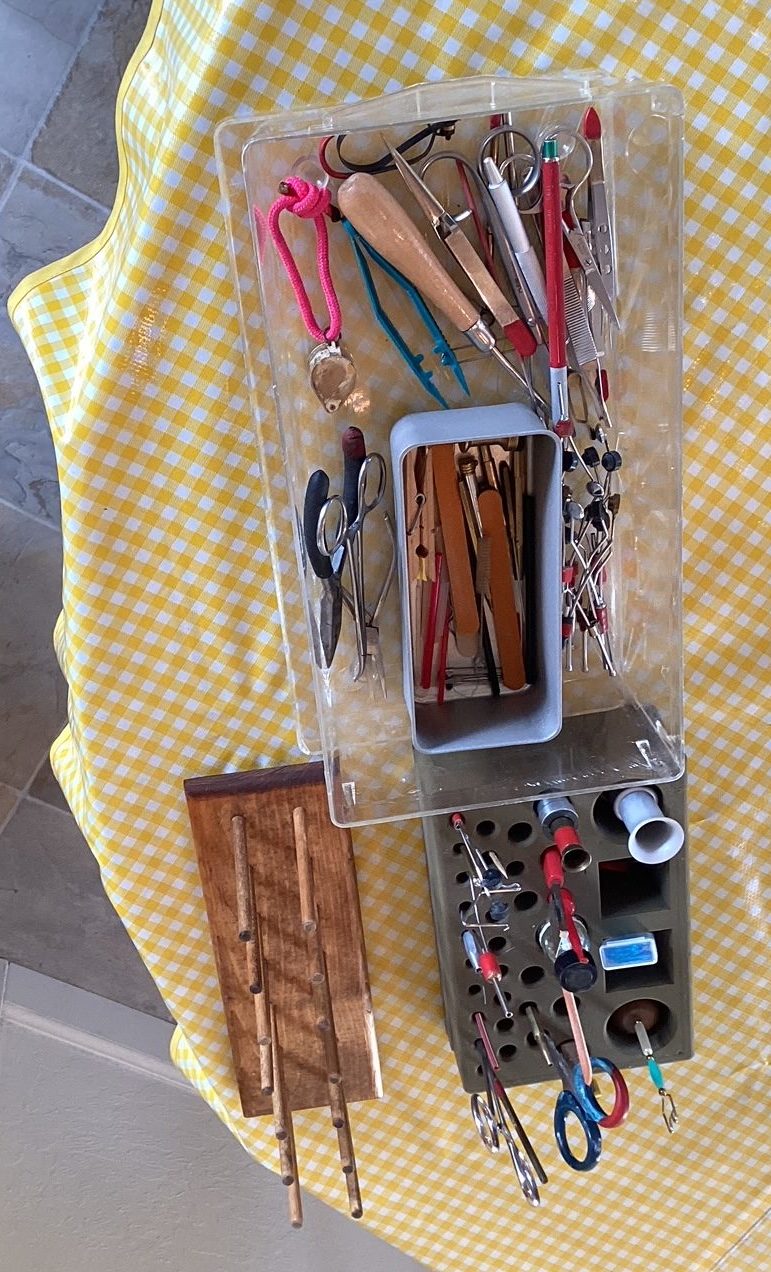
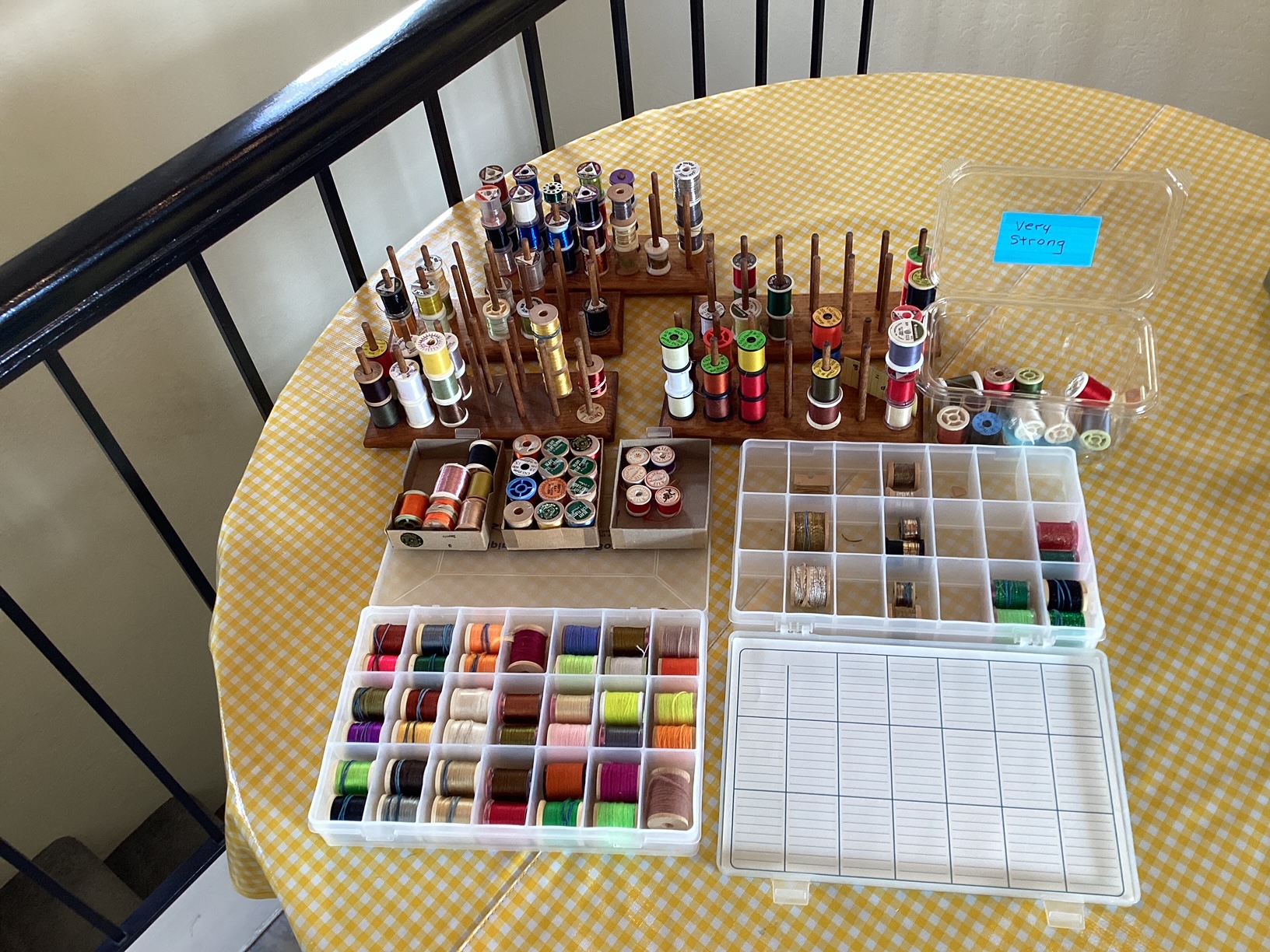
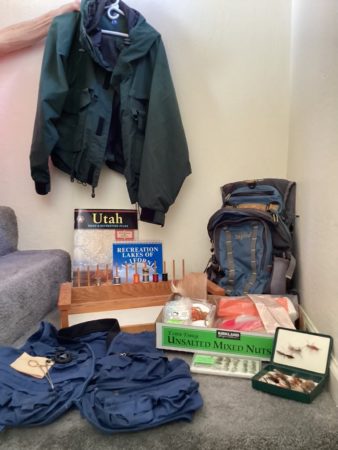
The estate of our dear friend Doug Severin and club member of many years, has donated his fly fishing belongings to our club. As Doug desired, his belongings will be made available at raffles and club events. The first opportunity to acquire something will be at our Jan. meeting and BBQ. The picture shows some of the items that will be available which will include fly tying materials. Beat the crowds, come early ! (Editor’s note: There is a lot more stuff than this and will be available at the next three meetings.)
Everyone who attends the December Fly Club zoom meeting get a free ticket to the monthly door prize drawing.
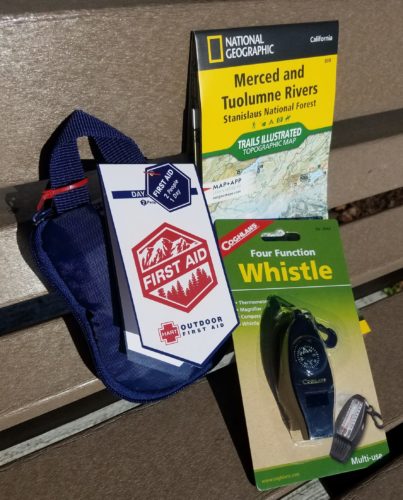
We have some neat stuff, keep it yourself or use it for fly buddy stocking stuffers.
The FirstAid kit is not intended for major surgery but will come in handy for cuts, bruises, and other minor medical mishaps that might be encountered during a fly fishing adventure.
The four function Coghlan’s has a compass, magnifier, thermometer, and whistle. Great on the the back trails or on your float tube on the water.
How about a National Geographic trail topographic map for the Merced and the Tuolumne river? Great for planning and executing a fly fishing back pack trip.
These prizes are all from the new REI store that has opened up in Santa Cruz across from Dominican Hospital. Great place, check it out . Gift receipts are included if you would like to swap out the prize for some other treat.
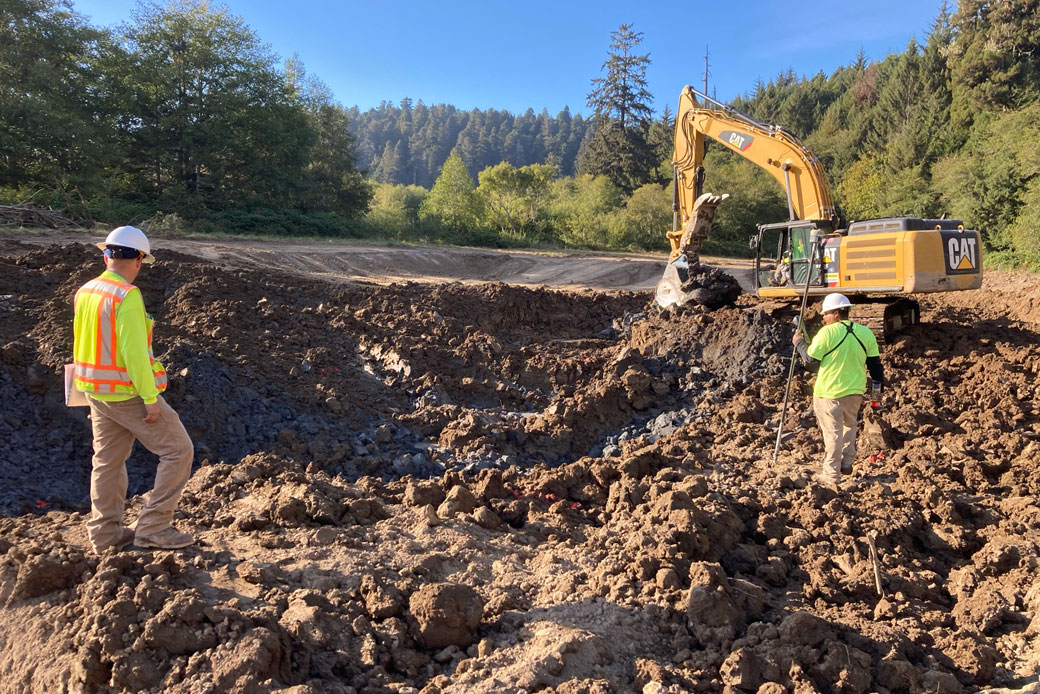
The Resource Conservation District of Santa Cruz County, the City of Santa Cruz, the San Lorenzo Valley Water District and the County of Santa Cruz have partnered to complete an instream improvement project on Zayante Creek. The work took place on a one mile stretch of the upper creek. Large trees were anchored in the creek to improve the natural habitat for steelhead and coho salmon. Historically, some of the higher juvenile steelhead population densities in the San Lorenzo River watershed been found in Zayante Creek. Check out the web link below: https://carcd.org/2021/10/rcd-san-cruz-completes-an-instream-habitat-improvement-project-on-zayante-creek/
Make sure you view this brief Youtube video that describes the project.
90 members have renewed 2021 dues for a total of $4,500 including $1,200 in donations averaging $50/member.
100 membership renewal letters have been mailed out to those members who have not yet responded. Deadline to be included in the 2022 roster is Dec 31st. Member names who have not responded will be deleted from the roster and Googlegroups.
We are on schedule to meet our membership dues budget and are hoping for additional donations in order to offset the $4,500 loss from our annual fundraiser dinner not being held for 2 years. With additional member contributions we could double our High School scholarships from $200 to $400/student, maintain our conservation project funding, and pay to restore the County Steelhead plaque on the San Lorenzo River damaged by vandalism with matching funds.
For those that have already renewed and donated online, THANK YOU
Happy Holidays everyone. I hope you are all doing well looking forward to time with family and friends this year.
For those of you who made it to April Vokey’s presentation and tutorial on two-handed rods and gear for big rivers, you might be asking Santa for a Skagit head, some Rio MOW tips, and a variety of Hobo-Spey flies in yer stockings!
As April mentioned in her presentation, “spey” casting techniques are not only effective for two-handed rods, but also very effective for single hand fly rods. Most of you know the “roll cast”. Spey casting is associated with the roll-cast, or is in fact a roll-cast (I dare say), but with certain movements with the rod, that put your line and leader in different places on the water in front of you or to the side of you.
I encourage all of you to explore “spey” casting techniques by searching the inter-web, YouTube… You’ll come across some new casting names and begin to understand what they are; single-spey, double-spey, snap-T, Circle-C, and more. All very effective when there is no room to cast behind you, or just another set of great casting techniques to add to your repertoire.
A couple weeks ago, I had the opportunity to travel home to Ohio to see my mom and family. I’m always timing these trips as a means to kick off the holiday season, and have a chance to fish for Lake run Steelhead on the Chagrin River, where I grew up fishing as a child. This year I took my 13’ 6”, 8 weight two-handed rod, a box of steelhead flies and my waders. Not much else you need.
When I arrived in Ohio it was a beautiful 70 degrees, but the water was low. But weather changes quickly in these parts of the country and it’s common to get rain that will move the river from 150cfs to 400 or more, overnight. Thursday was that day. It has rained just enough to bring the river up. Puffy clouds brought cover and contrast to the stunning fall colors still hanging on the maple, pin oak, buckeye and more.
It’s not always possible to time trips perfectly, but each time is an opportunity to get on the water with my brother Pat. The river was beautiful and the flows made this place look about as close to a big British Columbia watershed as I could imagine. We were on the water at 7:30 and immediately rolled two fish across the river, getting our hopes up quickly. We fished hard till 10:00 then headed off to the Chagrin River dinner for a couple egg sandwiches and a hot cup of coffee before traveling about 30 seconds to the next place on the river. Almost like it was here on the San Lorenzo in the old days. If you don’t know this already, the San Lorenzo River was once noted as “The Most Famous” steelhead river on the Central Coast. Mostly because guys brought their friends, and wives spent the weekend, went shopping, found easy access along the 11+ miles of fishable water, and found they could pull off the river and grab coffee, food, beer and whiskey in just minutes, no matter where they were on the river. It was fun to do just that with my brother on the Chagrin, still in our waders and no one looking at us as differently.
The flow of the river enabled me to get a very good grasp on my spey casting techniques, delivery and swing. It was soooooooo much fun. When you can throw 80 feet of line almost effortlessly clear across the water and feel the line tug on your reel because it still wants to go farther – you’ll know what I mean. As the wind picked up in the afternoon, I got to try a few other of the methods necessary- like the Perry Poke (coined after a fella named Carl Perry kept “blowing his anchor” – wait, what?…! – recovering his cast effectively. Something that’s been done for 100 years, but never really called anything until spey casting anglers began naming it after Carl – at least that’s what I researched thus far), and casting with my right hand. Yes – spey casting also teaches you to be ambidextrous.
Part of my timing in the coming years will be that time when the steelhead are in but the leaves have either not fallen off the trees yet, or are already completely fallen off. As the day wore on, the wind gusts befuddled our success choking the water with leaves, and despite nice off-color water, I imagined hundreds of leaves bouncing off the noses of fish, causing them to hunker down no matter how colorful my flies tried to compete with the leaves.
Despite not landing any fish, it was the best day on the water with my brother on a river I never really appreciated as much as a kid. Except, perhaps, on those warm summer days when Mike and I would quit fishing and go swimming!
The Great Lakes rivers are abundant with fish these days. Not just lake run steelhead, but also Chinook, Trout, Smallmouth Bass, Walleye (mostly in the lake), Perch, Catfish, Carp, Pike, and some Brown Trout. None of the fish are small. The Grand, Chagrin, Rocky and even the Cuyahoga, that river that once caught fire in the 60’s when it was so polluted with industrial waste, are all now healthy fisheries year-round. There is a Facebook page for the area called Ohio Steelhead. Look it up.
Well – a lot of fun in store for us in the coming months. December is Gordon Tharrett who is going to present to us on the Green River in Utah – and fly-fishing Utah/Idaho areas. He’s been a guide for a few of our members for years. Don’t miss this one.
January 5th will be a time for us to extend the holidays with a BBQ, Big Raffle, installation of Board and Directors AND our annual Club slide show which will be a collection of all the member photos from all the fishing you did this past year. We will be meeting at the Sherriff’s Posse Hall on Ocean Street Extension. Mark your calendars.
It’s been a great year and its fun seeing all the new members participate in fishing, fly-tying, and jumping on the Board to be a driving force for the future of the club. Super happy to see how this is coming together. If you’re interested, let us know. We still have a couple of positions we would love help with.
Happy Holidays. Jump in – we’ll land a few together. Tom Hogye – 831-214-7578
Notes of Fish Master, Kevin Murdock (Dock), from mysterious site #29 (O’Neill Forebay):
Fish Master Log Date Nov 3: Our beloved Stosh, bowing to the frailties of mortal life, was unable to host our November fish out to San Lois Reservoir. I agreed to stand in for him, as long as no organizing was to be involved.
When I arrived Wednesday afternoon, Elaine & John Cook had already been camping since Tuesday. They’d had some success amongst the weed patches around the islands. They also had thoughtfully placed a tablecloth and wood box at site 29, assuring it would be available for my arrival. I sat up camp (1) and returned to Aptos to pick up the mighty pokey-mon. (My 12ft. tin boat). (2)
FM Log Date Nov 4: Early Thursday morning Cooper and I launched the boat. Thank goodness I’d had the boat tagged the last time I’d fished on the lake. It had rained Wednesday evening, and my boat was full of water. No way would they have allowed me to launch.
We fished for naught for a couple of hours. That’s when I determined to find Elaine, for she is quite frequently in the close company of fish. I was right. I found her between the first and second Islands, firmly stuck to a Striper. With her in my sight, I quickly hooked and landed a couple of schoolies. I would offer this to all of our newbies on fish outs: keep Elaine in sight and you’ll probably find fish. It’s worked for John for ages. Indeed, he’d caught a couple that morning.
I moored the Pokey-man near our camp and had lunch with Pete, a new returning club member. He towed a gorgeous Air Stream in (3) and asked where to park so as not to impinge on any view-shed. I opined that the air-stream enhanced any view I might have.
After lunch, I motored to the north-west side of the fore bay where I found a dozen tubers and Kayakers from a neighboring fishing club. The name escapes me for the moment. (Don’t be alarmed, that happens on a regular basis). They were scratching out a fish here and there when Cooper decided he could catch a pelican. (4) That was the first of his three jumps into the drink.
The laughter of the other club’s members were still ringing in my ears when I decided to explore the great wall area. Near the south east corner, I finally located some fish on my 30 year old garage sale hummingbird. They were in 25’ water depth, holding at nearly 20’. There was a current pushing my boat from east to west, so I posted up current, about 40’from the wall and cast directly towards the wall. I counted down quite a while as I drifted over the fish, & then began a slow strip. I got a strong grab and had the fish on long enough to try to get it on the reel, with devastating consequences. Over the next hour I repeated this process several times. Eventually, after omitting the part where I tried to put the fish on the reel. I landed two smaller fish. (5)
Thursday evening the wind died enough to have a lovely campfire, and the four of us enjoyed a lively conversation as we took turns fussing over Cooper. Elaine shared her vast San Lois Intel with us. (Greatly appreciated!)
FM Log Date Nov 5: Friday Morning I woke early to find Yogi launching his u-boat. Still dark-thirty. A couple of cups of coffee later I launched and hustled to meet Jerry at the Rock Wall (6) by the old boat launch. I arrived in the vicinity just as the sun rose, and promptly caught a small striper. I found Jerry shortly after he had released one of his own. Jerry caught a couple more over the next hour. Ospreys and bald eagles were my entertainment.
I returned to camp for brunch and was helped to shore by another new club member, Jeff. Pete treated us to a spread of bacon & eggs, whilst I whipped up a batch of Bloody Mary’s. Tim Loomis and a friend I haven’t met yet launched at about that time. Good Luck to ya!
Yogi returned after having caught a few. Probably just getting warmed up for his upcoming tuna trip.
Thought I’d take a quick nap. Two hours later, Elaine & John pulled out of the water. Elaine had landed 8 or 10 fish that morning, & John a few more, including one he described as a nice 20 plus inches, with a huge head. I envisioned Bruce Bocce’s head on a striped bass.
Tim Loomis returned with tales of the biggest striper he had ever landed in this body of water. He estimated 6+ lbs., or about twice the size of the biggest fish I had caught that day. Tim caught his on the Delta smelt pattern. In fact, that’s the only fly I used on the trip, and others echoed that sentiment.
Jeff and Pete had also each caught fish that day.
FM Log Date Nov 6: Saturday found Pete and myself on our own. We fished separately, scratching up a fish here and there. The wind chased me off the water early. Too windy for a fire, Pete and I retired to our respective campers to stay warm. A book for me, a movie for Pete. Early to sleep.
That pretty well sums it up. Fair fishing for many, great for a few. A pretty good fish out.
Enjoy the resource while you can, future dam construction will make this place much more difficult to get to, for quite some time.
Douglas Severin
November 8, 1927– October 26,2021
Doug joined our club clear back in 1998. He had been a real outdoor person, but all his companions were no longer able to participate with him. So his wife Diane encouraged him to check out the SCFF club. As he put it , after doing just that, “ I’ve found a new home”. He jumped right in joining the fly tying classes and was soon helping beginners , as he was extremely skilled at tying. His specialty was small dry flies which over the years served him well at the Mammoth and Green River fishouts as well as throughout Montana and Wyoming. He was not a fan of flying so trips to the Green River were on Amtrak and to other Rocky Mountain destinations he would accomplish by driving almost non-stop to his destination. He loved the back country in the Sierra and a couple of his favorites were McGee and Convict Canyons. His participation and help with club functions were remarkable. In his quiet gentlemanly manner, you’d find him demonstrating fly tying to the public, donating and preparing, along with Diane, salads for the Club Fund Raiser, and then showing up at functions ahead of time to help set up then stay to pick up at the end. So now we say goodbye to our dear friend Doug. His company will be missed but the fond memories will live on.
Instead of featuring a specific fly this month, using the “whip finish” method to tie your favorite fly will be discussed. Having the skill of tying the knot to complete your fly using a “whip finish” is very important for certain flies. Some folks use the method more often, for they just find it easier when they get the hang of it. There are 3 methods to accomplish this:
Whip finish tool that’s referred to as a Matarelli (there are other similar brands but this is the most commonly used)
Standard whipper (a very old style tool and trickier to use)
Hand method (the only method available before there were tools and uses 2 fingers)
Specific flies that require this method are any that must be tied off behind the material on the hook, ie: beaded flies, poppers. You can use this method on the fly being tied at the fly tying class this month but won’t be required. This is a great time to learn how, refresh your skill, or learn a new technique. There are numerous demonstrations on YouTube for all 3 methods. Just ask for “whip finish demonstration for tying flies”.
I found the one done by Copper Landing Fly Fishing was well done for a Matarelli. Check them out and do some practicing on a bare hook.
Admittedly, I was very skeptical and downright depressed when the middle of October came and went with no rain. For me, rain signifies so much. For a kid who grew up loving the change of seasons in Ohio, all of them, even especially when it snowed, I was desperate for a change from the same old boring sunshine and warm weather. Seriously. Long before I was a steelhead fisherman, I longed for fall and winter, and moving to California, rain was that chance to slow down, get inside, rest, tie some flies, watch some fly-fishing shows.
So, you can imagine my delight when it started to rain, and it kept raining. It was almost like the first snow. And I loved it. The rain came gently, then strong, but never too strong. We got 10” at home and the San Lorenzo came up from 10CFS to 500 at 6 p.m. cresting at 1,500 at 10 p.m. All staying that nice tea brown color, never that dreadful chocolate milk that is a bi-product of scouring. The river mouth opened by itself and rushed out to welcome steelhead and coho – those genetic strains that have known for millennia that the San Lorenzo is home.
Let’s hope the rains continue throughout the winter in the same manner, that flows never get below 40 or 50 CFS at lowest and that the fish will thrive. When they thrive – we thrive.
November Club meeting – Tuesday, November 2nd. While I have your attention – please make note that November’s Meeting is Tuesday November 2nd – and will be via Zoom because April Vokey is going to be joining us to ring in the steelhead season with British Columbia Steelhead with Spey and Single-hand fly-rods.
Submit an Article Also, we want to hear from more of you. Did you know you can submit an article for the newsletter simply by going to the Newsletter-Submit tab on the website, copy and paste something you wrote and submit it to our newsletter editor for publishing? We want to hear from you! And, if it’s not you, have one of your children write an article and submit it on their behalf. You never know – you could have a writer on your hands and this could be there first published piece. Submit a photo too – easy!!
Hey – if you haven’t been around, I want you to know that we miss you. What an incredible year and a half this has been.
You know – it’s no coincidence that in April 2020, we launched our new-website and in May 2020 had our very first Zoom meeting. Before that Zoom was part of a Mazda commercial and our web-site and Facebook page were just, sort of there, doing what it had been doing for the past 29 years.
Do you know even despite our not being able to meet in person, our membership has grown from an average of 150 to now more than 177 members. We’ve had an average of 25 of you on every Zoom meeting and 50 of you attended the August BBQ at the Sherriff’s Posse when we thought the war was over. For the first time in 44 years, we’re renewing most of our memberships “on-line”, and many of you are already renewing your dues that way. Super.
We even have had six new board members who jumped on board during that time, remarkably some of them I’d not had a chance to meet until the August BBQ.
January Club Member Slide Show -Send in Your Photos. In January, we’re going to be back at the Sherriff’s Posse Hall for another BBQ and our annual Club Members Photo Slide Show. Submit your photos today to Tommy Polito Thomaspolito12@gmail.com then come join us the first week of January – in person!!!
While we will be missing our Annual Dinner/Fundraiser which is our primary funding source for our budget, we are working to do a number of other activities to help us with our finances to keep up with our goals in preserving and restoring trout, Steelhead and Coho habits, our high-school scholarships, youth programs/events, facilities rent, and more. Some of that can also come by way of the “Donation” tab on the membership renewal form which many of you have used. I would like to thank each and every one of you for doing this as it has made a significant difference in the importance and growth of our scholarship program for one. So, thank you to all of you who have done this. It is huge.
Well – again, don’t miss the November – Tuesday meeting via Zoom. April is going to be awesome. And I look forward to seeing you soon.
Good old campsite #29 was available again, the palapa posts 10′ apart and the new wind screen tarp cut to 8′ X 10′ was a bear to put up in strong winds and thankfully, our VP Kevin Murdock was already there with a site and his boat and tent trailer and helped lash together enough wind break that everything does not blow off the picnic table and you are chasing it across the field.
Two days of white caps and and flapping plastic day and night, our vehicles rocking through the night was like sleeping in the sailboat. I have to thank the 3 brave fishermen/campers who came on Thursday and sat it out, always ready for the wind to stop howling. Kevin arrived first and Jim Hall and Michael DiCiano in his Airstream land yacht. Jim’s dome tent bent in the wind like those blown air wind sock stick men you see to attract customers. Kevin had an extra bed and his dog ‘Cooper’ had someone new to flop on that night.
Huge thanks to all Lucky 13 of us and especially if you brought some firewood as my portable fire tub kept us all warm as we circled the fire and told stories and laughed through the night. Steven Rawson came to camp only and he brought his Dutch oven and from scratch made a cherry pie cooking with charcoal and timing it perfectly with ice cream to top off his fish taco’s as the main course our last night there.
Fishing was spotty at best Saturday and Sunday’s report just in has Michael landing 8 and Sam 1 fish. Other fishermen (no women this year for the first time). Jeff ‘Yog’ Goyert, Jim Hall, Jeff Zischke. John ‘Davis’, (Cuban cigar guy), Scott Kitayama, Jerry, Phillip, and Mike White who came up Friday night in his motorhome and when he opened the door the smell of good food was strong. He graciously roasted a monster amount of lamb perfectly and with baked potatoes and corn the 7 of us feasted at that windy campsite. Libation and conversations galore. Thank you all for bringing your game to one of the ‘ugliest’ campsites I ever stayed for so long. Too bad the fishing/catching wasn’t on fire in our part of the lake.
Remember that we do this again the first Thursday next month. Let me know your intentions before then. Peace, Stosh
To date we have 170 members on the roster including 40 new online members since 2021 , which is almost 25% of the membership. For Oct and November we would like to encourage members to renew online at santacruzflyfishing.org/membership which has proven to be more efficient, accurate, and cost effective offsetting postage and printing costs. Members can still renew by check mailed to PO Box 2008, Santa Cruz, Calif 95023. In December, a renewal packet will be sent to those members who have not renewed online…last year over 50% of members renewed online. For those new members after July 1, 2021, will not need to renew for 2022.
Please contact me if you have questions or membership concerns….Robert6367@aol.com
Before I delve into the subject of this article, I want to thank Steve (Stosh) Rudzinski for encouraging me to get involved in a more active role in SCFF as Conservation Director and to Tom Hogye and the board for welcoming me and their support. If any of you reading this have any input, questions about conservation as it pertains to the club or want to get involved, please contact me.
On the subject of fish handling to help them survive after release, I came across an organization devoted to that endeavor. I never heard of them but some of you members may have. The outfit is called Keep Fish Wet. I found out about them while visiting the FFI website. Reading some of the science-based tips on the website has me realizing I can do much better in the process of landing (or netting), photographing (if desired) and releasing fish under various conditions.
Here is a summary of the Tips found under Best Practices on the Keep Fish Wet website
Follow Local Regulations
Examples are some areas prohibit removing specific species of fish from the water and requirements to use barbless hooks.
Think Twice Before Going After Spawning Fish
One of the reasons given is that targeting and catching fish while spawning can disrupt and impact their lifecycle. This depends on the species of fish and spawning habits.
Be Wary of Warm Water
As water warms, the dissolved oxygen in it decreases. This causes the fish to get stressed quicker and take longer for them to recover. Some species are less resilient than others.
Use Barbless Hooks
Barbless hooks cause less damage to the fish’s mouth and are easier to remove. They are also much easier to remove from your body and clothing.
Use Artificial Baits
We fly fishers by nature adhere to this suggestion. This is the number one cause of fish mortality as they are more likely to swallow bait.
Use Rubber Nets
Rubber nets cause less damager to fish slime, scales, fins and gills. Hooks are less likely to get stuck in the net.
Limit Use of Lip Grippers
Lip grippers should only be used if there are no alternatives to controlling and handling fish (tiger fish, is an example). If it is used, never hold a fish vertically.
Carry Hook Removal Devices
Ideally this tool will help reduce the time it takes to release the fish with less damage. If the fish swallows the fly, cut the line instead of trying to remove the fly.
Limit Fight Time
Try to bring the fish to hand quickly without overplaying it. This will reduce stress on the fish.
Hold Fish In or Over Water
If held over land or a boat and if it slips out of your hand, that is obviously not good for the fish.
Grip Fish Carefully
Try to hold the fish gently without squeezing. Avoid placing you hand over the fish’s mouth and gills. Hold larger fish at the base of the tail and support the body close to the pelvic fins. Consider keeping very large fish in the water.
Photograph Wet Fish
This shows fish in their element which can make cool photos. Try to keep air exposure to ten seconds or less.
Only Revive Fish That Cannot Swim
If a fish can swim away on its own, let it do so. It will recover better. If the fish appears to have lost its equilibrium, submerge it and face it into the current. If you are in still water, move the gently to simulate swimming. See the website for other techniques specific to other fish like tuna.
If you desire or must have a steelhead fly for the San Lorenzo, here’s one that comes highly recommended. Of course it will probably work for the mighty fish elsewhere. This is a variation of Cliff Watt’s Kilowatt Fly. The color combinations are limitless but the 2 that seem to work best are: maroon marabou and hackle OR maroon marabou tail with both both blue and black hackles.
Material:
Hook: Gamagatsu 60 degree jig hook size 2
Thread: black 140 denier or 3/0
Eyes: “Lead Eyes” 1/30 oz. ( barbells)
Glue: UV resin, Zap-A-Gap, or Super Glue
Tail:
1. Orvis – New Age Holo Flash- Kaleidoscope color (Can substitute Flashabou or Mega Baitfish Emulator)
2. Spirit River UV2 maroon marabou. (Can substitute maroon marabou)
Forward Body: both UV ice dub- purple color AND Salar Synthetic Mikkeli-blue color
Wing: same Holo Flash
Hackle: maroon marabou
Instructions:
Crimp barb.
Attach thread behind hook eye. Wrap thread base to rear of shank then forward to blend in hook.
Paint eyes with 2 layers red nail polish then one of Sally Hanson’s-Hard As Nails nail polish. Attach at bend of hook with many figure 8 and circular tight wraps. Apply glue. Wrap thread to rear of shank.
Tie in small clump of Holo Flash. Cut to length of hook.
Tie in clump of marabou. Same length as Holo Flash.
Tie in UV Jelly. Make 2-3 touching wraps forward, forcing thread as you turn. Tie off, cut excess.
Blend both forward body materials. Place in dubbing loop. Advance thread to 1/4 back on shank. Twist dubbing loop making a thick chenille. Wrap forward a thick body. Tie off, cut excess. Pick out body with a bodkin.
Turn hook upside down. Tie in small clump Holo Flash on top of shank. Cut to hook length.
Select lg. marabou feather. Strip barbs off one side of feather. Tie in tip. Wrap, preening back barbs as you go. Tie off, cut excess. Whip finish, cut thread, apply glue.
This is not an early season fly. It can be swung on a Skaget line in the estuary when big fish are in, or dead drifted on a tight line through a riffle or under a bobber. It also can be jigged like a spoon through a pool or frog water. You may have noticed that there isn’t a lot of room for a back cast on the upper reaches of the San Lorenzo. That’s why most seasoned Steelheaders fish exclusively with mono line much like euronymphers. Strip casting is the common method of presenting a fly on the S.L. It is a similar technique to flipping for bass and allows the angler to pitch a fly into tight pockets in very tight quarters. Not to say that you can’t use a traditional fly line but many times anglers spook fish with a role cast over a run or pool, especially in low clear water.
Mark your Calendars!! October, November, December!!! Don’t miss these meetings via Zoom, and hopefully in person – maybe by December if the world starts spinning again.
And some other fun fly-fishing related things we’re doing – outside – for the most part.
Hey – seriously October is going to be that presentation you’d want to hear if you are at all interested in fishing from a float tube. Michael Malekos has been writing for California Fly Fisher magazine the last 25 years. He is a super guy who will have some informative, entertaining stories and tips on Float tubing from the bare basics to that and more. If you don’t subscribe to California Fly Fisher magazine – drop this and sign up for this subscription now!! It’s the very best California (and a bit of the rest of the west) fly fishing rag you’ll ever read.
On TUESDAY November 2nd – yes – Tuesday –via Zoom – since it’s November, it’s what I typically identify as the start of the winter steelhead season AND, this one is going to be a presentation by April Vokey from Anchored Outdoors. April is a world-renowned Steelhead spey fly angler, fly-tier, v-logger, … April has also offered some of her educational memberships as part of our door prize/raffle too. Anchored Outdoors has an extensive library of resources and most especially around some pretty spectacular fly-fishing opportunities. I’m super excited to have her as our November speaker.
December’s meeting is going to feature Gordon Tharrett who runs some fantastic fly-fishing opportunities in Utah and Idaho – most notably the Green River. Get your calendars out for planning your 2022 season and come hear what Gordon will bring to your future fly-fishing options in the West with big rainbow and big browns.
With the year coming to a close, many of you know that for the last forty plus years, we have had an annual dinner and fundraiser event that is the highlight of our year. It is the best time spending a whole day together preparing food, getting the raffle tables ready, hors de overs, setting tables, spending the evening eating, meeting new people, silent auction, installing new board members, some funny awards and some nice awards – like the John Steele/Dame Juliana Award, and the raffle.
While the Annual Dinner/Fundraiser will happen again in our future, we are opting for some smaller and perhaps even more engaging events for the membership as this latest setback from Covid has caused us some pause and is still creating uncertainty around a big 200 person gathering.
Our annual dinner/fundraiser nets the club on average $7,500 every year. Some years more, some less. While our budget is approximately $30,000 a year, these funds all go directly to running the club – facility rent, Conservation budget, High-School Scholarship fund, our speaker programs, raffle prizes for monthly meeting, fly-tying materials and classes, Fish-out needs and more. With so many opportunities to do so many different fundraising activities and with so many fun ideas coming from you and our board, we should be able to continue meeting our goals and creating new opportunities surrounding fly-fishing.
I’m also super excited about so many of you who are coming out of the woodwork with ideas for the club and requests to be more of an active member offering to help. To that I’m excited to say that Tommy Polito is going to be helping us with Programs for 2022. Tommy and his new young family live in Aptos. We met at the BBQ and boom, just like that, I was excited to hear his ideas about programs and the offer to accept this position on the Board. You’ll be hearing more from Tommy and company soon.
And, if that wasn’t surprise enough – Bob Garbarino, who I’ve had the pleasure of fishing with a few times, casting classes and hanging out together came to the board meeting. I thought he was there as a guest which was really nice, but then Steve Rudzinski surprised us by saying that Bob was offering to take on the position of Conservation Chair for 2022, which is going to leave Steve more time to orchestrate Casting clinics, casting practices, outings and even some camping/fishing fun.
I’m really happy with everyone coming forward and please know we need a few more to help us this coming year and into the future. IF you are remotely interested, just come visit a board meeting and you might like it! I do.
Stay tuned. If you haven’t been to a Zoom meeting yet and need help navigating this – PLEASE reach out to me or Scott Kitayama. We’ll set you up – easy!!
Watch your newsletter for some really fun outdoor get togethers over these next several months.
It has been fun meeting all our new members – I’d like to highlight and welcome you so if you come to the meeting, we’d love to hear from you.
See you soon and again on Zoom – we’re going to have fun!!